
 By admin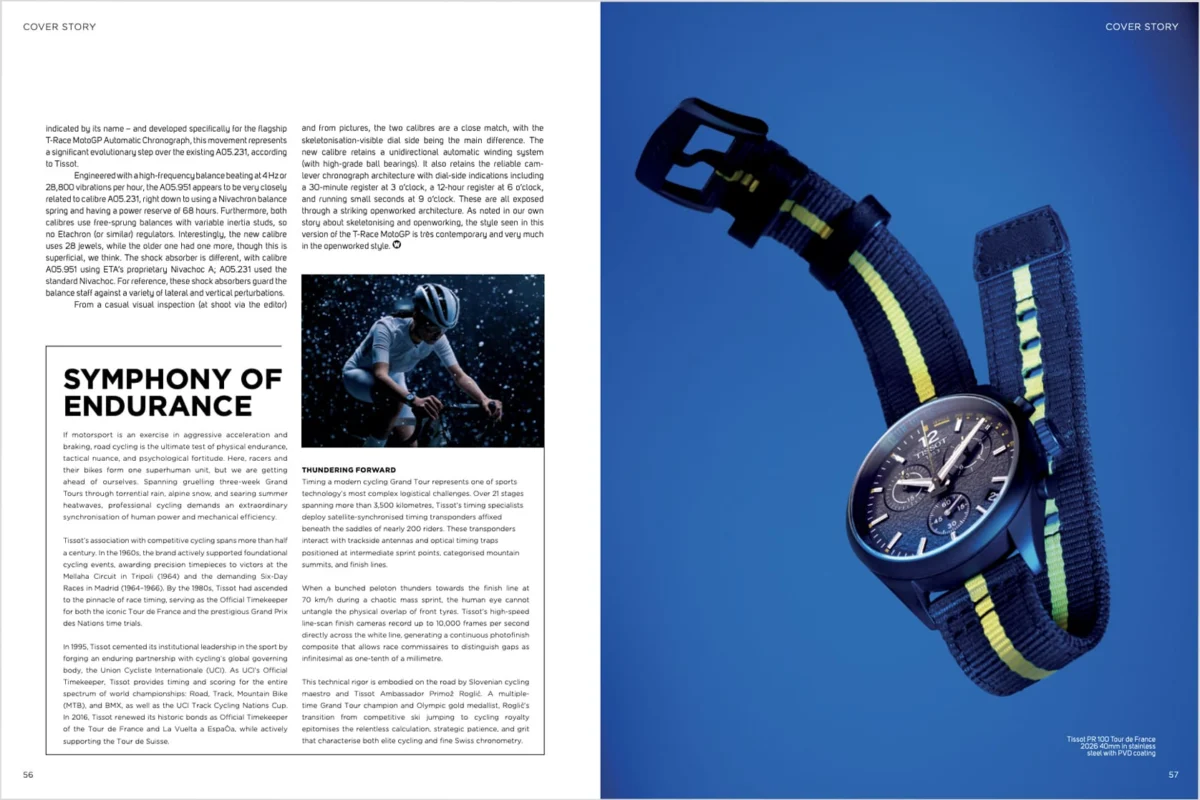
WOW Singapore’s Autumn 2026 issue, designated as Issue #86, arrives at a pivotal moment for the global horological industry, offering a comprehensive investigation into the technological advancements and shifting consumer psychologies that are currently redefining the landscape of luxury watchmaking. Following a series of summer editorials focused on the concept of value, the latest edition pivots toward the technical extremes of the craft, ranging from the rugged, high-precision demands of professional motorsports timing to the ethereal and complex world of the tourbillon. The issue is anchored by a deep dive into the mechanics of the Tissot T-Race MotoGP 2026 Automatic Chronograph, a timepiece that serves as a bridge between the precision-engineered world of Grand Prix motorcycle racing and the traditional values of Swiss horology.
The Vanguard of Sports Chronometry: Tissot and MotoGP
The cover of Issue #86 features the Tissot T-Race MotoGP 2026 Automatic Chronograph 45mm, a piece that exemplifies the synergy between mechanical watchmaking and high-performance engineering. This 2,026-piece limited edition is not merely a branding exercise but a technical homage to the motorcycle chassis. The design integrates several racing-inspired elements: a brake-disc styling on the bezel, engine-cooling fins on the side of the case, and a forged carbon composite ring that mirrors the lightweight, high-strength materials found in MotoGP prototypes.

At the heart of this timepiece lies the skeletonized automatic calibre Valjoux A05.951. This movement represents an evolution of the legendary Valjoux architecture, known for its robustness and reliability in sporting contexts. By openworking the movement, Tissot allows the wearer to observe the intricate dance of the chronograph levers and gears, a visual metaphor for the transparency and precision required in professional timekeeping.
Beyond the watch itself, WOW Singapore provides an unprecedented look behind the pit wall at Tissot’s massive timing infrastructure. Since 2001, Tissot has served as the Official Timekeeper of MotoGP, a role that requires managing a complex network of transponders, photocells, and high-speed cameras capable of capturing finishes with millisecond accuracy. The article details how this data is synchronized across global broadcast networks, providing real-time telemetry that is essential for both race control and spectator engagement. This infrastructure serves as a reminder that while the mechanical watch on the wrist is a tribute to time, the electronic systems in the stadium are the ultimate arbiters of it.
The Tourbillon Dissection: A 30-Page Technical Odyssey
Perhaps the most ambitious segment of the Autumn 2026 issue is a 30-page exhaustive dissection of the tourbillon. While often categorized as a complication, the editorial team at WOW Singapore posits a more nuanced view, exploring the device as a mechanical solution to a historical problem of physics. Originally patented by Abraham-Louis Breguet in 1801, the tourbillon was designed to counter the effects of gravity on the escapement of pocket watches, which were typically held in a vertical position.

The feature explores the "bench realities" of the tourbillon, acknowledging a truth often whispered in the workshops of Neuchâtel: a well-poised, modern balance wheel can frequently outperform a standard tourbillon in terms of pure chronometric precision. However, the issue celebrates the tourbillon not merely as a chronometer but as a "kinetic marvel." The editorial highlights several record-breaking and avant-garde iterations that push the boundaries of what is possible within a 40mm to 45mm case:
- Jaeger-LeCoultre Gyrotourbillon à Stratosphère (Gyro 6): An exploration of multi-axis rotation that aims to neutralize gravity in all positions, not just the vertical.
- Ulysse Nardin [Super] Freak: A dual flying tourbillon that serves as the watch’s minute hand, removing the traditional dial and hands entirely in favor of a rotating movement.
- Breguet Expérimentale 1: Operating at a staggering frequency of 10 Hz (72,000 vibrations per hour), this piece uses silicon components to achieve a level of stability and precision that honors the founder’s legacy while utilizing space-age materials.
- Jacob & Co. God of Time: Featuring a record-setting 15 rpm (rotations per minute) tourbillon, this piece prioritizes visual spectacle and high-velocity mechanics, representing the "theatrical" wing of modern horology.
Shifting Collector Paradigms in Southeast Asia
In a roundtable discussion featuring the editors of WOW Singapore, Malaysia, and Thailand, the issue addresses a significant shift in collector behavior within the ASEAN region. For decades, the "complication hierarchy"—the idea that a perpetual calendar or a minute repeater sat at the top of a rigid pyramid of desirability—governed the market. Furthermore, the "in-house movement" was often seen as the ultimate barometer of a brand’s worth.
The editors observe that the modern collector is increasingly moving away from these rigid metrics. There is a growing emphasis on aesthetics, independent watchmaking, and design-led "vintage cues." This shift suggests that the emotional and artistic resonance of a watch is becoming as important, if not more so, than its technical specifications. Collectors are gravitating toward independent makers who offer a personal story and a unique design language, even if they do not possess the industrial might of the major Swiss conglomerates. This trend is particularly evident in Singapore, which has established itself as a global hub for independent horology and high-end collecting.

The State of Watch Certifications: Ensuring Precision
Precision remains the bedrock of the industry, and WOW Singapore’s "Big Read" in this issue focuses on the evolving world of watch certifications. The article provides updates on the Contrôle Officiel Suisse des Chronomètres (COSC), the independent body responsible for certifying the accuracy of Swiss chronometers. However, the focus extends to the more stringent in-house measures adopted by industry leaders.
A significant portion of the analysis is dedicated to the Rolex Superlative Chronometer certification. Unlike COSC, which tests movements before they are cased, Rolex’s internal testing occurs after casing, ensuring a precision of -2/+2 seconds per day—a standard significantly stricter than the COSC requirement of -4/+6 seconds. The issue also examines the Master Chronometer certification by METAS, used extensively by Omega and Tudor, which includes testing for magnetic resistance up to 15,000 gauss. By comparing these standards, WOW provides collectors with a factual framework to evaluate the performance claims made by various manufactures.
Leadership Perspectives: Acoustic Architecture and Poetic Discretion
The Autumn 2026 issue features exclusive interviews with three prominent industry leaders, each offering a different perspective on the future of the craft:

- Marc Michel-Amadry (Managing Director, Girard-Perregaux): Michel-Amadry discusses the "acoustic architecture" of the Minute Repeater Flying Bridges. He elaborates on the challenge of hand-finishing 1,340 separate angles within the movement to ensure that the chime is not only mechanically perfect but also musically resonant. This focus on the "audible" side of horology highlights the multi-sensory nature of high-end watchmaking.
- William Faura (Development Director, Van Cleef & Arpels): In contrast to the exposed mechanics of Girard-Perregaux, Faura advocates for "poetic discretion." He explains the philosophy behind the Midnight Nuit Phase de Lune, where the complex mechanics are kept invisible to the wearer. The goal is to use technology to create a poetic representation of the cosmos, where the "how" of the movement is secondary to the "why" of the display.
- Maria Laffont (Chief Product Officer, TAG Heuer): Laffont speaks on the delicate balance between heritage and innovation. She details TAG Heuer’s strategy of utilizing modern materials—such as lab-grown diamonds and advanced ceramics—while maintaining the iconic motorsport liveries that have defined the brand since the mid-20th century.
Chronology of Innovation and Market Impact
The release of WOW Singapore #86 marks a specific point in the chronology of the 21st-century watch industry. We are currently seeing a "post-hype" market where the frenetic speculation of the early 2020s has given way to a more considered, education-based approach to collecting. The depth of the 30-page tourbillon feature reflects a demand for high-quality horological journalism that goes beyond surface-level aesthetics.
Historically, magazines like WOW (World of Watches) have served as the record of entry for the industry in Southeast Asia. Since its inception, the publication has tracked the rise of Singapore from a regional retail point to a global center of horological authority. The Autumn 2026 issue continues this legacy by documenting the current state of the art, from the $2,000 Tissot to the multi-million dollar Jacob & Co.
The broader impact of this issue lies in its ability to synthesize technical data with cultural trends. By addressing why a tourbillon might struggle with chronometry or why a collector might choose an independent maker over a legacy brand, WOW Singapore provides the transparency that modern consumers demand. As the industry faces challenges from a shifting global economy and the rise of digital secondary markets, the role of authoritative print and digital media in providing factual, objective analysis has never been more critical.

The Autumn 2026 issue of WOW Singapore is currently available at major newsstands across the Republic and is accessible globally via the digital platform Magzter. This edition stands as a definitive guide for those seeking to understand the mechanical, social, and economic forces that are currently shaping the world of time.
