
 By Nila Kartika Wati
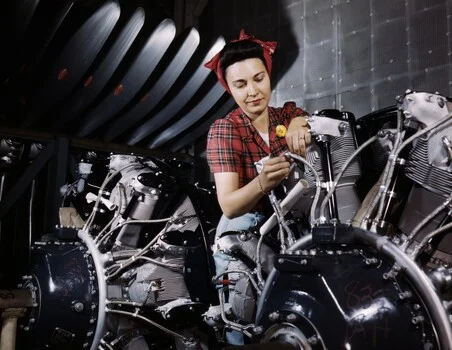
For decades, the enduring image of a young woman in a polka-dot bandanna, bent over a lathe, was widely believed to depict Geraldine Hoff Doyle, a symbol of American women’s pivotal role in the World War II industrial effort. However, meticulous historical detective work by Seton Hall University professor James J. Kimble has unequivocally identified the woman in the iconic 1942 photograph as Naomi Parker Fraley, a machine shop worker at Naval Air Station Alameda. This revelation not only corrects a persistent misattribution but also sheds light on the fragile nature of photographic provenance and the power of historical narrative.
The Genesis of an Image: Wartime Photography and Its Purpose
The photograph at the heart of this story was taken in March 1942 by an unnamed photographer from the Acme photo agency. Acme Newspictures, a prominent wire service operating from 1923 to 1952, routinely supplied glossy prints to subscribing newspapers, often accompanied by vital identifying information pasted onto the verso. The photographer was dispatched to Naval Air Station Alameda, California, with a specific brief: to create a story illustrating appropriate and inappropriate attire for women working around heavy machinery.
This assignment was set against the backdrop of a massive societal shift. As millions of American men departed for the battlefields of World War II, women were called upon to fill critical roles in factories, shipyards, and aircraft plants, transforming the domestic workforce. Terms like "Rosie the Riveter" began to emerge, embodying the spirit of these pioneering women. Government agencies and news outlets actively promoted their participation, often using imagery to convey messages about safety, patriotism, and the necessity of their labor. The series shot at Alameda, featuring Naomi Parker and her younger sister Ada, along with coworker Frances Johnson, was explicitly designed to show what constituted acceptable factory clothing, with Lieutenant Commander R.R. Darron of the station quoted on the dangers of mixing glamour with safety.
On March 24, 1942, the photographer captured a frame of a 20-year-old Naomi Parker, her hair neatly tied back in a polka-dot bandanna, focused on operating a turret lathe. A caption was typed, identifying her by name and offering a somewhat condescending yet specific description: "Pretty Naomi Parker looks like she might catch her nose in the turret lathe she is operating." This slip, along with an agency credit stamp and a received-date stamp from the handling picture desk, was glued to the back of the print. This physical attachment of information was standard practice, ensuring that the critical details—who, what, when, and where—traveled with the image. For Naomi Parker and her sister Ada, these slips were the only record connecting their names to the images; the photographs themselves contained no inherent identifying marks.
The Fragility of Information: How Captions Were Lost
The system of physically attaching captions worked perfectly for the original wire print. However, the journey of an image from print to widespread publication introduced a critical vulnerability: information loss. As the Alameda photographs, including Parker’s, circulated in newspapers and magazines throughout the spring and summer of 1942, they were reproduced as halftones of the front of the print. The verso, with its precious caption slip, did not accompany the reproduction. For the caption to survive, an editor had to manually retype it. Frequently, editors either omitted the caption, trimmed it, or replaced it with generic phrases like "women in war work," effectively divorcing the image from its specific context and subject.
This process highlights a fundamental challenge in historical documentation: the ephemeral nature of metadata when it is not intrinsically linked to the primary artifact. What began as a carefully identified record of a specific individual performing a specific task at a specific location quickly transformed into a generic image of "a woman at a machine" as it moved through the media ecosystem.
The Rise of a Misconception: Geraldine Hoff Doyle and the "We Can Do It!" Poster
Decades later, this loss of context paved the way for a widespread misidentification. In 1984, the photograph of the woman at the lathe resurfaced in Modern Maturity magazine, devoid of its original caption. Geraldine Hoff Doyle, who had worked as a metal presser at American Broach and Machine Company in Ann Arbor, Michigan, for about two weeks in 1942 before quitting to protect her hands for cello playing, saw the image and reasonably believed it was her. The woman in the photograph bore a striking resemblance to Doyle, making her claim entirely plausible on its face.
Ten years later, in March 1994, Smithsonian magazine featured J. Howard Miller’s "We Can Do It!" poster on its cover. Doyle, upon seeing the poster’s yellow background and the familiar polka-dot bandanna, concluded that the photograph she believed was of her had been the direct inspiration for Miller’s artwork. Though she never sought financial gain from this association, her story was widely accepted and repeated. Michigan institutions honored her, reporters echoed the narrative, and upon her death in December 2010, national obituaries prominently identified her as the inspiration behind the iconic "Rosie the Riveter" poster. This phenomenon, where a claim gains credibility through repeated citation without initial verification, is what James Kimble later termed a "woozle," borrowing from A.A. Milne’s Winnie-the-Pooh.
It is crucial to differentiate between several distinct but often conflated symbols: the 1942 photograph of Naomi Parker, J. Howard Miller’s "We Can Do It!" poster (created in 1943), and the broader "Rosie the Riveter" persona (associated with a 1942 song and Norman Rockwell’s Saturday Evening Post cover of May 29, 1943). The poster itself, now a globally recognized symbol of female empowerment, was not a government recruiting poster and had no connection to the Ad Council. Miller created a series of images for the Westinghouse War Production Co-Ordinating Committee, and "We Can Do It!" was displayed for approximately two weeks in February 1943 within Westinghouse plants where a predominantly female workforce produced Micarta helmet liners. The "we" in the poster’s message referred to Westinghouse employees, with the underlying goal of boosting production rather than recruiting new workers. For four decades, the poster largely disappeared from public view, only to re-emerge in the 1980s and be recontextualized as a universal feminist icon.
The Investigator’s Journey: James J. Kimble’s Six-Year Quest
The widely circulated obituaries for Geraldine Hoff Doyle in 2010 prompted James J. Kimble, then an associate professor of communication at Seton Hall University, to question the basis of the claim. As he told Smithsonian magazine, his primary question was: "How do we really know it was Geraldine, and, if it was not, who it was?" This query launched a six-year academic investigation, detailed in his 2016 paper, "Rosie’s Secret Identity, or, How to Debunk a Woozle by Walking Backward through the Forest of Visual Rhetoric."
Kimble’s methodology involved "walking backward" through the chain of citations, tracing each claim back to its predecessor until he reached the original source. In this case, the bottom of the woozle was Geraldine Hoff Doyle looking at an uncaptioned reprint of the photograph and saying, "that is me." To definitively resolve the identity, Kimble needed to find a copy of the original photograph that still retained its physical caption slip. He embarked on an exhaustive search through books, magazines, and the internet, eventually purchasing a vintage print from a photo dealer that had the intact slip.
The information on the slip was conclusive: the name was Naomi Parker, and the date was March 24, 1942. This date was three months before Doyle graduated from high school in Michigan and began her brief factory job. The evidence unequivocally pointed away from Doyle and towards Parker.
Assuming Parker was likely deceased given the passage of time, Kimble contacted a genealogical society to trace her descendants. To his surprise, the society informed him they could not proceed because they had reason to believe Naomi Parker was still alive. In February 2015, Kimble interviewed Naomi Parker Fraley, then 93, and her sister Ada, 91, at their shared home in Cottonwood, California. Fraley had carefully preserved her own clipping of the photograph for seven decades, a testament to its personal significance.
Naomi Parker Fraley’s Decades-Long Fight for Recognition
Naomi Parker Fraley’s story is one of quiet persistence against an overwhelming tide of misinformation. For years, she knew the photograph that had come to symbolize an era was of her, yet her claims were unheard or dismissed. In 2011, she and Ada attended a reunion of women war workers at the Rosie the Riveter/World War II Home Front National Historical Park in Richmond, California. There, they found the wire photo on display, but with Geraldine Hoff Doyle’s name beneath it. Fraley wrote to the Park Service, presenting her own captioned clipping as evidence. Despite her direct testimony and physical proof, nothing changed. She found herself unable to outweigh thirty years of accumulated citations and generic reproductions of the image that bore another woman’s name.
The vindication brought by Kimble’s research was profound. After his findings were published, the Omaha World-Herald interviewed Fraley in 2016, asking her how it felt to finally be publicly recognized as the woman in the photograph. "Victory! Victory! Victory!" she exclaimed. Kimble articulated the stakes in terms of what had been taken from her rather than what was given back: for years, her image circulated with another woman’s name, and she had no mechanism to reclaim her own identity. Her personal evidence, a simple clipping, was insufficient against the weight of widespread, albeit inaccurate, public perception. The crucial piece of evidence was the preserved original print, complete with its yellowed, glued-on caption slip, a relic that some dealer had simply left untouched.
The Correction Inside the Correction: Differentiating the Photograph and the Poster
While Naomi Parker Fraley’s identity in the 1942 photograph is now definitively settled, a common misconception persists: that she was the direct model for J. Howard Miller’s "We Can Do It!" poster. Kimble has consistently clarified that the evidence for this connection remains circumstantial. He acknowledges the striking resemblance between Parker and the woman in the poster, the presence of the polka-dot bandanna, and the fact that Parker’s photo ran in Miller’s home city seven months before the poster was created. His summary is cautious: "It’s a good guess."
However, Miller left no definitive record of his inspirations. Charles A. Ruch, a Westinghouse historian who knew Miller, stated that the artist preferred live models over photographs. No document has ever emerged to directly link the Alameda photograph to Miller’s drawing board, and it is unlikely one will. Therefore, while Naomi Parker Fraley is undeniably the woman in the iconic photograph, the claim that she was the model for the "We Can Do It!" poster goes further than the available evidence allows.
This distinction highlights two separate claims that have become intertwined: the identity of the woman in the 1942 photograph (settled as Naomi Parker) and the inspiration for the 1943 poster (unresolved). The woman who spent thirty years being congratulated for inspiring the poster was not even the one in the photograph.
The Broader Implications: Metadata in the Digital Age
The saga of Naomi Parker Fraley serves as a powerful historical lesson with profound relevance for the digital age. The physical caption slip of the Acme wire print has a direct descendant in modern metadata standards like IPTC (International Press Telecommunications Council) and EXIF (Exchangeable Image File Format). IPTC fields, embedded directly into image files and editable with cataloging tools, can carry creator, credit line, copyright, description, and location. EXIF records camera-specific information like capture time, body, lens, and exposure. When properly filled, these fields allow a photograph to travel with its own "caption slip," permanently attached without glue.
A caption does more than assign credit; it transforms an image into a record. The Alameda slip’s date, place, and name allowed a picture of an anonymous woman at a machine to become a document capable of settling a seventy-four-year-old argument. Strip away this information, and an image becomes a mere visual, susceptible to any convincing story. As the Fraley/Doyle case demonstrates, this can happen entirely without malice.
However, the digital realm introduces its own challenges. IPTC’s tests across major social media platforms found that most stripped crucial rights information upon upload. Facebook, Twitter, and Instagram, for example, removed nearly everything. Much of this loss is incidental, a byproduct of resizing and generating new derivative files that do not inherit the original metadata. Screenshots, ubiquitous in sharing, carry none of the original fields at all. This digital "stripping" mirrors the historical process of halftones losing physical captions, making provenance increasingly difficult to maintain.
New initiatives like Content Credentials (C2PA provenance standard) attempt to combat this with cryptographic signatures and "soft binding" – perceptual fingerprints or invisible watermarks that can re-match stripped manifests to their original images from external provenance stores. Meta’s recent announcement to use IPTC Digital Source Type to flag AI-generated images on its platforms also reflects this ongoing battle. Yet, even these advanced solutions face the same fundamental physics that defeated the Acme caption: provenance only survives if the software handling the file is built to carry it forward. If an image passes through a system that discards embedded assertions, its identity is lost, and its recovery depends on infrastructure rather than inherent file integrity.
The practical lesson from Naomi Parker Fraley’s long struggle is clear: always retain the original file with its intact metadata. Assume that any copy disseminated through a platform may return stripped of its identifying information and therefore assignable to anyone. Fraley’s personal clipping, a powerful piece of evidence to her, was never enough. What ultimately settled the historical record was an original print, carefully preserved by a dealer, with a yellowed slip of paper still glued to its back – a testament to the enduring power of primary sources and the vigilance required to protect historical truth.
