
 By admin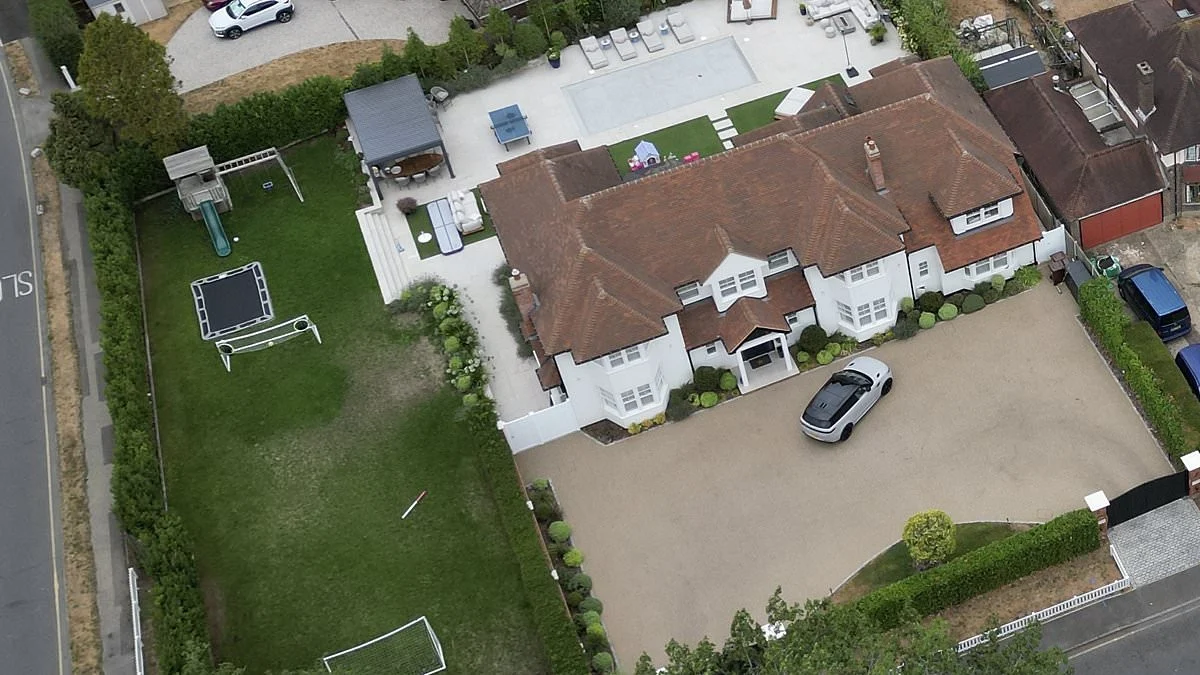
As the United Kingdom grapples with one of the most significant periods of water scarcity in recent history, a stark visual contrast has emerged between the parched, brown landscapes of the general public and the lush, verdant estates of several high-profile celebrities. Aerial photography across the home counties, particularly in Essex and the Cotswolds, has revealed vibrant green lawns that appear to defy the official drought status declared by the Environment Agency. While millions of households face legal prohibitions on the use of hosepipes and sprinklers, stars such as Billie Faiers, Mark Wright, and Sir Rod Stewart have maintained pristine grounds, sparking a national conversation regarding the exemptions, infrastructure, and workarounds available to the wealthy during environmental crises.
The Environment Agency has officially declared drought conditions across approximately three-quarters of England. This declaration followed a period of exceptionally dry weather, characterized by record-breaking temperatures and significantly below-average rainfall, which led to depleted groundwater levels and critically low river flows. In response, eight major water companies have implemented Temporary Use Bans (TUBs), commonly known as hosepipe bans. These regulations legally prohibit customers from using hosepipes to water private gardens, wash cars, or fill ornamental ponds and swimming pools. Under the Water Industry Act 1991, those found in breach of these restrictions face prosecution and fines of up to £1,000.
The Case of Billie Faiers and the Essex Drought
In Essex, a region particularly hard-hit by the dry spell, aerial images of the £1.4 million mansion belonging to former TOWIE star Billie Faiers and her husband, Greg Shepherd, have drawn significant attention. The couple, who purchased the property in early 2021, currently oversee a landscape that remains a vibrant green, featuring a long stretch of healthy grass, children’s play areas, and football nets. This stands in sharp contrast to the monotone brown lawns of their immediate neighbors, whose properties reflect the scorched reality of the local environment.
The couple’s water provider, Essex and Suffolk Water, recently announced a temporary ban following months of dwindling reserves. According to data provided by the utility company, the combined levels of the Hanningfield and Abberton reservoirs have dropped to approximately 69 percent, a figure notably below the seasonal norm. Despite these conditions, there is no direct evidence to suggest that Faiers and Shepherd have violated any regulations. Industry experts note that several legal avenues exist for maintaining greenery during a ban, including the use of watering cans, the recycling of "greywater" from household use, or the employment of private irrigation systems not connected to the mains supply.
Social Media Scrutiny and the Mark Wright Controversy
The phenomenon of the "celebrity oasis" extends to the nearby estate of Mark Wright and Michelle Keegan. The couple’s renovated £1.3 million Essex mansion, which features sprawling landscaped grounds and an Ibiza-style outdoor swimming pool, has also retained its lush appearance throughout the heatwave. The visual disparity between their grounds and the surrounding countryside led to intense scrutiny on social media, prompting a defensive response from Wright.
In a series of Instagram posts, Wright shared images of his family on a patch of scorched, brown grass, seemingly intended to demonstrate that his property was suffering from the drought like any other. However, observant followers pointed out that the final photograph in the carousel clearly showed the vibrant green lawn of his primary residence in the background. The ensuing backlash led to the deletion of several critical comments on the platform. The incident highlights the growing public sensitivity toward perceived "environmental elitism," where the wealthy are seen as insulated from the consequences of climate-related restrictions.
Legal Exemptions and Private Infrastructure
The ability of certain individuals to maintain green gardens during a drought is often the result of private infrastructure rather than a disregard for the law. Jeremy Clarkson, the broadcaster and farmer, recently addressed the curiosity surrounding the "weirdly verdant" lawns at his Cotswolds pub, The Farmer’s Dog. Writing in his regular column, Clarkson explained that the property utilizes a borehole—a private well drilled deep into the ground to access subterranean aquifers.
Boreholes represent a significant investment, often costing upwards of £10,000 to £15,000 to install, but they provide a water source that is entirely independent of the public mains. Water extracted from a private borehole is not subject to the Temporary Use Bans imposed by water companies, allowing owners to irrigate their land legally even during a declared drought. Clarkson suggested that other celebrities, including Sir Rod Stewart, likely utilize similar systems.
Similarly, celebrity chef Jamie Oliver has managed to preserve his Essex estate’s greenery through a different legal exemption. His Grade I-listed property sits on a 70-acre site that includes a large personal lake. Under current UK regulations, water taken from a privately owned source—such as a lake, pond, or spring located on the property—is exempt from hosepipe ban restrictions. Oliver has reportedly installed a system of pumps and hoses to transfer water from the lake to his gardens, a practice that is entirely lawful under the current regulatory framework.
Historical Precedents and the Ethics of Water Use
The current debate is not without historical context. Sir Rod Stewart, whose current 18th-century mansion features a lush mini-golf course and a football pitch, has a history of conflict with water authorities. In 2006, during a previous drought, Stewart was warned he faced a £1,000 fine for flouting a ban at his former property, Copped Hall. At the time, his representatives argued that he was using an underground irrigation system; however, his provider, Three Valleys Water, clarified that such systems were prohibited if they drew from the mains.
Stewart’s subsequent comments to the media reflected a prioritisation of aesthetic and personal utility over conservation efforts. He famously stated, "Only my football pitch was a beautiful, lush green. Because, naturally, I continued to water it." He further remarked that he would accept any fines, as he found nothing more beautiful than "walking across tended grass." While Stewart’s current property is supplied by Affinity Water—which has a ban in place—the presence of private wells or advanced water-recycling systems on such large estates often makes enforcement difficult for utility companies.
Not All Greenery is Natural: The Rise of Artificial Solutions
For some celebrities, the secret to a green garden in a drought is not water management, but the use of synthetic materials. Billie Mucklow and her former partner, footballer Andy Carroll, maintained a perfectly green expanse at their £8.5 million Essex mansion regardless of the weather. Aerial analysis confirms that the "grass" in question is high-quality artificial turf. While artificial grass avoids the need for irrigation, it has faced criticism from environmental groups for its impact on biodiversity and its tendency to contribute to the "urban heat island" effect, as synthetic fibers retain more heat than natural soil and vegetation.
Horticultural Expertise and Regional Variations
It is also important to note that hosepipe bans are not uniform across the country. Monty Don, the veteran horticulturalist and presenter of Gardeners’ World, has maintained healthy grounds at his "Longmeadow" estate in Herefordshire. While much of the UK is under restriction, Severn Trent Water, which serves Don’s area, has not yet implemented a formal hosepipe ban. Furthermore, Don has long advocated for sustainable gardening practices, such as the use of mulching to retain soil moisture and the collection of rainwater in large-scale butts, which can sustain a garden through dry periods without relying on the mains supply.
Analysis of Implications and Public Sentiment
The divergence between celebrity estates and the average household lawn serves as a microcosm of a larger societal issue: the "resilience gap." As climate change increases the frequency and severity of heatwaves and droughts in the UK, the ability to adapt to these changes is increasingly tied to financial capital. Whether through the installation of boreholes, the ownership of private lakes, or the ability to pay fines, the wealthy possess a layer of environmental insulation that the general public lacks.
From a journalistic and policy perspective, this trend raises questions about the equity of water management laws. If the goal of a hosepipe ban is to preserve a collective resource during a crisis, the existence of "workarounds" for those with private land and infrastructure may undermine public cooperation. Water companies, however, maintain that the volume of water extracted via private boreholes is negligible compared to the savings achieved by a general hosepipe ban.
As the Environment Agency continues to monitor reservoir levels and river health, the optics of the "great green divide" are likely to remain a point of contention. While the actions of these celebrities may be legally sound, the visual evidence of their flourishing gardens serves as a persistent reminder of the differing realities experienced by UK residents during a national environmental emergency. The ongoing situation underscores the need for a broader discussion on long-term water security, the ethics of private extraction, and the sustainable management of the English landscape in an era of climatic volatility.
