
 By Nila Kartika Wati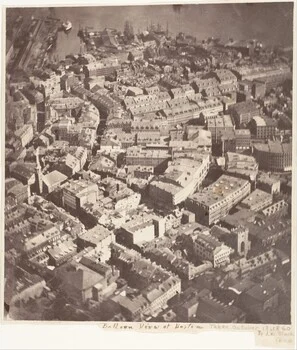
In a remarkable chapter of technological innovation and human ambition, the very first photograph ever taken from the air, captured by the audacious French balloonist Nadar in 1858, remains an elusive phantom of history, a groundbreaking image that no longer exists. Yet, just two years later and across the vast expanse of the Atlantic, an American photographer, James Wallace Black, successfully secured what is widely recognized as the oldest surviving aerial photograph: a hazy, silver-toned panorama of Boston, immortalized as "Boston, as the Eagle and the Wild Goose See It." These two distinct yet interconnected achievements, separated by an ocean and the whims of time, collectively mark the true genesis of aerial photography, a revolutionary medium that would forever alter human perspective, cartography, and reconnaissance.
The Visionary Frenchman: Nadar’s Pioneering Ascent
Born Gaspard-Félix Tournachon in Paris in 1820, Nadar was a quintessential figure of 19th-century bohemian and artistic circles. By the 1850s, he had already carved out a formidable reputation as a brilliant caricaturist, a perceptive journalist, and a novelist. His studio became the preferred destination for the cultural elite of France, drawing luminaries such as Charles Baudelaire, Victor Hugo, Sarah Bernhardt, Eugène Delacroix, and Franz Liszt, all of whom sat for his iconic portraits. The moniker "Nadar" itself was a playful, self-adopted contraction stemming from a contemporary slang trend, so deeply ingrained that his birth name faded into obscurity for many.
Beyond his terrestrial artistic endeavors, Nadar harbored a profound and almost obsessive fascination with flight. He was convinced that the nascent technology of ballooning held the key to unlocking unprecedented views of the Earth. This conviction wasn’t merely aesthetic; it was driven by a practical, albeit ambitious, vision for scientific and commercial application. On October 23, 1858, the very same year he achieved his first successful aerial exposure, Tournachon secured a patent for what he termed a "système de photographie aérostatique" – a system for aerostatic photography. His proposal was audacious: tether a balloon over a series of predetermined ground stations, photograph the terrain directly from overhead, and thereby produce maps of unparalleled accuracy and detail, far surpassing anything achievable by manual surveying methods. Nadar was genuinely convinced this pioneering scheme would bring him immense wealth. While the fortune never materialized, his unwavering ambition propelled him skyward repeatedly, enduring numerous failures until success finally emerged from the challenging conditions.
The technical hurdles Nadar faced in 1858 were immense, providing crucial context for why his initial photographic triumphs vanished. The dominant photographic process of the era was the wet collodion plate. This demanding technique required a glass plate to be meticulously coated with a syrupy collodion solution, then sensitized in a bath of silver nitrate, and exposed while still wet. Critically, the development process had to commence within a tight window of ten to fifteen minutes before the emulsion dried and lost its sensitivity. This was no simple point-and-shoot operation; every single exposure was a delicate chemical experiment demanding immediate execution on site.
Now, imagine attempting this intricate chemical ballet within the confines of a swaying wicker basket suspended hundreds of feet above the ground. Nadar, ever the innovator, transported a portable darkroom aloft, a small tent rigged within his gondola, where he mixed and manipulated his sensitive chemistry mid-air. His initial attempts were plagued by mysteriously blackened and fogged plates. Through meticulous deduction, he eventually identified the culprit: sulfurous impurities, specifically hydrogen sulfide, vented through the balloon’s valve. This gas was reacting with the silver on his delicate plates, ruining them before he could even begin development. His ingenious solution was not to modify the balloon, but to shield his workspace. By enclosing the basket and its portable darkroom, he effectively created a barrier, preventing the escaping gas from contaminating his sensitive photographic materials.
With this critical technical issue resolved, the path to success opened. Sometime in 1858, from a captive balloon anchored approximately 80 meters (about 262 feet) above the village of Petit-Bicêtre, just outside Paris, Nadar exposed a glass plate capturing the fields and structures below. This time, he successfully developed it within the balloon’s darkroom. It was an unprecedented moment: the first time humanity had ever seen its world from an aerial perspective. The sheer absurdity and grandeur of this feat were later immortalized by Honoré Daumier in an iconic 1862 lithograph titled "Nadar élevant la Photographie à la hauteur de l’Art" (Nadar Elevating Photography to the Height of Art). The caricature depicted Nadar, top hat askew, hunched over his camera in a runaway balloon, with the rooftops of Paris labeled "Photographie" beneath him. While intended as a satirical jab at photography’s pretensions to artistry, it inadvertently served as an enduring monument to Nadar’s pioneering spirit.
The Picture That Vanished
Despite Nadar’s documented success, none of his earliest aerial photographs from Petit-Bicêtre or his subsequent initial experiments survive. The original plates are simply gone, victims of the fragility inherent in early photographic processes, prone to breakage, chemical degradation, and the relentless march of time – a fate shared by countless other photographic treasures from the dawn of the medium. What remains is the incontrovertible historical record of their creation, rather than the images themselves.
This is where the historical narrative often becomes muddled. The Bibliothèque nationale de France, for instance, holds an aerial print attributed to Nadar with the caption "First Result of Aerostatic Photography," accompanied by a note claiming the negative was obtained at an altitude of 520 meters in 1858. For a long time, this was mistakenly believed to be proof of the first aerial photograph’s survival. However, rigorous scholarly research has since debunked this attribution, revealing the image to be mislabeled. It was, in fact, captured over Paris approximately a decade later, around 1868. Nadar’s earliest genuinely surviving aerial photographs of Paris date from the mid-to-late 1860s, offering crisp views of landmarks such as the Arc de Triomphe and the Place de l’Étoile. By this later period, Nadar had escalated his aerial ambitions into grand spectacle. In 1863, he commissioned the renowned Godard brothers to construct "Le Géant" (The Giant), an enormous gas balloon standing roughly 45 meters (147 feet) tall, capable of carrying over a dozen passengers, complete with cold chicken and wine served aloft. Although an early flight of "Le Géant" tragically crashed, nearly claiming the lives of Nadar and his wife, it solidified his legendary status and famously inspired Jules Verne’s imaginative aerial narratives, further cementing his place in the annals of aviation history.
Across the Atlantic: Black’s Enduring Legacy in Boston
While Nadar’s inaugural aerial view faded into the mists of time, the distinction of the oldest surviving aerial photograph belongs to American ingenuity. James Wallace Black, a Boston photographer born in New Hampshire in 1825, was a figure of considerable technical prowess. He had established a strong reputation through his partnership with inventor John Adams Whipple, known for their daring photographic innovations. There is some historical debate suggesting Black, in collaboration with the renowned aeronaut Samuel Archer King, may have attempted aerial photography over Providence, Rhode Island, as early as August 16, 1860, two months before his famous Boston ascent. However, the existence and condition of any images from that purported flight remain unconfirmed and widely disputed.
The definitive moment arrived on October 13, 1860, precisely two years after Nadar’s initial success. Black once again ascended with Samuel Archer King aboard King’s gas balloon, aptly named the "Queen of the Air." For this crucial flight, the balloon was held captive over Boston Common, tethered by a robust rope connected to a windlass on the ground. This mooring system provided a critical degree of stability, allowing the balloon to hover relatively steadily at an altitude of approximately 1,200 feet (about 365 meters) while Black meticulously went about his work.
During this ascent, Black exposed eight glass plates, each measuring slightly over ten inches on its longest side. The majority of these plates, unfortunately, proved unusable. As King allowed the balloon to rise higher in an attempt to gain more altitude, Black encountered the same insidious enemy that had initially plagued Nadar: expanding gas from the balloon’s envelope seeped into the camera apparatus, neutralizing the sensitive photographic plates. King’s own accounts vividly describe the gas expansion as the balloon ascended. From the entire sequence of exposures, only one plate emerged clean and viable, yielding a single, remarkably clear print. This iconic image offered a sweeping view of Boston’s bustling harbor, its intricate network of wharves, and the dense, ordered grid of downtown rooftops, all captured from a steep, oblique angle.
The print quickly garnered attention, particularly from the prominent American poet, essayist, and physician Oliver Wendell Holmes Sr., a fervent enthusiast and early critic of photography. In an essay published in The Atlantic Monthly in 1863, Holmes eloquently described the photograph, observing, "Boston, as the eagle and the wild goose see it, is a very different object from the same place as the solid citizen looks up at its eaves and chimneys." This evocative sentence provided the enduring title by which the photograph became universally known: "Boston, as the Eagle and the Wild Goose See It." Today, this invaluable surviving print is housed at the Metropolitan Museum of Art in New York City, with related materials preserved at the Boston Public Library. This accessibility is why, unlike Nadar’s lost plate, Black’s masterpiece can still be viewed and studied globally, existing as a tangible link to the past rather than a mere historical anecdote. While the Met also attributes an 1860 photograph titled "Aerial View, North Weymouth, Massachusetts" to Black, its precise circumstances are less comprehensively documented. Regardless, the Boston plate remains the one universally recognized by history and is consistently cited as the oldest surviving aerial photograph.
The Unseen Revolution: The Science and Stakes of Early Aerial Photography
The triumphs of Nadar and Black were not merely about capturing novel images; they represented a significant leap in overcoming complex scientific and logistical challenges. The wet collodion process itself, while revolutionary for its time (replacing the even slower daguerreotype and calotype processes), was inherently cumbersome. The collodion, a solution of nitrocellulose in ether and alcohol, had to be poured evenly over a meticulously cleaned glass plate, which then had to be immersed in a bath of silver nitrate to become light-sensitive. The plate, still wet, was then placed into the camera for exposure. Exposure times, though significantly reduced from earlier methods, could still range from several seconds to minutes, depending on light conditions. This required extraordinary steadiness, a near impossibility in a balloon basket.
Furthermore, the environmental conditions at altitude presented unique difficulties. Temperatures could fluctuate wildly, affecting the chemical reactions. Air currents caused constant movement, blurring images. And, as both Nadar and Black discovered, the very nature of gas balloons – specifically the release of hydrogen sulfide as a byproduct or impurity in the illuminating gas – posed a direct threat to the silver-based emulsions. This chemical fogging was an unforeseen obstacle, demonstrating the raw, experimental nature of their endeavors.
Beyond the photographic challenges, 19th-century ballooning was itself a perilous and complex undertaking. Balloons, typically inflated with hydrogen or coal gas, required vast quantities of gas and careful management. Ascents were often public spectacles, but the scientific and military applications were increasingly recognized. Meteorologists used balloons for atmospheric research, while military strategists envisioned their potential for battlefield reconnaissance. The pioneering efforts of Nadar and Black, therefore, were not isolated artistic curiosities but critical experiments at the intersection of cutting-edge chemistry, engineering, and aviation. They were solving a problem nobody had explicitly asked them to solve, but one whose solutions would unlock immense practical utility.
From Curiosity to Critical Tool: The Broader Impact and Evolution
The immediate implications of aerial photography, once the pictures actually existed, became apparent with astonishing speed. Within a few years of Black’s Boston flight, both the Union and Confederate armies in the American Civil War began deploying observers in balloons for reconnaissance missions. It is crucial to distinguish, however, between "balloon observation" and "balloon photography." While Union crews certainly ascended in balloons to observe enemy positions and movements, often sketching maps from above, there is no authenticated aerial photograph known to have been made during the actual fighting of the Civil War, despite persistent claims in some historical accounts and museum captions. The technical difficulties, combined with the exigencies of warfare, made capturing and developing photographs from a moving balloon a near impossibility in combat conditions.
Nevertheless, the seed was sown. The concept of aerial surveillance had proven its worth. Photographers who lacked the means or courage for balloon ascents began exploring alternative methods of gaining altitude. In the 1880s, the British meteorologist E.D. Archibald successfully deployed cameras on kites, pioneering "kite photography." Later that same decade, Arthur Batut in France refined these techniques, making kite photography a more practical reality. By the advent of the First World War, the field of aerial reconnaissance had transformed into a precise, highly industrialized craft. Aircraft, no longer just for observation, were equipped with purpose-built cameras designed to be aimed straight down, systematically mapping enemy lines and terrain. This marked a pivotal moment, as the ephemeral, experimental flights of Nadar and Black gave way to a sophisticated, mission-critical technology.
Everything that followed, from the seemingly ubiquitous drone hovering over a wedding or a scenic coastline to the casual satellite view we scroll past on our phones, to the breathtaking sweeping shots that open landscape films, can trace its lineage directly back to those two tethered balloons. Nadar’s ambitious dream of mapping the world from above, driven by the hope of fortune, granted him the unparalleled view but not the wealth, and tragically, the proof of his initial triumph was lost. Yet, his ingenuity, alongside Black’s enduring image, laid the foundational groundwork for modern cartography, urban planning, environmental monitoring, and geospatial intelligence. The once-extraordinary act of seeing the world from an elevated perspective has become commonplace, fundamentally altering human perception and our relationship with the planet.
The history of aerial photography is richer for maintaining the precise distinction between its very first, lost inception and its oldest enduring artifact. Nadar, the Parisian polymath, was undeniably first in 1858, pushing the boundaries of technology and vision, even if his pioneering images did not survive the ravages of time. Black, the American innovator, followed two years later, securing a tangible record that continues to inform and inspire. The record of a beginning and the beginning one can still behold are indeed two distinct entities, and the refusal to blur them offers a more accurate and compelling narrative of this transformative human endeavor.
