
 By Nila Kartika Wati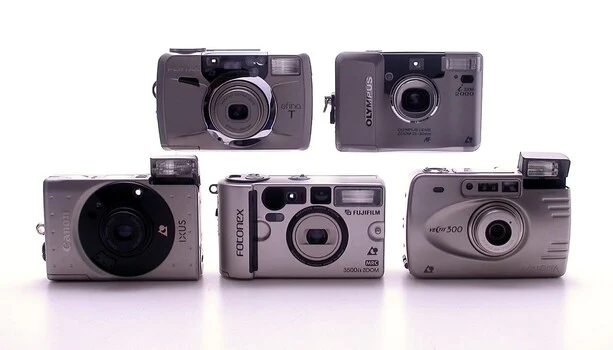
In February 1996, a remarkable and unprecedented event unfolded in Las Vegas: five of the photography industry’s most fiercely competitive giants—Kodak, Fuji Photo Film, Canon, Minolta, and Nikon—shared a single stage to formally unveil a revolutionary film format they had secretly developed together. This consortium had already invested an estimated $500 million into the project and anticipated spending a comparable sum before its market viability could be assessed. Adjusted for inflation, this represented a colossal bet of nearly $2 billion in today’s money, riding on the belief that analog film had one last, monumental reinvention left. Yet, within fifteen years, the Advanced Photo System (APS) would largely fade from public memory, a commercial failure that nonetheless cast a long, unacknowledged shadow over the subsequent digital revolution.
The Genesis of an Unlikely Alliance
The roots of the Advanced Photo System stretched back to the mid-1980s, originating as a clandestine project within Eastman Kodak. The Rochester-based titan had previously witnessed the commercial success of its earlier consumer film formats, the 126 Instamatic and the diminutive 110 cartridge. These formats, despite their notoriously poor image quality, demonstrated a clear market appetite for convenience: consumers were willing to sacrifice optical fidelity for the ease of simply dropping a film cartridge into a camera without the fiddly process of threading a film leader onto a take-up spool. Kodak’s objective for its new format was ambitious: to deliver the unparalleled convenience of these earlier systems but without the grainy, muddy prints that had become their unfortunate hallmark. The company dedicated nearly a decade to intensive laboratory research and development, striving to achieve this elusive balance.
However, the sheer scale and complexity of this endeavor soon necessitated a broader collaboration. Sometime between 1991 and 1992, in a move that stunned industry observers once it became public, Kodak extended an olive branch to its fiercest global rival, Fuji Photo Film. Joining this nascent "System Development Companies" consortium were three of the world’s most prominent camera manufacturers: Canon, Minolta, and Nikon. This "Big Five" alliance was nothing short of historic. For an industry notorious for its cutthroat competition, where companies fiercely guarded proprietary technologies and battled over every fractional f-stop and millimeter of a lens mount, their agreement to share development costs, standardize specifications, and launch a unified product was an extraordinary truce. This level of cooperation was unprecedented and underscored the perceived strategic importance of the new format.
The APS Unveiling and Initial Market Push
The collaborative effort remained a closely guarded secret for several years, fueling intense speculation within industry circles. The first public glimpse of the new system came in October 1995, when specialized photofinishing equipment designed for APS was previewed. The formal and full-scale announcement of the Advanced Photo System, designated IX240 for its "Information Exchange" capabilities and 24mm film width, took place on February 1, 1996, at the Photo Marketing Association (PMA) show in Las Vegas, the industry’s premier trade event. This was a grand affair, signaling the collective confidence of the participating giants. Consumer products, including cameras and film, began reaching stores worldwide on April 22 of that year. George M. C. Fisher, Kodak’s chairman at the time, articulated the group’s massive financial commitment, confirming the $500 million already spent and a comparable sum anticipated. This staggering investment, roughly equivalent to $1.96 billion in 2024 purchasing power, represented the industry’s desperate hope for film’s rejuvenation.
Each of the System Development Companies, and subsequently a host of licensees, branded the standardized APS film and cameras with their own distinctive labels. Kodak marketed its film as Advantix, Fuji as Nexia, and later adopters like Agfa and Konica released Futura and Centuria, respectively. On the hardware front, consumers could choose from Canon’s elegant IXUS line (known as ELPH in North America and IXY in Japan), Nikon’s Nuvis, Minolta’s Vectis, and Fuji’s Endeavor. The licensee list grew extensively, eventually encompassing prestigious names such as Olympus, Pentax, Contax, Yashica, and even Leica. This broad industry buy-in served as a powerful indicator of the widespread belief that APS represented the unequivocal future of consumer photography. When such a diverse and competitive array of manufacturers aligns behind a single standard, it creates an almost unshakeable perception of inevitable success.
Technological Innovations: A Closer Look at the Cartridge and Film
At its core, APS was a genuinely clever piece of engineering designed to enhance user convenience and picture quality within the constraints of an analog medium. The film itself was 24mm wide, narrower than the traditional 35mm film used by serious photographers, and utilized a polyethylene naphthalate base. This advanced plastic was notably thinner, stronger, and flatter than the acetate typically used for 35mm film. The flatness of the film was a crucial, often underestimated, technical detail; film that rests perfectly flat in the camera’s gate yields sharper images from corner to corner. The stronger base also allowed engineers to wind the entire film roll securely inside a sealed, light-tight cartridge.
This cartridge was arguably the system’s most ingenious feature. Its drop-in design eliminated the perennial frustration of threading a film leader onto a take-up spool, a common cause of ruined first frames or improperly loaded film. The camera automatically handled all winding and tensioning. Furthermore, a locked door mechanism physically prevented users from accidentally opening the cartridge mid-roll and fogging their precious pictures. More advanced APS cameras offered a groundbreaking "mid-roll change" feature, allowing photographers to remove a partially exposed roll, load a different film (e.g., for different lighting conditions), and then reinsert the original roll later. The camera would intelligently wind past the previously used frames, picking up precisely where the photographer had left off – a capability entirely absent from mainstream 35mm cameras.
The convenience extended beyond shooting. Upon development, the film was returned to the customer rewound into its original, protective cartridge, replacing the flimsy, sleeved strips common with 35mm. Each order also included an "index print," a small contact sheet displaying thumbnail images of the entire roll, facilitating easy review and reordering by frame number. The cartridge itself featured a small window with four molded symbols that visually communicated its status: a full circle for unexposed, a half circle for partly shot, an an "X" for exposed but not yet developed, and a rectangle for a roll that had already been processed. These small, thoughtful touches showcased a sophisticated approach to industrial design, prioritizing user-friendliness at every stage.
Post-Capture Flexibility and Metadata on Film
One of APS’s primary marketing pillars was its unique ability to allow photographers to choose their desired aspect ratio after the shot had been taken. Every frame could be printed in one of three formats:
- Classic (C): The familiar 3:2 aspect ratio, typically printed as a 4×6 inch photograph.
- High Definition (H): A wider 16:9 ratio, resulting in a 4×7 inch print.
- Panoramic (P): A dramatic 3:1 sliver, producing an elongated 4×11 inch print.
A simple switch on the camera allowed photographers to designate the preferred crop on a shot-by-shot basis, with the instruction relayed to the photofinishing lab.
While marketed as a magical post-capture choice, the technical reality was slightly less glamorous. On most APS cameras, the lens actually exposed the full 16:9 "H" frame every time. The format switch merely recorded a digital instruction, or "metadata," telling the printer how to crop the image. The "Panoramic" format, for instance, was not a wider capture but rather the same negative with significant portions of the top and bottom cropped away. This meant consumers were paying for a large print derived from a smaller, central slice of their own captured frame. Nevertheless, the flexibility to reconsider the aspect ratio at the print counter was a genuine convenience that 35mm photography simply could not offer.
This cropping instruction was just one element of the system’s more profound "Information Exchange" capabilities, represented by the "IX" in IX240. Running along the length of the film was a transparent magnetic coating, akin to the stripe on a credit card. Higher-end APS cameras leveraged this, writing data onto it frame by frame. This magnetic stripe could store a wealth of information: the date and time of capture, the chosen aspect ratio, exposure details (which labs could use to optimize prints), print quantity requests, and even a short line of text for titling shots. Cheaper models and single-use APS cameras often employed simpler optical marks, typically recording only the print format. The ultimate vision was a "smarter" photofinishing chain where the camera itself provided precise instructions to the lab for each picture. In essence, APS pioneered the concept of metadata embedded directly onto film, years before digital cameras made EXIF data a commonplace feature that photographers now take for granted.
Despite these innovations, APS suffered from a critical limitation for serious photographers: its restricted film menu. The format offered color negative film in ISO 100, 200, and 400 speeds, with an ISO 800 stock appearing a few years post-launch. A chromogenic black-and-white film, designed to be processed in standard color C-41 chemistry, was also available, alongside a thin, often hard-to-find selection of slide film that rarely exceeded ISO 100. Conspicuously absent were traditional silver-halide black-and-white stocks and the extensive catalog of specialty emulsions (e.g., high-speed, fine-grain, infrared) that 35mm shooters had come to expect and rely upon. For anyone aspiring to do more than casual snapshots, the APS format simply did not provide the necessary tools.
The Camera Hardware: A Glimpse of the Future
If APS holds any enduring positive memory, it is for its innovative hardware. The smaller negative size allowed for significantly more compact camera bodies, and designers exploited every saved millimeter. Canon’s IXUS line (ELPH in North America), launched in April 1996, was lauded as the smallest autofocus zoom compact camera in the world. Its distinctive, jewel-like stainless steel body conveyed a sense of luxury and precision engineering, making it an instant commercial success. By January 1999, Canon had shipped approximately 2.2 million units, solidifying its status as one of the format’s signature cameras. Nikon countered with its sleek Nuvis line, and Minolta with its Vectis, all emphasizing the same core selling proposition: a high-quality camera that was genuinely portable and easy to carry.
Perhaps the most unexpected and revealing chapter in the APS story was the development of single-lens reflex (SLR) systems around this consumer snapshot format. Canon released the EOS IX in October 1996, which notably retained the standard EF lens mount, meaning all existing Canon autofocus lenses were compatible. However, these lenses, designed for larger 35mm frames, produced an image that was effectively cropped by a factor of about 1.25x on the APS body. Nikon pursued a more forward-looking path with its Pronea 600i. While it also accepted Nikon’s F-mount lenses, Nikon simultaneously designed a dedicated line of IX-Nikkor lenses. These lenses featured deliberately smaller image circles, precisely sized to cover only the APS film frame. Their rear elements were positioned so far back that they could not be safely mounted on a 35mm Nikon body. This design philosophy should sound familiar to modern photographers, as Nikon itself acknowledges the IX-Nikkor lenses as direct ancestors of the DX lenses it would later develop for its digital cameras a decade later. Minolta went even further, inventing a brand-new V-mount for its Vectis SLR, a lens family that it would later repurpose for some of its earliest digital SLRs.
These APS SLRs were serious cameras targeting a market segment that ultimately showed little interest in serious APS photography. However, the advanced engineering behind them was far from wasted. The teams of engineers designing tiny image circles and crafting crop-factor lenses for a 24mm film frame in 1996 were, perhaps unknowingly, conducting a crucial rehearsal for the digital camera revolution that would sweep the globe by 2010.
The Unsolved Problem: Photofinishing and Quality Compromises
Despite its numerous innovations, APS harbored a critical flaw embedded within its very design: the photofinishing process. The ubiquitous corner drugstore and one-hour minilab, where the vast majority of consumer film in America was developed, could not simply process an APS cartridge using their existing 35mm equipment. The film’s different width, its unique winding mechanism, its return to a sealed cartridge, and especially its magnetic data layer all necessitated APS-specific equipment. While the chemical processing itself was the standard C-41, the steps of extracting, handling, reading, and reloading the narrower film in its cartridge required a significant, additional capital investment for labs. Many operators, faced with these added costs and complexities, opted not to upgrade, deciding it wasn’t worth the trouble. Consequently, a substantial volume of APS processing was routed to larger, centralized labs.
This bottleneck had profound implications. The "one-hour photos" promised by many minilabs were no longer one hour for APS film, often extending to several days or even a week. A format explicitly sold on its convenience ironically became slower and more expensive to develop than the 35mm system it aimed to supersede. For the average snapshot shooter, the prospect of waiting longer and paying more to see pictures that, to a critical eye, looked objectively worse, was a formidable marketing hurdle that no budget could fully overcome.
And indeed, the pictures did look worse to discerning eyes. A standard APS "Classic" negative had less than half the surface area of a full-frame 35mm negative. This meant that to produce a print of the same size (e.g., a 4×6), the APS image had to be enlarged significantly more. Greater enlargement invariably translates to more visible film grain and a corresponding loss of fine detail. Herbert Keppler, the esteemed veteran magazine columnist who had witnessed countless photographic formats come and go, evaluated a pre-production APS system. While he acknowledged it as a clear improvement over the old 110 and 126 cartridges, he firmly stated it would not replace 35mm. Working professionals never seriously considered APS; a wedding album or a magazine cover would not be printed from a negative smaller than a postage stamp when superior full-frame 35mm film was readily available. APS was, from its inception, positioned as a format for the family album, but its pricing, processing time, and inherent quality limitations ultimately priced and paced itself out of even that target market.
The Digital Onslaught: Timing’s Cruel Hand
Ultimately, APS was killed not by a single design flaw, but by catastrophic timing. The monumental decade-long effort and billion-dollar investment by the industry’s titans culminated in the perfect analog snapshot system precisely at the moment the analog snapshot began to lose its relevance. The irony was particularly sharp for Kodak, which, in the very same year APS launched, also released its first consumer digital camera. The pace of digital innovation was relentless. By the year 2000, consumers could purchase a 1-to-2-megapixel digital camera for under $1,000, and Nikon had already introduced its groundbreaking professional D1 DSLR in 1999, signaling the beginning of the end for film in professional applications. Digital photography offered the one thing APS could only simulate: instant gratification. Users could see their pictures immediately, and critically, they never paid for a print they didn’t want.
APS attempted a last-ditch response. At Photokina in 2000, Kodak unveiled the Advantix Preview, a film camera featuring a small 1.8-inch color screen on its back. While this might sound futuristic, its functionality was limited. A tiny internal sensor captured a low-resolution digital copy of each shot, allowing users to view it on the LCD. However, the actual photograph was still recorded on film, and the screen’s primary purpose was merely to assist users in deciding how many prints to order. It was a film camera donning a digital camera’s face, a hybrid that satisfied no one. Photography enthusiasts desired a true digital camera experience, while snapshot shooters were unwilling to pay extra for a preview feature that still required a trip to the lab and did not eliminate printing costs.
The market numbers tell the story of APS’s rapid demise. Manufacturers had ambitiously predicted that APS would capture a staggering 80 percent of new camera sales by 2000. By most accounts, its market share peaked at a mere 15 percent. Sales of APS SLRs plummeted after 2000, and camera magazines that once dedicated pages to APS listings quietly replaced them with growing sections on digital SLRs by 2002 and 2003. Kodak officially announced it was ceasing the manufacture of APS cameras in January 2004. Konica had already discontinued its Centuria APS film by 2006. The final nail in the coffin came in 2011, when both Kodak and Fuji, the original rivals turned partners, stopped manufacturing the film itself. Fresh supplies dwindled thereafter, though expired stock continued to surface for years. The format that five giants had built together died almost without a headline, overshadowed by the very technology it inadvertently helped to foster.
The Enduring Legacy: APS-C and the Digital Age
Herein lies the ironic twist that elevates APS from a mere footnote to a pivotal, if uncelebrated, chapter in photographic history. You are, in all likelihood, holding its ghost right now. When the same companies that developed APS began designing digital sensors, creating large, full-frame sensors was prohibitively expensive. Consequently, they developed smaller sensors. When it came time to name a sensor roughly the size of the old APS "Classic" negative, they reached for the most obvious designation: APS-C. Today, a vast majority of affordable interchangeable-lens cameras, from entry-level DSLRs to mirrorless systems, utilize a sensor named directly after this "failed" 1996 film format.
The lineage is far more than just a name. A modern APS-C sensor typically measures around 23.6 x 15.7mm, yielding a 1.5x crop factor (or 1.6x on Canon bodies). This translates to the same kind of tighter framing that APS shooters experienced on film. Canon even developed an APS-H sized sensor, named after the old wide "H" format (though not an exact match to the film frame), for its early professional EOS-1D bodies. Pick up a Fujifilm X-T5, a Sony a6700, or a Canon EOS R7 today, and you are capturing images on a sensor whose name and approximate dimensions are a direct inheritance from a consortium’s ill-fated attempt to sell your parents a better point-and-shoot camera.
The innovative ideas surrounding lenses also survived. Nikon’s immensely successful DX line of lenses, designed specifically for its crop-sensor digital SLRs, owes a direct conceptual debt to those peculiar IX-Nikkor lenses developed for APS. Nikon itself has explicitly described them as a forerunner to the DX system. Similarly, Minolta’s V-mount glass, though designed for a film format the public rejected, pointed towards the future. While the concept of smaller image circles for lenses was not invented by APS, the experience gained in designing for the 24mm frame proved invaluable. The multi-billion dollar modern crop-sensor lens ecosystem still carries the indelible trace of a format that most people had forgotten by 2005.
The Advanced Photo System ultimately lost the war it was built to fight. It never came close to replacing 35mm film, and the rapid ascent of digital photography effectively rendered both analog formats obsolete in the mass market within a single decade. Yet, the APS frame, in spirit and dimension, lives on. It has been standardized, multiplied, and integrated into tens of millions of digital cameras that will never hold a strip of film. The negative format that consumers were dissuaded from buying in 1996 is, in a profound historical twist, very likely the sensor hanging around a photographer’s neck today, a silent testament to a bold, if commercially unsuccessful, innovation that unexpectedly shaped the future.
