
 By admin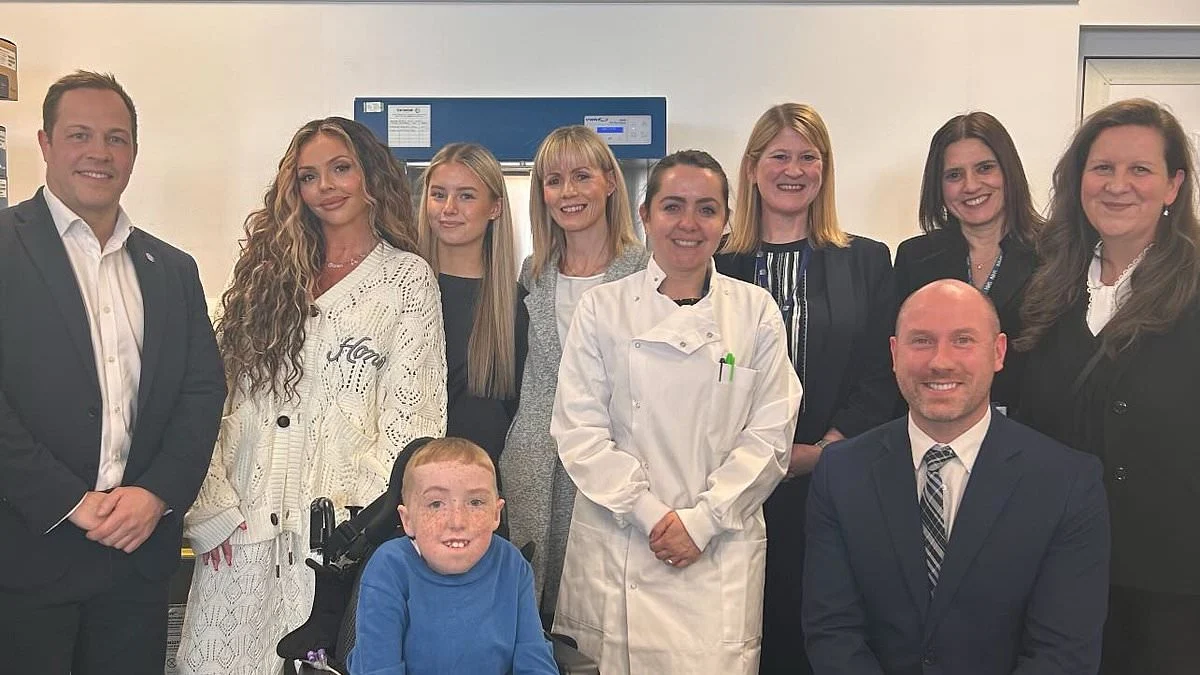
The British singer and public advocate Jesy Nelson has conducted a high-profile visit to a specialized newborn screening laboratory in Scotland, marking a significant milestone in her ongoing campaign for healthcare reform. The visit follows the Scottish Government’s landmark decision to become the first nation in the United Kingdom to implement routine screening for Spinal Muscular Atrophy (SMA), a rare and potentially fatal genetic condition. For Nelson, the development is deeply personal, as her nine-month-old twin daughters, Ocean and Story, were diagnosed with the most severe form of the condition earlier this year.
The 34-year-old former Little Mix member, who welcomed her daughters in May with ex-fiancé Zion Foster, has used her platform to highlight the critical necessity of early diagnostic intervention. During her visit to the facility on Wednesday, Nelson met with medical professionals and laboratory technicians to observe the processes that will now be used to identify SMA in every infant born in Scotland. Taking to social media to document the event, she described the experience as an "emotional day," reflecting on the "bittersweet" nature of a policy change that could have fundamentally altered the trajectory of her own children’s health had it been in place at the time of their birth.
Understanding Spinal Muscular Atrophy: A Clinical Overview
Spinal Muscular Atrophy is a hereditary neuromuscular disorder characterized by the degeneration of motor neurons in the spinal cord. This loss of nerve cells leads to progressive muscle wasting and weakness, often affecting the muscles closest to the torso, such as the shoulders, hips, and back. The condition is caused by a mutation or deletion in the Survival Motor Neuron 1 (SMN1) gene, which is responsible for producing a protein essential for the survival of motor neurons.
The severity of the condition is categorized into types, based on the age of onset and the highest physical milestone achieved:
- Type 1 (Werdnig-Hoffmann Disease): This is the most severe and common form, typically diagnosed within the first six months of life. Infants with Type 1 SMA often struggle with breathing, swallowing, and head control. Without advanced medical intervention, the life expectancy for these children is frequently less than two years.
- Type 2: Symptoms usually appear between 7 and 18 months. While children may be able to sit independently, they are generally unable to stand or walk without assistance.
- Type 3 (Kugelberg-Welander Disease): A milder form where symptoms appear after 18 months. Individuals can usually walk but may lose this ability later in life.
- Type 4: Adult-onset SMA, which typically results in mild muscle weakness and does not affect life expectancy.
Ocean and Story have been diagnosed with Type 1 SMA. This diagnosis has placed them at the center of a complex medical journey involving intensive therapy and the use of specialized equipment, such as leg splints designed to correct foot positioning—a common complication of the muscle weakness associated with the disorder.
The Scottish Pilot Program and the ‘Heel Prick’ Test
The breakthrough in Scotland involves the integration of SMA testing into the existing "blood spot" or "heel prick" test. This routine screening, performed on infants within the first few days of life, currently screens for nine rare but serious conditions in the UK, including cystic fibrosis and sickle cell disease.
The Scottish initiative is a two-year pilot program designed to evaluate the efficacy and logistical requirements of universal SMA screening. By identifying the condition at the neonatal stage—often before physical symptoms manifest—clinicians can administer gene therapies and disease-modifying treatments during a critical window of time. Medical research consistently indicates that treating SMA pre-symptomatically leads to significantly better motor outcomes and increased survival rates compared to treating children after muscle degeneration has already begun.
The implementation of this pilot makes Scotland a pioneer within the British Isles, as England, Wales, and Northern Ireland have yet to adopt universal screening for the condition. The UK National Screening Committee (UK NSC) is currently reviewing evidence for a UK-wide rollout, but progress has been viewed as slow by patient advocacy groups and families affected by the disease.
A Timeline of Advocacy and Personal Struggle
The narrative of Nelson’s involvement in this cause began in May of the previous year with the birth of her twins. However, it was not until January of this year that she publicly revealed the diagnosis that would change her family’s life. The revelation sparked a wave of public interest and a concerted effort by Nelson to influence national health policy.
- May: Birth of Ocean and Story.
- January: Public disclosure of the twins’ Type 1 SMA diagnosis.
- February – March: Nelson launches a formal campaign and petition, which rapidly garnered over 100,000 signatures. The petition urged the UK government to include SMA in the standard newborn screening panel.
- Early April: The Scottish Government announces the commencement of the SMA screening pilot.
- Current: Nelson’s visit to the Scottish laboratory and the continued filming of her Prime Video documentary series.
Despite the emotional toll of managing her daughters’ health, Nelson has remained committed to filming her upcoming documentary. She noted in a recent Q&A that she and her family decided to continue documenting their journey to ensure the reality of SMA is understood by the public. "As hard as it was, we were like, ‘You know what? There’s a reason you guys are here, and we’ve got to make the best out of this situation,’" she explained.
Professional and Charitable Reactions
The move by Scotland has been met with widespread acclaim from the medical community and charitable organizations. Giles Lomax, Chief Executive of SMA UK, emphasized the urgency of the situation, noting that approximately four babies are diagnosed with the condition every month in the UK.
"The screening pilot in Scotland will be a huge impetus for other parts of the UK to speed up their own testing plans," Lomax stated. He highlighted that with modern treatments like Zolgensma (a one-time gene therapy) and Spinraza now available through the NHS, the primary barrier to optimal outcomes is the delay in diagnosis. "The clock is always ticking. With screening, the future for anyone diagnosed with SMA is very different… It basically gives children the life they deserve."
The financial implications of screening also form part of the broader analysis. While the initial costs of implementing universal testing are significant, proponents argue that the long-term savings to the NHS—achieved by reducing the need for lifelong intensive care, respiratory support, and complex surgeries—far outweigh the upfront investment.
Implications for Healthcare Policy in England and Beyond
The discrepancy between Scottish and English healthcare policy regarding SMA has become a focal point of Nelson’s activism. In her recent statements, she expressed frustration over the geographical "lottery" of healthcare, stating, "I will never be able to understand why we still do not test for it here in England. To know that my girls’ lives and so many other children in England could look so different if this had been here for them."
The UK National Screening Committee’s cautious approach is rooted in a rigorous evidence-based framework that evaluates the balance of benefit and harm. However, critics point out that many other nations, including most states in the US and several European countries, have already moved to universal screening based on the clear clinical benefits of early treatment.
The Scottish pilot serves as a "living laboratory" that will provide the UK NSC with the localized data required to potentially approve a nationwide mandate. For families currently navigating the diagnosis, the hope is that the data will be processed with urgency.
The Human Element: Daily Management of SMA
Beyond the policy debates and laboratory visits, the reality for Nelson and her daughters involves a rigorous daily regimen. Recently, Nelson shared updates regarding the twins’ use of orthopedic leg splints. These devices are necessary because SMA can cause muscles to contract, leading to "pointed" feet or joint contractures.
"It made me really sad," Nelson admitted to her followers, noting that while the splints—decorated with hearts and butterflies—are small and "cute," they serve as a constant "reminder" of the physical limitations her daughters face. These personal insights have been instrumental in humanizing the statistics of the disease, providing a face to the advocacy for newborn screening.
As Scotland leads the way, the eyes of the medical community remain on the results of the pilot program. For Jesy Nelson, the mission continues to be one of transformation—turning a personal tragedy into a catalyst for a systemic change that ensures no other family in the UK has to wait for a symptomatic diagnosis before receiving life-altering care. The campaign for "the heel prick test" remains her primary focus as she balances her roles as a public figure, advocate, and mother.
