
 By Nila Kartika Wati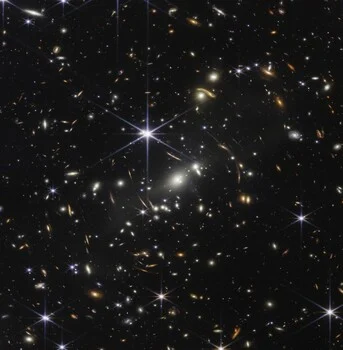
The breathtaking "Cosmic Cliffs" of the Carina Nebula, a cornerstone image that captivated the world upon the James Webb Space Telescope’s (JWST) debut in July 2022, presents a vibrant tableau of teal peaks and orange haze. Yet, these specific hues, as perceived by the human eye, do not exist in the raw cosmic data. The vast majority of light captured by Webb’s instruments operates far beyond the visible spectrum, residing squarely in the infrared. Understanding the sophisticated process behind translating this invisible data into stunning, colorful images not only clarifies their scientific veracity but also deepens appreciation for the telescope’s groundbreaking capabilities. Far from being a mere artistic interpretation, the assigned colors represent a meticulously constructed visual map of an otherwise unseen universe, revealing structures and phenomena previously hidden from our gaze.
Why Infrared? Peering Beyond Human Vision
The fundamental reason behind Webb’s unique design and its infrared focus lies in the very fabric of the cosmos. Unlike its predecessor, the Hubble Space Telescope, which primarily observes in visible and ultraviolet light, JWST is engineered to detect infrared radiation across a broad spectrum, from approximately 0.6 to 28 microns. This strategic choice allows Webb to tackle two of astronomy’s most profound challenges: observing the universe’s earliest epochs and piercing through dense cosmic dust clouds.
-
The Invisible Spectrum: Webb’s Advanced Instrumentation
Webb’s primary instruments are the Near-Infrared Camera (NIRCam) and the Mid-Infrared Instrument (MIRI). NIRCam operates from roughly 0.6 to 5 microns, while MIRI extends this reach to about 28 microns. To put this into perspective, the human eye and conventional camera sensors perceive visible light, which spans a narrow range from about 0.4 to 0.7 microns. This means almost everything Webb collects exists beyond the red end of human vision. Its shortest filters just graze the deep red, while the bulk of its observations delve deep into the infrared. Much of this infrared light is not the familiar glow of visible stars but rather the thermal emission from warm dust and gas, or the stretched-out light from the most ancient, distant galaxies. -
Cosmic Redshift: Unveiling the Early Universe
The universe is in a perpetual state of expansion. As light from extremely distant galaxies travels across billions of light-years to reach us, the expansion of space stretches its wavelengths. This phenomenon, known as cosmological redshift, causes light that was originally emitted as ultraviolet or visible light by the first stars and galaxies to arrive at Earth as infrared radiation. To truly witness the birth of the universe, to observe the very first luminous objects that ignited after the Big Bang, a telescope must be capable of detecting these redshifted infrared signals. Webb’s sensitivity to these longer wavelengths is precisely what enables it to peer back in time, offering an unprecedented glimpse into the universe’s infancy. -
Dust Penetration: Illuminating Stellar Nurseries
Another critical advantage of infrared astronomy is its ability to penetrate thick clouds of cosmic dust. These opaque shrouds, prevalent in star-forming regions and the hearts of galaxies, completely block visible light, rendering the nascent stars and planetary systems within them invisible to optical telescopes like Hubble. Infrared light, with its longer wavelengths, is less susceptible to scattering by these dust particles, allowing it to pass through relatively unimpeded. This capability transforms Webb into a cosmic ultrasound machine, revealing the intricate processes of star birth and the formation of protoplanetary disks — the fertile grounds where planets eventually coalesce. Without Webb’s infrared "eyes," many of the most dynamic and crucial phases of cosmic evolution would remain obscured.
From Grayscale Data to Breathtaking Vistas: The Art and Science of Color Assignment
The path from raw, invisible infrared data to the vibrant, iconic images released by NASA and its partners is a sophisticated process involving multiple steps of data acquisition, processing, and artistic interpretation, all grounded in scientific principles.
-
The Monochrome Truth: How Webb’s Detectors See
Perhaps one of the most surprising facts for the public is that Webb’s detectors, like those in NIRCam, are fundamentally monochrome. Each of the ten light-sensitive chips in NIRCam, for instance, records only brightness, assigning a single numerical value (representing intensity) to each pixel. There is no inherent color information in this raw data. A single exposure through a filter yields a grayscale frame, where each pixel can register one of more than 65,000 shades of gray. The concept of "color," as human vision defines it, is entirely absent from these initial measurements. -
The Role of Filters: Slicing the Infrared Spectrum
Webb perceives the cosmos in "color" by employing a diverse array of specialized filters. NIRCam is equipped with 29 such filters, and MIRI with 9. Each filter is essentially a piece of optical glass designed to transmit a specific, narrow slice of the infrared spectrum while blocking all other wavelengths. These filters are named according to the central wavelength they transmit, such as F090W (passing light near 0.9 microns) or F444W (passing light near 4.4 microns). Some are "broadband," allowing a wider range of wavelengths to pass, while others are "narrowband," precisely tuned to isolate the emission from specific elements or molecules, like F470N, which is optimized to detect molecular hydrogen.To construct a color image, the telescope captures the same region of the sky multiple times, using a different filter for each exposure. This results in several grayscale frames, each representing the intensity of light within a specific infrared wavelength band.
-
Chromatic Ordering: A Logical Approach to Visualization
Once these multiple grayscale frames are obtained, the crucial step of assigning visible colors begins. The governing principle for this assignment is known as "chromatic ordering," a refreshingly logical convention widely adopted in astronomy for decades. The process involves:- Sorting: The filters used for the image are sorted by their central wavelength, from shortest to longest infrared.
- Mapping: The shortest infrared wavelength data is assigned to the shortest visible wavelength color, typically blue. Conversely, the longest infrared wavelength data is assigned to the longest visible wavelength color, which is red.
- Interpolation: Intermediate infrared wavelengths are then mapped to corresponding visible colors along the spectrum (green, orange, yellow, etc.).
NASA refers to this as a "baseline" rather than a rigid rule, acknowledging that slight deviations may occur to optimize scientific interpretation. For the iconic "Cosmic Cliffs" image, the published color key maps F090W (shortest) to blue, F187N to cyan, F200W to green, F470N to yellow, F335M to orange, and F444W (longest) to red. Notably, in this specific case, the F470N filter, a narrowband filter for molecular hydrogen, is mapped to yellow, while the F444W, a broadband filter for longer wavelengths, is mapped to red. This subtle shift from strict ordering often serves a scientific purpose, as discussed below.
-
Scientific Interpretation and Aesthetic Judgment: The Human Element
While chromatic ordering provides a strong foundation, the creation of Webb’s final images also involves expert judgment from a team of "science visuals developers." These specialists, like Alyssa Pagan and Joe DePasquale at the Space Telescope Science Institute (STScI), blend scientific rigor with aesthetic sensibility.They might, for example, stretch the contrast to make faint structures visible, enhancing details that would otherwise be lost in the raw data. They also meticulously clean out "artifacts" such as cosmic ray hits that can contaminate detector pixels. Furthermore, when a narrowband filter captures something of particular scientific importance, processors may deliberately assign it a color that contrasts with its neighboring broadband filters. This ensures the specific feature "pops" and is easily discernible, even if it slightly deviates from strict chromatic ordering.
Pagan has been candid about this flexibility: "We will even stray from chromatic order sometimes, if we feel abandoning it helps see detail in a specific filter." This was likely the case for F470N in the Cosmic Cliffs, where assigning it yellow, distinct from the longer-wavelength F444W mapped to red, highlighted the molecular hydrogen that would otherwise be blended. DePasquale echoes this sentiment, explaining how flexibility was crucial for Hubble’s famous "Pillars of Creation" image, which combined narrowband filters for oxygen, sulfur, and hydrogen. "The sulfur and the hydrogen are both red, so that would make a very red image with some cyan for the oxygen," he noted. "Being flexible about how you color the data, but maintaining chromatic order, is really what makes the images pop and allows you to pull more detail out." These choices are transparently made and documented, representing an aesthetic layer carefully applied to hard scientific data.
Reading the Cosmic Cliffs: What the Colors Truly Represent
With this understanding, revisiting the "Cosmic Cliffs" image transforms its interpretation. What appears as a majestic mountain range bathed in golden hour light is, in reality, the intensely active edge of a vast gas cavity within NGC 3324, located approximately 7,600 light-years away. The towering "peaks" are colossal pillars of gas and dust, with the tallest reaching an astounding 7 light-years in height. There is no ground, no sky, and certainly no sunset; the cavity itself has been carved out by the powerful ultraviolet radiation and stellar winds emanating from enormous, young, hot stars positioned just above the frame, out of direct view.
The orange, cloudy lower half of the image corresponds to dust and gas captured by NIRCam’s longer-wavelength channels, indicating warmer regions where light is predominantly emitted by heated material. The dark blue-black upper region, in contrast, represents comparatively emptier space, glowing faintly in the shorter infrared wavelengths. At the dramatic boundary between these regions, Webb’s infrared capabilities cut through the obscuring murk, revealing hundreds of previously hidden stars, along with energetic jets and streams erupting from newborn stars still deeply embedded within the gas and dust. Incorporating MIRI’s mid-infrared view adds another layer of detail: young stars, still enshrouded in their planet-forming dusty disks, light up in brilliant pink and red, glowing brightly at the specific wavelengths where their cooler dust radiates most intensely.
Crucially, none of these profound scientific details – the stars, the jets, the dusty disks, the towering ridges – depend on the specific shade of teal or amber. The image could be recolored tomorrow with a different palette, and the underlying structures, their positions, and their relative intensities, derived from the same measurements, would remain unchanged. The colors, therefore, serve as a sophisticated legend for a map; the territory itself is unequivocally real and measured.
"Assigned" Versus "Fake": Reconciling Perception with Reality
The term "fake" is frequently, yet erroneously, applied to Webb’s images, stemming from a misunderstanding of how scientific data is visualized. However, this perspective overlooks the common and accepted practices in many scientific fields. Consider a weather map, where different colors represent temperature ranges; a microscope image, where fluorescent tags are artificially colored to highlight specific biological structures; or an MRI scan, which uses color to depict variations in tissue density. No one labels these as "fake" because there is a universal understanding that they are translations of real, measured data into a format that humans can readily interpret.
Webb’s images operate on precisely the same principle, performing this translation for a spectrum of light that the human eye is simply not equipped to perceive. As Alyssa Pagan aptly articulates, "There is an audience of people that think this is fake, just because it’s representational. But when you’re talking about ultraviolet or infrared, how else are you supposed to represent it?"
Indeed, a version of these images closer to the "raw truth" exists: the monochrome grayscale frame from a single filter. While honest and precise, such an image is largely unreadable to anyone without specialized training in photometry. Chromatic ordering takes multiple such frames and synthesizes them into a single, comprehensive picture that the human visual system can instantly parse, without sacrificing the underlying scientific measurements. In fact, a colored composite often allows us to perceive more of what the telescope recorded, not less, by layering information from different wavelengths.
The Enduring Impact of Webb’s Images: A New Era of Astronomical Discovery and Public Engagement
The initial release of JWST’s first full-color images in July 2022 marked a pivotal moment not just for astronomy, but for global science communication. The "Cosmic Cliffs," along with images of the Southern Ring Nebula, Stephan’s Quintet, and Webb’s First Deep Field, instantly became cultural touchstones, sparking awe and inspiring a new generation of scientists and space enthusiasts.
Beyond their aesthetic appeal, these images are already revolutionizing our understanding of the universe. Webb’s unparalleled sensitivity is providing critical data on the formation of the earliest galaxies, probing the atmospheres of exoplanets for signs of life, and revealing the intricate dance of star and planet formation within dusty nurseries. Each pixel, each assigned color, contributes to a vast mosaic of data that scientists worldwide are meticulously analyzing to unlock cosmic secrets.
The work of science visuals developers like Pagan and DePasquale is therefore indispensable. They bridge the gap between complex, invisible data and public comprehension, making cutting-edge astronomy accessible and engaging. Their careful choices in color assignment ensure that scientific value is maximized while also producing images that resonate deeply with human curiosity and wonder.
Conclusion: A Faithful Portrait of an Unseen Universe
So, the next time the question arises about the "reality" of the colors in a James Webb Space Telescope image, the answer is nuanced yet profound. The colors themselves are assigned, a necessary translation because the light Webb collects is fundamentally invisible to human eyes. However, the underlying data – the structure, the wavelengths, and the intensities – are all meticulously measured and demonstrably real. The colors are assigned with the ordering of this data as a fundamental starting point, providing a logical and scientifically justifiable means of visualization.
What we witness in these extraordinary images is a faithful, high-fidelity portrait of a sky that no human eye will ever directly perceive. Rendered by a team of dedicated scientists and artists who transparently explain their methodology, these images stand as a testament to human ingenuity and our insatiable drive to comprehend the universe. They are not merely photographs; they are windows into the invisible, meticulously crafted to reveal the grandeur and complexity of the cosmos, making a stronger claim to reality than many conventional images can make.
