
 By admin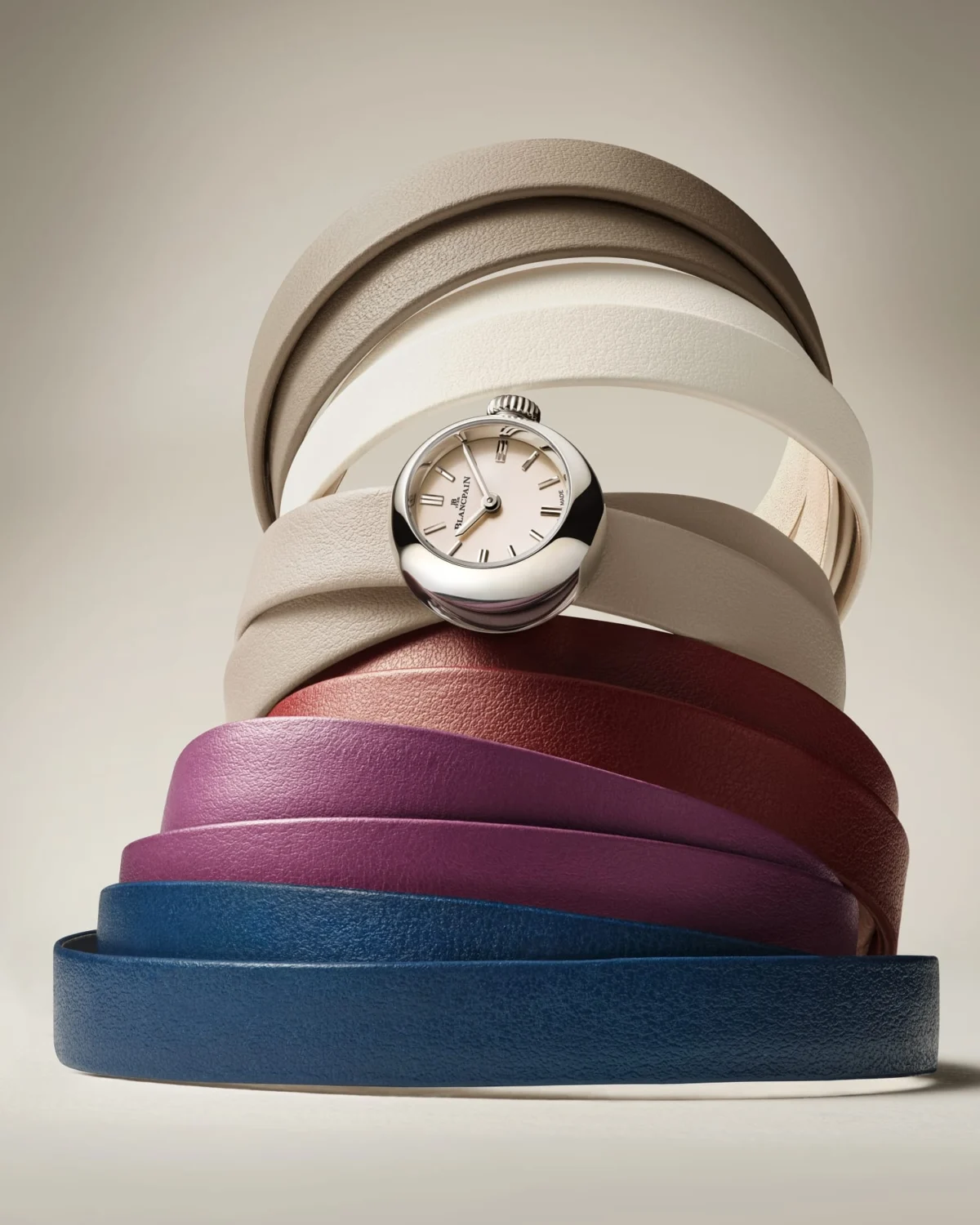
Seventy years after the introduction of the legendary Ladybird Bullet, Blancpain has officially unveiled the Lady B, a contemporary masterpiece that revisits the manufacture’s historic achievements in mechanical miniaturization. This new release serves as both a tribute to the brand’s mid-century innovations and a firm reassertion of its core philosophy: a refusal to succumb to the convenience of quartz technology in favor of pure mechanical artistry. The Lady B, powered by the self-winding Calibre 615, represents a significant milestone for the Villeret-based manufacture, blending high-precision engineering with a bold, biomorphic design language that challenges the traditional silhouettes of women’s horology.
A Legacy of Leadership and Innovation: The Fiechter Era
The genesis of the Lady B is inextricably linked to the legacy of Betty Fiechter, a pioneering figure who remains one of the most influential women in the history of Swiss watchmaking. In 1932, following the death of Frédéric-Emile Blancpain, the last of the founding family line, Fiechter became the first woman to own and lead a major Swiss watch firm. Alongside her nephew, Jean-Jacques Fiechter, she steered the company through some of its most transformative years. While the duo is most famously credited with the 1953 launch of the Fifty Fathoms—the world’s first modern diver’s watch—their 1956 contribution to women’s horology was equally revolutionary.

The original Ladybird Bullet, launched in 1956, was a marvel of its time. During an era when the industry was racing to create the smallest and thinnest movements possible for women’s cocktail watches, Blancpain achieved a record-breaking feat with the hand-wound Calibre R55. Measuring just 11.85mm in diameter, the R55 remains the smallest round mechanical manual-winding movement ever produced in series. This movement was not merely a feat of scale; it was a feat of architecture. Unlike standard movements of the time that utilized a four-wheel going train, the R55 incorporated an additional fifth wheel to better regulate the distribution of force to the regulating organs, ensuring that the watch remained robust and accurate despite its diminutive size.
The Design Language of the Lady B: Biomorphic Elegance
The 2026 Lady B departs from the literal aesthetics of a "reissue" to embrace a more avant-garde, sculptural identity. Described by the manufacture as "biomorphic," the watch’s shape evokes the fluid, organic forms popularized in mid-century modern design. The case, measuring 19mm in diameter and 13.2mm in thickness, occupies a total volume of just 2.9cm³. On the wrist, the watch presents as a "golden pebble"—a seamless, monolithic object that hides the complexities of its construction.
One of the most striking features of the Lady B is the total absence of traditional lugs. To maintain the purity of the spherical volume, Blancpain’s engineers machined an integrated passage directly through the solid metal of the case. This 10mm x 1.6mm aperture allows a double-tour calf leather strap to glide seamlessly through the body of the watch, creating a visual continuity that would be impossible with standard spring bars. The two-part case, available in either stainless steel or 18K 5N red gold, is meticulously hand-polished to ensure that the junction line between the components is invisible to the naked eye.

The dial follows a minimalist ethos, prioritizing depth and texture over ornamentation. Eschewing the traditional use of gemstones, Blancpain has opted for a simple opaline finish. Applied gold indices and pencil-style hands provide a classic touch, while a mirror-polished rehaut (the inner rim of the watch) reflects the dial, creating an optical illusion of greater spherical depth.
Technical Specifications and the Calibre 615
While the original 1956 Ladybird was powered by the manual-winding R55, the modern Lady B utilizes the self-winding Calibre 615. This choice reflects a commitment to modern wearer convenience without compromising the manufacture’s mechanical-only mandate. The Calibre 615 is one of the smallest automatic movements currently in production, designed to fit within the constrained dimensions of high-jewelry and miniature timepieces.
Key Technical Data:
- Case Diameter: 19mm
- Case Thickness: 13.2mm
- Movement: Calibre 615 (Self-winding)
- Historical Reference: Calibre R55 (11.85mm diameter)
- Materials: Stainless Steel or 5N Red Gold
- Total Volume: 2.9 cubic centimeters
- Strap Integration: Internal 10mm x 1.6mm passage
- Dial: Opaline with mirror-polished rehaut
The Calibre 615 represents the evolution of the miniaturization goals set by the Fiechter family seventy years ago. In the mid-20th century, the challenge was to provide enough power reserve and shock protection in a movement small enough for a cocktail watch. The modern 615 addresses these issues with contemporary materials and manufacturing tolerances, ensuring that the Lady B is not just a decorative object but a reliable instrument for daily wear.

The "No Quartz" Manifesto: A Strategic Stand
The release of the Lady B is a reaffirmation of Blancpain’s famous internal maxim: "Since 1735, there has never been a Blancpain quartz watch. And there never will be." This philosophy, championed by Jean-Claude Biver during the brand’s revival in the 1980s, was a direct response to the "Quartz Crisis" that decimated the Swiss mechanical watch industry. While many brands survived by adopting battery-powered movements for their women’s collections, Blancpain doubled down on mechanical purity.
Industry analysts view the Lady B as a strategic move to capture a growing segment of the luxury market: women who value horological substance as much as aesthetic form. By offering a watch that is "not gem-set" yet "sculptural," Blancpain is targeting a demographic that appreciates the "quiet luxury" of mechanical engineering. The decision to omit diamonds—a rarity in high-end women’s watches of this size—places the focus entirely on the case’s silhouette and the movement’s integrity.
Chronology of Blancpain’s Miniaturization Milestones
- 1735: Jehan-Jacques Blancpain founds the manufacture in Villeret, Switzerland.
- 1932: Betty Fiechter takes ownership of the firm, marking the start of a new era of innovation.
- 1953: Launch of the Fifty Fathoms, establishing Blancpain’s reputation for robust tool watches.
- 1956: The Ladybird Bullet is introduced, featuring the Calibre R55, the world’s smallest round mechanical movement.
- 1970s-80s: The Quartz Crisis; Blancpain remains one of the few manufactures to never produce a quartz movement.
- 2026: Launch of the Lady B, celebrating 70 years of the Ladybird legacy with a biomorphic design and the Calibre 615.
Broader Impact on the Horological Landscape
The debut of the Lady B comes at a time when several top-tier Swiss manufactures are revisiting smaller case sizes. For decades, the trend in the industry moved toward larger, more masculine dimensions, often leaving women’s mechanical watches as an afterthought or as "shrunk-down" versions of men’s models. Blancpain’s approach with the Lady B is different; it is a purpose-built design that celebrates the constraints of small-scale watchmaking.

Furthermore, the Lady B challenges the notion that a women’s luxury watch must be defined by its carat weight. By focusing on the "sculptural" nature of the metal and the "monolithic" finish of the case, Blancpain is advocating for a form of horological appreciation that is rooted in shape, volume, and mechanical heritage.
As the luxury watch market continues to evolve, the Lady B stands as a reminder that the most significant achievements are often the smallest. By revisiting the spirit of Betty Fiechter and the technical breakthroughs of 1956, Blancpain has created a timepiece that bridges the gap between mid-century modernism and 21st-century mechanical excellence. The Lady B is more than just a watch; it is a golden pebble of history, meticulously polished and powered by a legacy of uncompromising mechanical devotion.
