
 By Nila Kartika Wati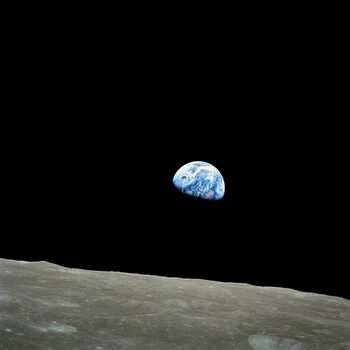
The most influential environmental photograph ever taken was not on anyone’s shot list, nor was its creation a pre-planned scientific endeavor. It materialized in a hurried, almost accidental sequence aboard Apollo 8, humanity’s first journey to orbit another celestial body. As the spacecraft executed a critical roll, a shimmering blue planet swung into view over the barren lunar horizon. Astronaut Bill Anders, designated the mission’s primary photographer, had barely a minute to locate and load color film before the fleeting spectacle vanished. His initial impulse to capture the scene was met with a half-joking caution from his commander, Frank Borman, highlighting the mission’s tightly scheduled, high-stakes nature.
The resulting image, which almost certainly graces countless books, posters, and digital screens, depicts Earth as a luminous, half-lit marble suspended above the desolate lunar surface, appearing remarkably small and undeniably fragile against the profound blackness of space. It stands as one of the most reproduced images in history, yet the widely circulated narrative of its genesis often omits the raw, human spontaneity and the technical improvisation that truly defined its creation. The actual events were far messier, more rushed, and ultimately more poignant than the sanitized legend that subsequently formed around it.
The Genesis of a Pioneering Mission: Apollo 8
Apollo 8 launched on December 21, 1968, from Cape Kennedy, Florida, atop the colossal Saturn V rocket, a thunderous assertion of American technological prowess during the height of the Space Race. Aboard were three highly skilled astronauts: Colonel Frank Borman, serving as commander; Captain Jim Lovell, the command module pilot; and Major Bill Anders, designated lunar module pilot. Intriguingly, despite Anders’ title, the mission carried no lunar module at all. This was a testament to the audacious, somewhat improvised nature of Apollo 8. NASA had accelerated its plans to send a crew all the way to the Moon and back without a lander, driven by intense concern that the Soviet Union was on the verge of achieving its own circumlunar flight, potentially seizing a critical psychological victory in the ongoing space contest. The mission was a high-risk gamble, pushing the boundaries of human spaceflight further than ever before.
The crew of Apollo 8 achieved an unprecedented feat, becoming the first humans to escape low Earth orbit and journey to another world. Over approximately twenty hours, they executed ten orbits around the Moon, meticulously scouting future landing sites for subsequent Apollo missions. Their responsibilities included critical navigation maneuvers and engine burns, essential practices that would later prove vital for lunar landings. Anders’ primary role during these orbits was largely photographic, tasked with documenting the lunar surface in granular detail. His flight plan was exhaustive, mapping out specific craters, geological features, and orbital passes he was mandated to photograph with precision.
Remarkably, photographing Earth during these lunar passes was not a specific, scheduled component of Anders’ photographic duties, nor was it explicitly highlighted in the broader mission objectives while in lunar orbit. While Earth photography was generally an objective for Apollo missions, the specific focus during lunar orbits was firmly on the Moon itself. The spacecraft’s orientation for the first three orbits deliberately kept the lunar surface filling the small command module windows, with Earth remaining entirely out of view. This was by design: the Moon was the singular target, and every item on the mission checklist, every assigned task, intentionally directed the crew’s attention downward, toward the rugged, cratered terrain sliding past beneath them at speeds approaching 3,700 miles per hour (6,000 km/h).
The Unscheduled Revelation: Earthrise
Everything changed dramatically on the fourth orbit. Commander Borman initiated a critical roll maneuver, altering the spacecraft’s attitude for navigation and communication purposes. As the command module, named "Columbia," slowly rotated, the stark lunar horizon began to drop away from the windows, and then, with breathtaking suddenness, Earth climbed majestically into view. This was not a staged event, no carefully choreographed moment for a photograph. The crew had simply reoriented the spacecraft, and the immutable laws of celestial mechanics and orbital geometry delivered the rest.
Bill Anders, ever vigilant with his camera, was the first to witness the stunning apparition. The mission audio tape, a meticulous record of every spoken word, captured his reaction with an unfiltered awe that resonates even decades later. "Oh my God! Look at that picture over there!" he exclaimed, his voice laced with wonder. "There’s the Earth coming up. Wow, that’s pretty." He instinctively grabbed the camera already in his hand, which, adhering to his photographic schedule, was loaded with black-and-white film. He immediately fired off a monochrome frame, a quick, almost reflexive capture of the unexpected sight.
It was then that Commander Borman uttered the line that has become a legendary footnote to the story, a moment of dry wit tempered by the immense pressures of a pioneering space mission. "Hey, don’t take that, it’s not scheduled," Borman remarked, half-joking but also reflecting the ingrained discipline of a test pilot accustomed to strict adherence to flight plans. This was a pilot’s reflex, the instinct of a man meticulously executing a mission where any deviation, however minor, could carry catastrophic consequences. Anders, however, possessed the equally potent instinct of a photographer presented with an unparalleled, once-in-a-lifetime subject. He judiciously ignored the commander’s playful admonition and immediately began a frantic search for color film.
"You got a color film, Jim?" Anders urgently asked Lovell. "Hand me that roll of color quick, would you." Lovell, equally aware of the fleeting nature of the moment, scrambled to locate a magazine of color film. Accounts from the crew suggest a tense, fumbled minute or more passed as they struggled in the confined space, their bulky gloves hindering the swift change of film magazines. The scene outside the window continued to drift, the Earth slowly moving across their field of view. Miraculously, Earth remained in sight long enough. Anders, with the color film finally loaded, managed to squeeze off two precious color exposures before the magnificent view finally slid out of the window. Lovell’s voice on the tape, echoing the collective sentiment, plainly declared, "Oh man, that’s great." The moment, though fleeting and unscripted, had been preserved.
For many years following the mission, popular accounts and even some official reports incorrectly attributed the iconic image to Frank Borman, or at least the initial black-and-white frame. However, meticulous reconstructions by institutions like the Smithsonian and NASA, based on forensic analysis of the onboard audio tapes, film magazines, and camera logs, definitively confirmed that Bill Anders shot all of the "Earthrise" photographs—both the initial monochrome frame and the two celebrated color frames. The commander who had playfully advised "don’t take that" was not, in fact, the one holding the camera.
The Tools and Techniques Behind the Icon
The camera that immortalized "Earthrise" was a Hasselblad 500 EL, a robust Swedish medium-format body renowned for its optical quality and reliability. This particular model was fitted with an electric drive, a crucial modification allowing the crew to advance film even while wearing bulky pressurized gloves, which severely limited manual dexterity. Unlike modern SLR cameras, the Hasselblad 500 EL used in Apollo missions lacked a reflex viewfinder. Instead, it was equipped with a simple sighting ring, meaning Anders was essentially aiming the camera, relying on instinct and experience, rather than composing the shot precisely through the lens. The lens attached to the camera at that pivotal moment was a 250mm telephoto, which Anders had been using for tight, detailed shots of the lunar surface—a lens ill-suited for a wide, sweeping landscape, yet it captured the intimate fragility of Earth perfectly.
The film stock itself was a custom 70mm color reversal emulsion, a specialized thin-base Ektachrome variant developed by Kodak specifically for the rigorous demands of spaceflight and the unique film magazines used on Apollo missions. This particular stock was rated at approximately ASA 64, offering fine grain and excellent color rendition. The exposure that ultimately yielded the most famous color "Earthrise" photograph was made at a shutter speed of 1/250 second and an aperture of f/11. Jim Lovell can be distinctly heard on the mission audio tape reading out these very settings, underscoring the rapid, collaborative effort of the crew to secure the shot before the celestial tableau slipped from view.
One final, often overlooked detail regarding the enduring image is its orientation. The version widely seen on posters, stamps, and in countless publications is subtly rotated. In the raw, unedited frame captured by Anders, the lunar horizon runs roughly vertical across the image. This orientation was a direct consequence of how the spacecraft was angled when Anders took the photograph, with Earth appearing off to the side rather than directly "rising" from the bottom of the frame. NASA, recognizing the human tendency to interpret landscapes with a horizontal horizon, strategically rotated the image so that the lunar surface sits at the bottom, making Earth appear to "rise" in a more conventional, evocative manner. Thus, the picture that ignited a global movement is, in a small but significant way, a reinterpretation of what the crew actually witnessed.
None of these technical details, or the slight reorientation, diminish the profound impact of the photograph. The combination of a 250mm optic, a basic sighting ring, a camera body designed for gloved operation, and a bespoke film stock that no longer exists in its original form, resulted in a frame that was an extraordinary confluence of meticulous preparation and sheer, improbable luck. While modern photographic equipment has advanced exponentially, the spirit of capturing such a moment—the blend of technical skill, rapid improvisation, and an unyielding commitment to seizing the fleeting—remains a testament to the human endeavor. Today, Kodak still produces a color reversal film under the Ektachrome name, and Hasselblad continues to build cameras, though their contemporary Hasselblad lineup represents a sophisticated evolution far removed from the utilitarian 1968 lunar body.
The Photograph That Rewired Our Collective Self-Perception
Bill Anders journeyed to the Moon, not merely to document its desolate expanse, but to return with the definitive, most intimate portrait of Earth ever conceived. His own concise summary of the trip became almost as famous as the picture itself: "We came all this way to explore the Moon, and the most important thing is that we discovered the Earth." This was not a casual remark; it was a profound philosophical realization. Prior to Apollo 8, no human being had ever visually experienced the entirety of our home planet floating freely in the vastness of space with their own eyes. The sheer novelty of this perspective was transformative.
The image’s dissemination was remarkably swift. Within days of the Apollo 8 crew’s return, "Earthrise" graced the pages of newspapers and magazines worldwide, instantly capturing global attention. In 1969, it famously appeared on the cover of the influential Whole Earth Catalog, a publication that became a touchstone for counterculture and environmental movements. That same May, it was immortalized on a United States postage stamp, reaching millions more. Even before the Apollo 8 crew had splashed down, the esteemed poet Archibald MacLeish published a front-page essay in The New York Times on December 25, 1968, titled "A Reflective Christmas," eloquently pondering humanity’s shared fate as "riders on the Earth together." The photograph, and the profound perspective it offered, served as a powerful catalyst for the burgeoning environmental consciousness. The first Earth Day, observed in 1970, emerged directly in its wake, and "Earthrise" instantly became one of its most potent emblems. It was a single frame arguing, with unparalleled visual force, that our planet was a small, finite, and utterly vulnerable entity, desperately in need of protection.
The renowned landscape photographer Galen Rowell famously declared "Earthrise" to be "the most influential environmental photograph ever taken," a label that has firmly stuck because its truth is almost impossible to dispute. The picture did not introduce a single new scientific fact about ecology or planetary systems. What it fundamentally altered was the vantage point from which humanity collectively understood itself. Seen from a quarter of a million miles away, the arbitrary divisions of national borders vanished, the entire planet hung as a delicate, shimmering orb against the infinite black, and it looked precisely as vulnerable as it inherently is. That unprecedented perspective shift achieved more profound work in a fraction of a second than any scientific chart, political speech, or ecological treatise could have accomplished in years.
Bill Anders spent the remainder of his long life inextricably linked to the photograph he took. He flew no more space missions, instead transitioning into significant roles in government and industry, serving as the first chairman of the Nuclear Regulatory Commission and later as U.S. Ambassador to Norway. Yet, he continued to pursue his passion for aviation, often flying vintage aircraft for pleasure. On June 7, 2024, at the age of 90, while piloting a Beechcraft T-34 Mentor alone, his aircraft tragically crashed into the waters off the San Juan Islands in Washington State. The astronaut who, in a moment of hurried improvisation, almost did not get the shot, and who was told mid-scramble that it was "not scheduled," left behind a single frame that not only outran the mission it was attached to but profoundly and permanently altered humanity’s understanding of its place in the cosmos. His legacy is etched not only in the annals of space exploration but in the collective consciousness of a planet forever changed by a single, breathtaking glimpse of home.
