
 By admin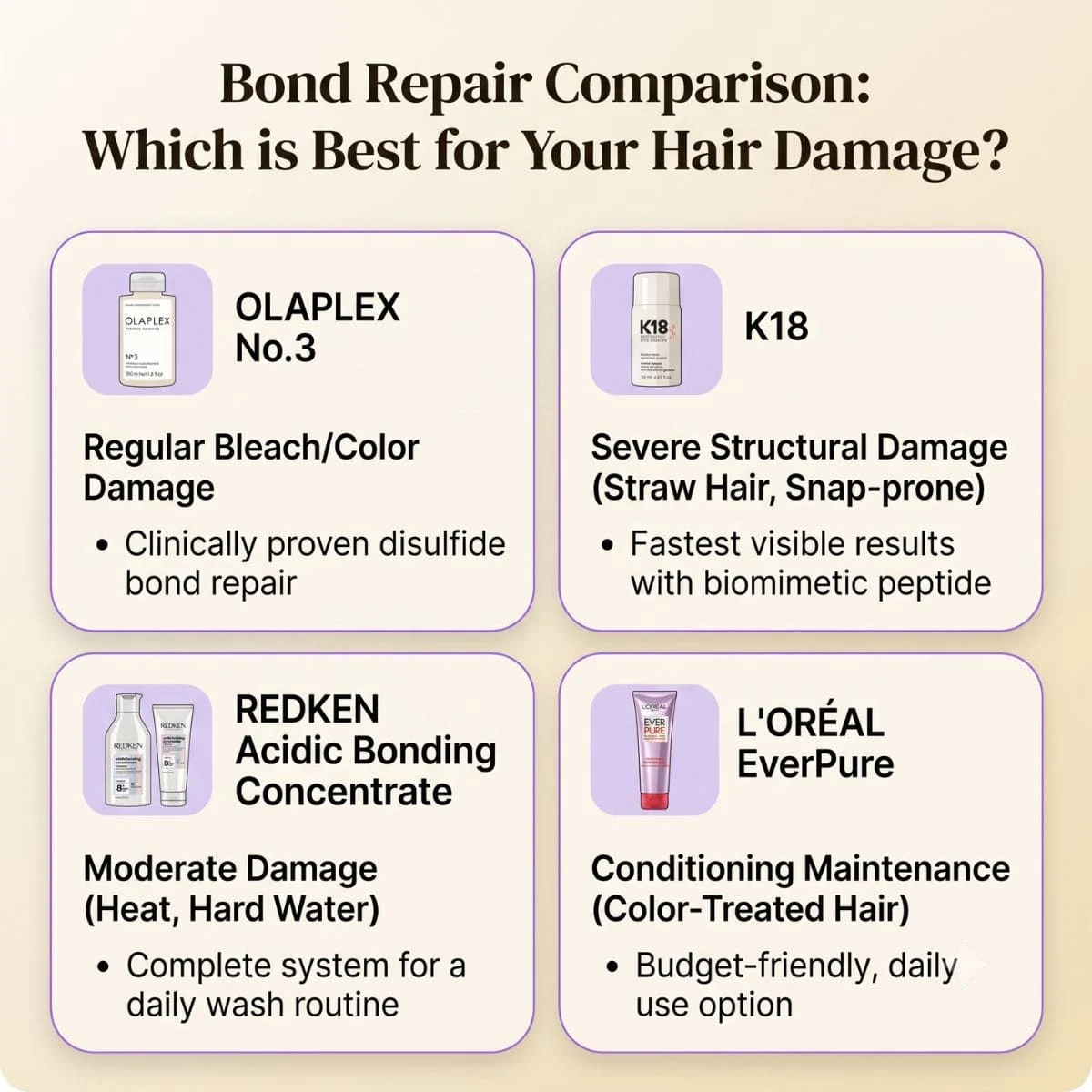
Bond repair treatments have rapidly evolved from a specialized salon service to a ubiquitous presence on retail shelves, leaving consumers navigating a complex landscape of options. Over the past decade, Olaplex pioneered the category, K18 introduced innovative peptide technology, Redken developed a comprehensive wash-day system, and L’Oréal democratized access with drugstore-friendly pricing. While all claim to mend hair from within, their underlying science, application methods, cost, and suitability for different damage types vary significantly. This comprehensive guide delves into the scientific mechanisms, usage protocols, financial implications, and real-world user experiences of four leading bond repair brands, aiming to equip consumers with the knowledge to make an informed purchasing decision and avoid costly trial-and-error. Whether your hair has suffered damage from balayage, highlights, perms, or other chemical services, this comparison will illuminate the optimal starting point for restoration.
A Comparative Overview of Leading Bond Repair Brands
| Brand | Active Technology | Application Method | Entry Price (approx.) | Best Suited For |
|---|---|---|---|---|
| Olaplex No. 3 | Bis-aminopropyl diglycol dimaleate | Pre-shampoo treatment (10-90 mins) | $30 / 3.3 oz | Bleach and chemical damage, color-treated hair |
| K18 Leave-In Mask | K18PEPTIDE™ (biomimetic peptide) | 4-minute leave-in, no rinse | $75 / 1.7 oz | Rapid, deep structural repair, severe damage |
| Redken ABC | Citric acid + Bonding Care Complex | Full wash-day system (shampoo, conditioner, treatment) | $18-22 per product | Color-treated hair, comprehensive system approach |
| L’Oréal EverPure Bond Repair | Citric acid bond technology | Shampoo, conditioner, treatment | $10-15 per product | Accessible, everyday maintenance for color-treated hair |
Understanding the Science of Bond Repair
Hair’s structural integrity is primarily derived from keratin, a protein composed of amino acids linked by various chemical bonds. The strongest of these are disulfide bonds, but hydrogen and ionic bonds also play crucial roles in maintaining hair’s form and elasticity. Processes such as bleaching, dyeing, perming, and frequent heat styling can sever these bonds, leading to a cascade of visible damage: brittle strands, increased porosity, frizz, and a propensity to break rather than flex.
Bond repair products are engineered to address this molecular disruption. Broadly, they fall into two primary categories based on their scientific approach. One involves small molecules designed to bridge the gaps created by broken disulfide bonds, effectively "patching" them at a molecular level. This is the mechanism employed by brands like Olaplex. Another approach utilizes acidic formulations to lower the hair’s pH, which prompts the cuticle—the outer protective layer of the hair shaft—to close. This process not only reduces external damage but also minimizes breakage during styling and manipulation. Redken and L’Oréal utilize this pH-balancing, cuticle-sealing technology. A third, distinct pathway, pioneered by K18, involves a proprietary biomimetic peptide. This peptide is designed to mimic the natural structure of keratin, enabling it to reconnect multiple types of bonds simultaneously within the hair’s core.
It is important to note that no bond repair product offers an overnight cure for severe hair damage. The most significant and lasting improvements are typically cumulative, achieved through consistent application over time. However, the appropriate product, used as directed, can yield measurable improvements in hair’s tensile strength and elasticity.
Olaplex: The Trailblazer in Bond Restoration
Olaplex emerged in 2014, a product of innovation by chemists Eric Pressly and Craig Hawker at the University of California, Santa Barbara. Its patented active ingredient, bis-aminopropyl diglycol dimaleate (BADGD), is engineered to create a molecular bridge between the severed ends of a broken disulfide bond. This process forms a covalent link, effectively repairing the damage from within. Research published in the International Journal of Drug and Scientific Research details how BADGD integrates into the hair structure, reforming connections and enhancing internal strength rather than merely coating the hair surface.
The Olaplex No. 3 Hair Perfector, priced at $30 for a 3.3 oz bottle, is the brand’s flagship at-home treatment. It is applied to damp hair prior to shampooing and left on for a duration ranging from 10 to 90 minutes before being washed out. This product is particularly effective for hair that has undergone regular bleaching or coloring. For individuals who frequently opt for blonde highlights or consistent color treatments, Olaplex’s formulation is specifically designed to counteract the particular damage patterns these services induce.
A key insight from professional stylists is that Olaplex performs optimally when applied to freshly clarified hair. Buildup from silicones or heavy oils can impede the product’s penetration and effectiveness. Therefore, clarifying the hair before treatment is recommended for achieving the most noticeable results. While Olaplex offers a comprehensive system of nine consumer products and a professional range, the cumulative cost of the entire system can become substantial. Furthermore, users often report that visible results require several weeks of consistent use, a factor that can test the patience of those seeking immediate transformations.
K18: The Peptide Revolution in Four Minutes
Launched in 2020, K18 entered the market with a singular product and an ambitious promise: to reverse damage from bleaching in just four minutes, without the need for rinsing. The cornerstone of its efficacy is the K18PEPTIDE™, a biomimetic peptide. This peptide was developed through an extensive research process involving the analysis of over 1,235 peptide sequences, leveraging AI-powered molecular modeling to identify the sequence that most closely mirrors the natural keratin structure of hair. According to K18’s published discovery research, this meticulous approach aimed to create a peptide that could effectively integrate and repair.

A significant distinction between K18 and Olaplex lies in their scope of repair. While Olaplex primarily targets disulfide bonds, K18’s peptide is claimed to address both disulfide bonds and polypeptide chains (the fundamental building blocks of keratin). This broader repair claim suggests a more comprehensive restoration of the hair’s internal structure. Furthermore, K18 posits that its biomimetic peptide integrates into the hair fiber, becoming a permanent part of its structure, unlike topical treatments that may wash out over time.
The application protocol for K18 is notably streamlined: shampoo hair, skip conditioner, apply K18 to damp hair, wait four minutes, and then proceed with styling. The Leave-In Molecular Repair Mask, priced at $75 for 1.7 oz, represents a significant investment. However, the brand emphasizes that a small amount—typically one to three pumps—is sufficient per application, with the cost-effectiveness stemming from its potent concentration and the minimal quantity required.
Stylists advise that K18’s efficacy is maximized when applied to a clean canvas. Residual conditioner or oil can impede the peptide’s absorption. Therefore, using a clarifying shampoo before K18 application is recommended.
Redken Acidic Bonding Concentrate: A Holistic System Approach
Redken’s Acidic Bonding Concentrate (ABC) line champions a multi-product strategy centered around citric acid and its proprietary Bonding Care Complex. Rather than a single hero ingredient, this range offers a complete wash-day routine encompassing shampoo, conditioner, an intensive treatment, and a leave-in product. The core mechanism involves pH adjustment. Citric acid helps to lower the hair shaft’s pH, which promotes cuticle closure, reduces swelling, and consequently minimizes breakage during brushing and styling.
A 2025 peer-reviewed study published in the International Journal of Cosmetic Science highlighted the benefits of citric acid treatments for chemically damaged hair. The research indicated that such treatments reinforce the hair’s protein network through non-covalent bonds and significantly reduce calcium buildup from hard water—by as much as 21-42%. These combined effects contribute to demonstrably improved hair strength and texture. While this approach doesn’t replicate the deep structural repair of Olaplex’s covalent bond bridging, it offers tangible improvements in hair condition.
The pricing for individual Redken ABC products ranges from $18 to $22, making a full system acquisition approximately $55 to $80. This positions it as a more budget-conscious option compared to the overall cost of the Olaplex system. For individuals who frequently color their hair and seek a daily-use routine that also enhances the vibrancy of shades like caramel highlights, Redken presents a practical and sustainable solution for weekly hair care.
A stylist’s tip for the Redken Intensive Treatment is to allow it adequate contact time. Applied to freshly shampooed hair for 5-10 minutes, the pH adjustment requires sufficient time to effectively alter the hair’s environment and deliver its benefits.
L’Oréal EverPure Bond Repair: Accessible Innovation
L’Oréal’s EverPure Bond Repair line leverages the same citric acid technology as Redken, benefiting from the shared research and development infrastructure within the L’Oréal Group. This range is formulated without sulfates or parabens and is vegan, designed specifically to provide daily conditioning support for color-treated hair without stripping its color. The shampoo and conditioner, priced between $10 and $15 each, serve as the entry point into the line, with a pre-shampoo treatment also available separately.

The scientific foundation for this line is well-established. Research published in ScienceDirect demonstrates that citric acid, in conjunction with organic acid crosslinkers, can reinforce keratin structure in damaged hair, leading to measurable increases in tensile strength and a reduction in protein loss. The EverPure line applies this mechanism effectively, offering significant benefits at a fraction of the cost of premium brands.
However, the depth of repair offered by L’Oréal EverPure is primarily geared towards maintenance and daily protection rather than reversing severe bleach or structural damage. It is an ideal choice for individuals seeking to maintain the health of moderately color-treated hair, rather than addressing extensive breakage from aggressive chemical treatments.
Scientific Comparison: A Deeper Dive into Mechanisms
| Feature | Olaplex / Redken / L’Oréal | K18 |
|---|---|---|
| Bond Type Targeted | Disulfide bonds (via covalent bridging or pH correction) | Disulfide bonds + polypeptide chains |
| Mechanism | Small molecule intercalates between broken bonds | Biomimetic peptide integrates into keratin structure |
| Penetration Depth | Hair cortex (varies by product) | Deep cortex (optimized size and charge) |
| Permanence | Repairs may wash out over time (Olaplex/pH acids) | Peptide claimed to remain in hair fiber |
| Best Damage Type | Color, bleach, heat (all brands) | Bleach + structural, multi-bond damage |
| Independent Studies | Limited; often brand-funded | Limited; typically brand-funded lab studies |
The Economics of Hair Repair: What You’re Paying For
The most striking divergence among these four brands lies in their pricing structures. K18 commands the highest price per ounce, though the brand argues this is offset by the minimal quantity required per application. Olaplex No. 3 presents an accessible entry point as a standalone treatment, but the cost escalates considerably if one opts for the full nine-product system. Redken and L’Oréal emerge as the most cost-effective options for establishing a comprehensive daily routine.
| Brand | Entry Price | Cost per Ounce (approx.) | System Cost (full routine) |
|---|---|---|---|
| Olaplex No. 3 | $30 | ~$9/oz | $90-$120+ |
| K18 Leave-In Mask | $75 | ~$44/oz | $75-$150 |
| Redken ABC | $18-$22 | ~$3-$4/oz | $55-$80 |
| L’Oréal EverPure | $10-$15 | ~$1.5-$2/oz | $30-$50 |
Real-World Performance: Voices from the Community
Consumer feedback provides a more nuanced perspective than marketing claims alone. Across online forums, beauty communities, and verified purchase reviews, consistent themes emerge regarding the efficacy and user experience of these brands.
K18: Rapid Results Justify Premium Price for Many
"After ONE use, my hair felt silky and soft! Something my hair hasn’t been in months since my last balayage. Seriously, if your hair is damaged, you NEED this!"—Verified purchase review.
On platforms like Reddit’s r/HaircareScience, users report noticeable improvements after a single application, particularly on severely bleached hair. A common critique, however, is that the no-conditioner step can leave some users, especially those with coarser or curlier textures, experiencing tangles and difficulty detangling during the initial uses. Community recommendations often suggest using a slightly more generous amount than the brand advises until hair adjusts.
Olaplex: The Gradual Impact of Consistent Application
"Olaplex has such an outstanding product line. I used No. 1 and 2 on my colored and permed hair. I saw an overall improvement after use. The frizzy parts are much smoother, and my hair feels healthier."—Verified purchase review, eBay.
Olaplex users consistently indicate that visible results require 4-6 weeks of regular application. While this gradual improvement can be a point of frustration for those anticipating immediate changes akin to K18, loyal users often attest to its long-term efficacy. A recurring observation is that the professional rinse-out treatments, if left on for too long, can contribute to a feeling of stiffness or heaviness in the hair.

Redken & L’Oréal: Everyday Manageability and Strength
"After a week, I could really see and feel the difference. I’m someone who enjoys every different type of hair color, but I stopped because my hair was so dead and breaking. Now my morning routine is so much easier!"—Verified purchase review, Walmart.
Users of both Redken ABC and L’Oréal EverPure lines frequently highlight improvements in daily manageability, reduced breakage during brushing, enhanced color vibrancy, and a smoother overall texture. These benefits are typically observed with consistent use over a period of 2-3 weeks.
The Verdict: Which Bond Repair Product is Right for You?
The optimal choice among these leading bond repair brands is not universal; it is contingent upon individual hair needs, damage severity, budget, and preferred application routine.
- For Severe Bleach and Structural Damage Requiring Rapid Results: K18 stands out. Its peptide technology addresses multi-bond damage, and its four-minute application time offers unparalleled convenience. While expensive, its efficacy in restoring elasticity and tensile strength in severely compromised hair is frequently cited.
- For Ongoing Color and Chemical Damage Management: Olaplex No. 3 is a strong contender. It excels at repairing damage from bleaching and coloring, providing cumulative strength over weeks of use. It is particularly recommended for those who undergo frequent chemical services.
- For a Comprehensive, Salon-Inspired System: Redken ABC offers a complete wash-day solution. Its citric acid-based approach, coupled with a multi-product system, provides a robust regimen for color-treated hair, balancing affordability with effectiveness.
- For Accessible, Daily Maintenance and Protection: L’Oréal EverPure Bond Repair is the pragmatic choice. Utilizing the same citric acid technology as Redken, it offers an effective, budget-friendly option for everyday hair care, maintaining the health of moderately treated hair.
Frequently Asked Questions About Bond Repair Treatments
Can Olaplex and K18 be used together?
While it is possible to use both Olaplex No. 3 and K18, they should not be applied in the same wash session. A recommended approach is to use Olaplex No. 3 as a pre-shampoo treatment, ensuring it is thoroughly rinsed out. Subsequently, in a separate wash, apply K18 as a leave-in treatment. Layering both products simultaneously can lead to buildup, potentially hindering the absorption of K18’s peptide technology.
What is the recommended frequency for bond repair treatments?
For Olaplex No. 3 and Redken’s Intensive Treatment, weekly application is suggested for damaged hair, reducing to every two weeks for maintenance. K18 should be used at every wash for the initial 4-6 weeks if hair is significantly damaged, then transitioning to every other wash. L’Oréal EverPure products are designed for daily use as part of your regular shampoo and conditioner routine.
Is bond repair science or marketing hype?
The underlying science of bond repair is demonstrably real, though marketing claims can sometimes be overstated. Independent research, including studies on citric acid’s effects on hair structure and K18’s peptide development, validates the mechanisms by which these products improve hair strength and reduce breakage. However, it is crucial to acknowledge that most clinical studies are funded by the brands themselves, and the degree of efficacy is heavily dependent on an individual’s hair type, damage level, and adherence to the treatment regimen.
Is K18 worth the price compared to Olaplex?
For mild to moderate color-related damage, Olaplex No. 3 generally offers superior value. However, for severe bleach damage where rapid restoration of elasticity and tensile strength is paramount, K18’s premium price point is often justified by its swift and significant impact. The time savings—four minutes versus ten to ninety minutes—is also a significant practical advantage.
Can these products be used on natural or uncolored hair?
Yes, all four brands’ consumer products are effective on uncolored hair. They address structural damage caused by heat styling, UV exposure, and mechanical stress, not exclusively chemical damage. While the benefits are most pronounced on chemically treated hair, users with natural hair may observe subtle improvements in texture and manageability.

Which bond repair brand is best for curly hair?
K18 often performs exceptionally well on curly and coily textures due to its deep penetration and lack of heavy residue, allowing curls to retain their definition without being weighed down. Olaplex No. 3 is also effective, though some curly-haired individuals find the rinse-out application requires careful detangling.
Are these bond repair products safe during pregnancy?
The consumer-grade products from all four brands are generally considered safe for topical use during pregnancy. They do not contain ingredients typically flagged as pregnancy risks when used as directed. However, individuals with specific concerns should consult their obstetrician for personalized guidance.
Does L’Oréal EverPure Bond Repair work, or is it merely a budget alternative?
L’Oréal EverPure Bond Repair is an effective product, albeit designed for a different intensity of repair. Its citric acid technology mirrors that of Redken’s higher-priced line, and its sulfate-free formulation is beneficial for color-treated hair maintenance. While it may not reverse severe bleach damage as dramatically as K18 or Olaplex, it excels at keeping moderately treated hair healthy and strong on a daily basis, offering excellent value for its price point.
In conclusion, the choice of bond repair treatment ultimately hinges on an individual’s specific hair concerns, financial considerations, and commitment to a hair care routine. For the most severe cases of bleach and structural damage, K18 offers the swiftest results. For long-term color maintenance and cumulative strength, Olaplex and Redken provide robust solutions. L’Oréal EverPure offers accessible, daily care for moderately treated hair. Regardless of the product selected, consistency is the paramount factor; sporadic use will yield limited results, whereas a dedicated routine is the true key to transformative hair repair.
Sources:
- Dermatology Times: Examining Bond-Building Hair Care Treatments
- International Journal of Drug and Scientific Research: Research Paper on Bis-aminopropyl diglycol dimaleate
- K18 Hair: The Discovery of K18PEPTIDE™
- Chemical & Engineering News: Repairing hair with the help of chemistry
- International Journal of Cosmetic Science: 2025 Peer-Reviewed Study on Citric Acid and Hair
- ScienceDirect: Research on Citric Acid and Organic Acid Crosslinkers in Hair Structure Reinforcement
