
 By Nila Kartika Wati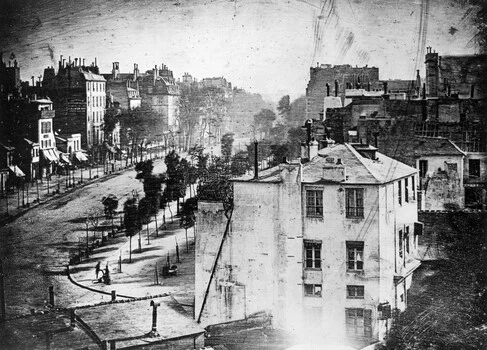
In the annals of photographic history, few images hold as much mystique and profound significance as Louis Daguerre’s Boulevard du Temple, captured in Paris in 1838. This daguerreotype, initially striking for its seemingly deserted streetscape—wide sidewalks, a stately row of trees, and grand, tall buildings bereft of the usual hustle—conceals a secret that elevates it from a mere technical marvel to a foundational document of human experience. Tucked away in the lower left corner, a solitary figure stands with one foot propped on a shoeshine box, attended by a second, crouching individual. This unassuming pair, engaged in a mundane morning ritual, inadvertently etched themselves into history, becoming the earliest identifiable human beings ever recorded in a surviving photograph. Their presence was not planned, nor was their unwitting role in defining the nascent medium; rather, it was a serendipitous consequence of a slow, revolutionary process.
The Unseen Crowd: Physics of a Pioneering Image
The paradox of Boulevard du Temple lies in its apparent emptiness. Paris in 1838 was a bustling metropolis, and the Boulevard du Temple, known as "Boulevard du Crime" for its numerous popular theaters and vibrant street life, would have been teeming with carriages, vendors, pedestrians, and animals even at an early hour. Yet, Daguerre’s plate presents an almost ethereal stillness, a ghost city where life has evaporated. To comprehend this visual anomaly, one must delve into the fundamental physics of early photography.
Daguerre’s invention, the daguerreotype process, was revolutionary but inherently slow. Unlike modern cameras that capture an instant in a fraction of a second, the light-sensitive plates of 1838 required prolonged exposure times to register an image. While Daguerre had dramatically reduced the hours-long exposures of his predecessor, Joseph Nicéphore Niépce, he was still operating in minutes. Estimates for this particular plate vary, ranging from as little as four or five minutes to as much as ten or fifteen, with a common consensus settling between seven and thirteen minutes. During this extended period, anything that moved continuously across the frame—a horse-drawn carriage, a strolling pedestrian, a dog darting across the street—spent too little time in any single spot for its light to accumulate sufficiently on the silver-coated copper plate. Their fleeting forms smeared into invisibility, leaving no discernible trace against the minutes of static pavement and architecture.
This phenomenon is why the boulevard appears deserted. It wasn’t empty; it was simply too alive, too dynamic, for the slow eye of Daguerre’s camera. The man getting his boots shined, however, unwittingly defied this photographic erasure. The act of having one’s boots cleaned requires several minutes of standing still. This prolonged stillness allowed the light reflecting off his form, and that of his bootblack, to build up on the plate, creating a discernible, albeit faint, image. They were two among thousands, yet their brief pause in the relentless flow of urban life secured their unique place in history. Close examination of the daguerreotype by historians suggests the faint, spectral outlines of other moving elements—perhaps a carriage, a distant horse, or even a child at a window—but these are largely interpretive, whereas the shoeshine pair remains undeniably present.
A Glimpse into 1838 Paris: Setting the Scene
The Boulevard du Temple was more than just a street; it was a microcosm of Parisian society in the early 19th century. Positioned in the northeastern part of the city, it was a fashionable artery, a grand promenade lined with elegant buildings housing cafes, shops, and, most famously, a concentration of popular theaters that gave it its "Boulevard du Crime" moniker. These theaters catered to all classes, offering melodramas, vaudeville, and pantomimes, making the area a constant hub of activity from morning till late night.
Louis Daguerre made this pivotal image from a window of his studio, which was strategically located near his famous Diorama theater. The Diorama, a popular spectacle of illusion and light, had already made Daguerre a household name in Paris. From his elevated vantage point, he looked down and across the boulevard, capturing an angled view where the near sidewalk sweeps across the bottom of the frame. The precise time of the exposure is believed to be a spring morning, likely between late April and early May 1838, around eight o’clock. Some accounts cautiously suggest 1837, but either date places it firmly before photography’s public unveiling. Daguerre’s methodical approach is evident in the fact that he took other exposures of the same view at different times of day—a midday plate also survives, though an evening one is lost—suggesting a scientific curiosity about the effects of light and time on his process, rather than a purely accidental capture.
The Daguerreotype Process: A Revolutionary Medium
The physical object itself, the daguerreotype, is a marvel of early technology. Roughly 13 by 16 centimeters, it consists of a sheet of copper coated with a thin, highly polished layer of silver. This mirror-bright surface is central to the process’s magic. To create the image, the silver surface was first fumed with iodine vapor, forming a light-sensitive silver iodide layer. After exposure in the camera, the latent image was "developed" by fuming the plate over heated mercury vapor, which amalgamated with the silver iodide particles that had been exposed to light. Finally, the image was "fixed" using a solution of sodium thiosulfate (hypo) to remove any unexposed silver iodide, making the image permanent.
A daguerreotype is not a print in the modern sense; it is a unique, one-of-a-kind object. Its appearance shifts dramatically depending on the angle of light and the viewer’s perspective, transitioning between a positive and a negative image, giving it a ghostly, almost ethereal quality often described as "engraved." The process yielded an astonishing level of fine detail and sharpness that later photographic techniques would struggle for decades to match.
One crucial detail that often confounds viewers and historians is the lateral reversal of the image. Like any daguerreotype made without a reversing mirror or prism in front of the lens, Boulevard du Temple is a mirror image of reality. What appears on the left of the plate was on the right in life, and vice versa. This is because the image was recorded directly onto the plate without an intermediate negative stage to flip it back. This seemingly minor technicality has had significant implications, leading some early researchers astray in their attempts to precisely map the shoeshine location onto contemporary Paris. It serves as a powerful reminder that these pioneering photographs were not neutral windows into the past but physical artifacts with their own unique optical rules, obeying the inherent properties of the mirror-like surface upon which they were etched.
Louis Daguerre: Showman, Innovator, Visionary
Louis-Jacques-Mandé Daguerre, born in 1787, was not a scientist by training but a true artist and showman, a master of illusion and light. His early career was defined by his success with the Diorama, a theatrical spectacle he co-created in Paris. The Diorama featured immense, intricately painted canvases that, through clever manipulation of light and mechanical effects, created breathtakingly realistic scenes that seemed to shift and change, transporting audiences to distant landscapes or dramatic events. This background instilled in Daguerre an obsession with realism, optical effects, and the capture of fleeting moments, laying the groundwork for his photographic pursuits.
Daguerre’s path to photography was intertwined with Joseph Nicéphore Niépce, a less celebrated but equally crucial figure. Niépce, an inventor from Burgundy, had been experimenting with capturing images from a camera obscura for years. His surviving View from the Window at Le Gras, made in the 1820s, is generally recognized as the earliest surviving photograph of a real scene. This heliograph, depicting rooftops and a courtyard, required an exposure time so extraordinary—traditionally estimated at eight hours, with some modern scholars suggesting it could have stretched over several days—that it rendered the capture of any moving subject impossible. There are no people in Niépce’s image, and at that timescale, even a patiently standing individual would likely have registered only as an indistinct smudge.
Daguerre partnered with Niépce in 1829, combining their efforts to refine the process. Following Niépce’s death in 1833, Daguerre continued his relentless experimentation with chemistry and optics. His crucial leap was in dramatically reducing the exposure time, transforming photography from an academic curiosity that took days to a practical process that could be accomplished in minutes. This reduction was the key that unlocked the potential for capturing not just static landscapes but the ephemeral presence of human life. Boulevard du Temple stands as the monumental proof of this achievement, demonstrating that, whether by design or by chance, a human being could now be captured, even if only through the accident of standing still for a shoeshine.
The Dawn of Photography: Public Unveiling and Global Impact
For several years, Daguerre kept the specifics of his groundbreaking process under wraps, seeking a profitable avenue for his invention. The turning point arrived through the intervention of François Arago, a prominent astronomer, physicist, and politician. Arago, recognizing the immense scientific and cultural importance of the daguerreotype, became its fervent champion. On January 7, 1839, Arago made the initial public announcement to the Académie des Sciences in Paris, declaring the existence of photography without yet revealing its intricate methodology. This created an immediate international sensation, igniting intense curiosity and speculation.
The full, step-by-step "recipe" for the daguerreotype process was finally disclosed on August 19, 1839. Arago presented the details before a packed joint session of the Académie des Sciences and the Académie des Beaux-Arts, with an overflow crowd spilling into the courtyard. The atmosphere was one of profound excitement and anticipation. However, a select few had already witnessed the astounding results firsthand. Notably, Samuel Morse, the American inventor of the telegraph, visited Daguerre’s studio in March 1839 and was utterly astonished by what he saw, including likely the Boulevard du Temple. Morse’s enthusiastic letters detailing his experience were published in the American press within weeks, further fueling global excitement.
Instead of issuing a French patent, the French state made a remarkable decision. It acquired the rights to the daguerreotype process from Daguerre and Niépce’s son, Isidore, granting them lifetime pensions in return for full public disclosure. This act was celebrated at the time as a "gift to the world," making the invention freely available for all to use and develop. However, this generosity had a geographical limit: five days before the Paris announcement, on August 14, Daguerre’s agent had shrewdly patented the daguerreotype in England. Consequently, British photographers had to purchase licenses, while the rest of Europe and the United States rapidly embraced the technology. Within months, ateliers dedicated to the new art sprung up globally, with photographers coating their own silver plates and pointing their cameras at anything that would hold still, ushering in the photographic age. Boulevard du Temple, created on the cusp of this public revelation, became both a testament to the new medium’s capabilities and an early demonstration of its inherent limitations.
The Plate’s Perilous Journey: A Fragile Legacy
The original Boulevard du Temple daguerreotype, a cornerstone of photographic history, has endured a remarkably difficult existence. In October 1839, Daguerre presented it to King Ludwig I of Bavaria as part of a framed triptych showcasing his work. It eventually found its way into the collection of the Bavarian National Museum in Munich. Tragically, the plate’s journey through history was not gentle. Accounts describe severe damage incurred during the Second World War, likely due to poor storage conditions amidst the chaos and destruction.
Further misfortune struck decades later. In 1970, when the plates were loaned to the Munich City Museum, an attempted restoration effort went so catastrophically wrong that many scholars now consider the original image to be effectively destroyed. The delicate chemical layers that formed the image were irreparably damaged, rendering the once-sharp details almost indistinguishable. Consequently, the version of Boulevard du Temple that most of us recognize today—the crisp, detailed image widely reproduced in books and online—is not the original plate as it currently exists. Instead, it is a photographic reproduction, primarily those meticulously made by the renowned photographic historian Beaumont Newhall in 1936 or 1937, before the worst of the damage occurred.
This historical twist imbues the image with a poignant layer of fragility. The "earliest known surviving photograph to show people" is, in a sense, doubly a ghost. The people within it survived a long exposure that erased everyone else, and the picture itself survives primarily through copies of a ruined original. When a viewer gazes upon that solitary man on the corner today, they are not looking directly at Daguerre’s original silver plate but at a stand-in, a photographic echo of a delicate smudge of silver that nearly vanished entirely. This inherent fragility, this sense of a precarious survival against the odds, undeniably contributes to the immense weight and enduring fascination that the Boulevard du Temple daguerreotype continues to hold.
Contemporary Echoes: Long Exposure Photography Today
The same fundamental physics that serendipitously preserved the shoeshine customer on the Boulevard du Temple is a principle photographers actively harness with modern cameras. Pointing a camera at a busy plaza or a bustling street and setting a sufficiently long exposure will still cause the moving crowds, vehicles, and transient elements to melt into a soft blur or disappear entirely, while the static architecture remains razor-sharp. This technique is a staple in contemporary photography, employed for a variety of artistic and practical purposes.
Photographers frequently use long exposures to "clear" famous landmarks of distracting tourists, creating serene, timeless vistas of popular sites that are rarely seen empty. It’s also used to transform dynamic elements into abstract beauty—a river of car headlights becomes mesmerizing streaks of light, turbulent water turns into a silky, ethereal mist, and clouds blur into painterly strokes across the sky.
The key difference between Daguerre’s era and today is control. Daguerre was constrained by the slow chemistry of his process, forced into minute-long exposures. Modern photographers, however, achieve these effects deliberately. In bright daylight, they use powerful neutral density (ND) filters—dark glass placed in front of the lens—to drastically reduce the amount of light entering the camera, thereby stretching what would normally be a fast exposure into seconds or even minutes. A sturdy tripod is essential to keep the camera perfectly still, ensuring that the static parts of the scene remain crisp and defined while the moving elements vanish. This transformation of a technical constraint into a creative tool highlights the evolution of photography. Daguerre could not avoid erasing the crowd; contemporary photographers choose to. This deliberate manipulation of time and light, whether to create an empty street or a glassy seascape, traces its lineage back to that accidental moment on a Parisian boulevard, where one man paused for a shoeshine and, without knowing it, became an immortalized pioneer.
Enduring Significance: The First Human and the Fabric of Time
The Boulevard du Temple daguerreotype transcends its identity as a mere historical artifact; it is a profound testament to the power of photography to capture, distort, and preserve time. It stands at the confluence of science and art, a groundbreaking technical achievement that inadvertently yielded a deeply human story. The image not only marks the birth of practical photography but also introduces the very concept of capturing a human presence—a face, a form, a moment of life—for posterity.
The accidental nature of the "first human" makes the image even more compelling. It wasn’t a posed portrait, a grand historical tableau, or a deliberate attempt to document individuals. It was an ordinary, mundane act that, through the sheer mechanics of a nascent technology, became extraordinary. This accidental capture underscores photography’s democratic potential from its very inception: its ability to elevate the anonymous, the everyday, into the realm of the historically significant.
In its fragility, its lateral reversal, and its spectral figures, Boulevard du Temple serves as a powerful reminder of photography’s initial limitations and its boundless promise. It forces us to contemplate the passage of time, the fleeting nature of human existence, and the profound impact of technology on our perception of reality. The lone shoeshine customer, an unknown figure from a forgotten morning, remains a timeless symbol of humanity’s first step into the photographic age, a silent witness to a revolution that would forever change how we see ourselves, our world, and our place in history.
