
 By Nila Kartika Wati
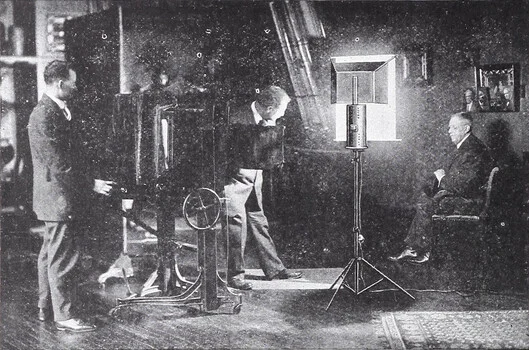
On April 3, 2013, a significant chapter in American retail history closed abruptly as CPI Corp., the operator behind Sears Portrait Studios and PictureMe studios within Walmart, switched off the lights in over 2,000 portrait studios across the United States and Canada. This mass closure, affecting thousands of employees and leaving countless customers with unfulfilled orders, marked a poignant end to a service that had, for nearly a century, been where ordinary American families went to have their faces "made." The mottled blue backdrops, the nascent laser-beam backgrounds, and the ubiquitous sheets of wallet-sized prints became relics almost overnight, signifying a fundamental shift in how families captured and preserved their memories.
A Century of Captured Faces: The Origins of Accessible Portraiture
The notion that every family, regardless of socioeconomic status, should possess a formal portrait is a relatively modern concept. For the vast majority of human history, a painted likeness was an exclusive luxury, accessible only to the wealthy elite who could commission artists. The advent of photography in the mid-19th century dramatically democratized this art form. The daguerreotype, introduced in 1839, swiftly led to the establishment of storefront studios. Within a mere decade, these establishments were offering likenesses to a burgeoning middle class of shopkeepers, clerks, and even farmers—individuals who could never have afforded the time or expense of sitting for an oil portrait. This innovation laid the groundwork for photography to become an integral part of everyday life.
The true democratization of the portrait, however, came later and was often mobile. Itinerant photographers, equipped with portable gear, traveled from town to town, setting up temporary studios wherever foot traffic was abundant. Early department stores, with their captive audiences, became prime locations for these pop-up operations. At popular tourist destinations like Niagara Falls and Atlantic City, a particularly ingenious method emerged: multiplying cameras. These specialized cameras utilized banks of small lenses to expose a grid of tiny images onto a single photographic plate. These individual images were then cut apart and sold for a mere penny each, giving rise to the enduring term "penny picture." What once commanded a month’s wages for a painted likeness now cost a coin that could be found in the street, fundamentally altering the accessibility of personal iconography.
This foundational principle—making the portrait session affordable and placing it where people already congregated—became the steadfast blueprint for generations of mass-market portrait studios. From these early, mobile setups to the later, more sophisticated chain operations, the core strategy remained consistent: sell the sitting at a loss or near cost, embed the camera within the currents of ordinary life, and generate profit primarily from the sale of prints and packages. Every subsequent iteration, from the expansive Olan Mills empire to the experiential Glamour Shots, was a refinement of this singular, successful bet.
Building Empires: Olan Mills and the Rise of Mass-Market Photography
The first enterprise to scale this "penny picture" model into a national empire was Olan Mills. Founded in the early 1930s by husband-and-wife team Olan Mills Sr. and Mary Stephenson Mills in Alabama, their journey began modestly. Initially operating from a simple board-and-batten shed in Selma, they focused on copying and hand-tinting old photographs. By 1933, they formally established their portrait studio in Tuscaloosa, acquiring a bankrupt studio and integrating portraiture into their existing copy work. Mary Mills, leveraging her artistic training, developed a distinctive soft, hand-finished house style that quickly gave the nascent company a recognizable aesthetic, setting a standard for quality within the affordable market.
However, the true catalyst for Olan Mills’ meteoric growth was not just the quality of their images, but a revolutionary sales strategy: the telephone. In 1948, after a salesman’s experimental use of telemarketing reportedly quadrupled his weekly sales, the company strategically built its entire booking operation around this concept. A few years later, they introduced a "club plan," allowing customers to pay a small upfront fee for a series of sittings spread throughout the year. The Millses shrewdly identified that the most challenging aspect of their business was not the technical act of taking a photograph, but rather securing a family’s immediate decision to visit the studio. By employing telemarketing and subscription models, they effectively streamlined this decision-making process for the customer, ensuring a steady flow of business.
The scale achieved by Olan Mills was staggering. By approximately 1940, the company boasted around 650 employees working across three shifts, processing an astonishing 12,000 portraits daily. In 1941, its main processing operation relocated to Chattanooga, Tennessee, to accommodate this immense volume. At its zenith, Olan Mills operated an estimated 1,000 free-standing studios and generated roughly $475 million annually, commanding close to a tenth of the entire American portrait market. Beyond individual and family portraits, a separate church-directory division flourished, photographing entire congregations for the member books found in narthex racks across the country. For multiple generations, Olan Mills was a household name, synonymous with family portraiture.
While the distinctive Olan Mills style—characterized by the mottled backdrop, the carefully posed chin-down stance, and the older sibling’s protective hand on a younger one’s shoulder—eventually became a cultural punchline, its ubiquity and influence were undeniable. This visual grammar was not merely popular; it was standardized and mass-produced by companies like Olan Mills, instilled into thousands of camera operators who meticulously followed prescribed scripts. These conventions themselves were rooted in the painted backdrops and posed family groups of 19th-century studios; the chains did not invent them but rather amplified and replicated them by the millions, creating a shared visual lexicon for American families.
The Retail Giant’s Ally: CPI Corp. and Sears Portrait Studios
For many Americans, the most enduring memory of a portrait studio wasn’t a free-standing Olan Mills but rather the studio tucked away at the back of a Sears department store. This operation was the domain of CPI Corp., a company whose origins were as humble as Olan Mills’. In 1942, St. Louis photographer Milford Bohm opened his lone "Rembrandt Studio" with a single camera. Over the subsequent two decades, Bohm and his family diligently expanded it into a chain of approximately 20 studios spanning from Kansas to Pennsylvania. In 1968, the thriving business was acquired by Chromalloy American and subsequently rebranded as CPI.
The relationship that truly defined CPI’s trajectory was its protracted and strategic alliance with Sears, Roebuck and Company. According to CPI’s own SEC filings, the company had been photographing Sears customers since 1959 and had held a Sears license since 1961, initially one of more than fifteen such licensees. By 1973, CPI narrowed its focus, shedding other retail accounts to become a Sears-exclusive partner. It wasn’t until 1986, however, that CPI secured its position as Sears’ sole portrait studio operator, solidifying a partnership that would last for four decades. This arrangement provided CPI with an unparalleled piece of real estate. In the 1970s, Sears was the largest retailer in the United States, and a vast majority of the population resided within a short driving distance of one of its stores. CPI ingeniously capitalized on this existing infrastructure; it did not need to construct a single new store or generate its own foot traffic. Instead, it simply set up a camera, a posing stool, and a collection of backdrops in a corner of a bustling department store, where a steady stream of shoppers already flowed past. At its peak, this Sears-only venture saw CPI operate over 1,000 studios, with the vast majority nestled within Sears stores across the U.S. and Canada.
The choreography of a Sears portrait session is etched into the collective memory of generations. It often began with a coupon, delivered in the Sunday paper or through direct mail—an offer for a sitting at a nominal fee, a free 8×10 print, or a package that seemed almost too good to be true. Families would meticulously coordinate outfits, endure a wait past their appointment time, and then perch on a carpeted riser while a camera operator, often employing a squeaky toy or exaggerated gestures, coaxed smiles and attention. The critical juncture, and the revenue driver, was the sales table: a stack of proofs and a menu of package options transformed that initial, inexpensive sitting into a substantial bill. The iconic mottled gray-blue muslin, the artificial autumn leaves, and the infamous laser-grid background, projecting colored lines into the studio’s darkness, were the tangible props of a genuinely national ritual.
CPI also expanded its reach beyond its primary Sears footprint. It operated the PictureMe Portrait Studios within Walmart locations, further diversifying its access to mass-market consumers. In 2010, the company acquired the assets of Kiddie Kandids, a Utah-based children’s portrait chain that had declared bankruptcy, inheriting approximately 200 locations situated within Babies R Us stores and various malls. By the latter stages of its existence, CPI was operating approximately 2,700 studios across the United States, Canada, Mexico, and Puerto Rico, projecting an image of an indomitable fixture in American retail.
The Glamour Era: Niche Studios in the Mall Landscape
While department store studios like Sears focused on capturing family milestones, the enclosed shopping mall environment gave rise to a distinct, more flamboyant cousin: the portrait as a recreational experience. The quintessential brand of this era was Glamour Shots. Jack Counts Jr., an entrepreneur from Oklahoma City who already ran a photo-finishing business, was inspired after encountering a makeover-and-photo shop during his travels. In 1988, he launched his own version. His initial venture, branded "Fantasy Faces," failed to gain traction. The concept truly ignited when he opened a location in Dallas under the name Glamour Shots.
The appeal of Glamour Shots was potent, particularly for the late 1980s and early 1990s aesthetic. For an average fee of around $30, a woman would receive professional hair and makeup, access to a wardrobe of feather boas, sequined wraps, and off-the-shoulder tops, culminating in a soft-focus photo session designed to transform an ordinary Tuesday at the mall into a fashion shoot. The clientele was overwhelmingly female, drawn by the promise of a fantasy self. The resulting look was unmistakable: heavily teased hair, bold blush, a pervasive haze of diffusion, and a slightly parted-lips gaze over a bare shoulder. Crucially, the photograph was not intended to be a realistic depiction of the individual; its entire purpose was to sell a stylized, idealized version—a fantasy.
The Glamour Shots model scaled rapidly. Within its first three years, revenue surged from under $250,000 to nearly $7 million. By the mid-1990s, the chain reached its peak, operating approximately 380 stores, including international locations in Mexico, Canada, Asia, and the Middle East. It employed roughly 6,000 individuals and generated around $100 million in annual sales. The enclosed mall proved to be the ideal host: it offered high foot traffic, a captive weekend audience, and customers already in a spending mindset. Other free-standing chains, such as Picture People, carved out similar niches, offering quick family and children’s portraits from storefronts and kiosks strategically positioned between food courts and shoe stores.
These mall studios were not "serious photography businesses" in the traditional sense recognized by wedding or commercial photographers. Lighting setups were typically fixed, poses were standardized from binders, and camera operators were often retail employees who received a week of training rather than seasoned photographers building intricate portfolios. The genius of these operations lay not in artistic craft but in their strategic location, accessible pricing, and the inherent understanding that a physical print in hand held tangible value for the customer.
The Unseen Value: What These Studios Truly Offered
It is easy, and indeed common, for photography purists to sneer at the laser background or the airbrushed cheeks of these mass-produced portraits. Such condescension, however, often overlooks the profound and practical value these studios delivered, a value worth appreciating before dismissing the entire industry.
These studios primarily sold consistency and a finished object. For a working parent, the desire was not to master lighting ratios or aperture settings; it was to obtain a decent, presentable picture of their children, at a predictable price, by a predictable date, with physical prints they could easily mail to grandparents or display at home. The mall and department store studios delivered precisely this, repeatedly, with the reliability of a fast-food menu. The soft, even, often unmemorable light that critics mocked was, in fact, incredibly difficult to execute poorly, which was precisely why a chain could entrust it to a teenager with minimal training and still consistently produce an acceptable 8×10 print. While crafting a truly exceptional headshot is an art form demanding considerable study and skill, the mall studio’s objective was never to produce a masterpiece. Its goal was to create a "good-enough" one, thousands of times a day, without fail.
Furthermore, these studios sold a ritual, and rituals possess a powerful, enduring quality. "Going to get the picture taken" was an event in itself. It involved planning outfits, corralling family members, maintaining composure, and then, a few weeks later, receiving a tangible object that would find its place on a wall or in a frame on the mantelpiece. This physical artifact transcended the day it was created, becoming a lasting record. Indeed, countless individuals today possess photographs of grandparents or even great-grandparents whose only surviving formal portrait originated from a department-store backdrop. These studios were not merely selling photography; they were offering a small, affordable piece of permanence, a tangible link to the past that, for generations of families of modest means, was otherwise unattainable.
The Digital Tsunami: How Smartphones Rewrote the Rules
The ultimate undoing of the mall and department store portrait studio was not a rival chain or a superior competitor. It was the ubiquitous device in nearly every pocket: the smartphone, and the subsequent collapse of the scarcity model upon which the entire industry was built.
The business model of mass-market portraiture fundamentally depended on a scarcity of photographic resources that no longer exists. A generation ago, capturing a high-quality photograph of one’s child was a complex endeavor. It required purchasing film, owning a decent camera, possessing some level of photographic skill, and then relying on a specialized lab to develop and print the images. The portrait studio bundled all these components—the equipment, the expertise, the processing, and the prints—and offered them at an affordable, convenient price. Early digital cameras, emerging in the early 2000s, began to chip away at this premise by making capture easier, but the truly seismic shift occurred with the advent of the smartphone.
The first iPhone, launched in 2007, featured a modest 2-megapixel camera. While rudimentary by today’s standards, it signaled a fundamental change. By 2010, the iPhone 4 delivered a genuinely usable 5-megapixel camera into the hands of millions. From that point onward, the dedicated point-and-shoot camera market entered a freefall from which it never recovered. Suddenly, virtually every parent carried a competent camera at all times, seamlessly integrated with a free "photo lab" that fit in a jacket pocket and could transmit a picture to grandma in mere seconds via email or social media. Capture and distribution, two-thirds of the value proposition offered by the traditional studio, had become free and instantaneous. A physical print was no longer the sole, or even primary, method of sharing an image with others. The digital revolution, spearheaded by smartphones, had rendered the studio’s core offering obsolete.
A Cascade of Closures: The Industry’s Final Act
The chains, once seemingly invincible, began to fall one after another. CPI Corp., already burdened by debt and witnessing a precipitous decline in sales, defaulted on its lenders. In an abrupt move in early April 2013, the company ceased its United States operations. Financial disclosures painted a grim picture: across the first nine months of that fiscal year, CPI’s net losses had ballooned fivefold to exceed $60 million, even as its revenue plummeted by nearly a quarter, landing at $192.7 million. In a letter to its employees, CEO Jim Abel acknowledged that "the decline of our business proved too great an obstacle to overcome." More than 2,000 studios went dark almost overnight, thousands of workers lost their jobs without prior notice, and countless customers who had already paid for sessions or print packages were left staring at a website message indicating the company was "attempting to fulfill as many customer orders as possible." Weeks later, CPI formally filed for bankruptcy protection.
Other players in the industry followed similar scripts. Picture People, a prominent mall-based studio chain, filed for Chapter 11 bankruptcy in September 2016. Its assets were subsequently sold in November of that year to a new operating company. This new entity attempted to revitalize the brand, even moving into some of the vacant Sears studio spaces left behind by CPI. However, it too eventually succumbed, shutting its United States operations without warning on May 18, 2018, once again leaving employees jobless and customers stranded mid-order. While the Picture People name has since re-emerged under different ownership, its earlier collapse underscored the ongoing fragility of the model. Glamour Shots, which once boasted 380 stores globally, dwindled to a literal handful of mall locations by the end of the decade, a shadow of its former self.
Even the venerable Olan Mills, sensing the irreversible market shifts, had proactively sought an exit. On November 9, 2011, it sold its entire portrait and church-directory business to Lifetouch, the dominant force in school photography. Lifetouch itself, a multi-generational photography giant, was later absorbed in a larger industry consolidation. In April 2018, Shutterfly, the online personalized photo product and services company, acquired Lifetouch for a staggering $825 million, marking a definitive shift in the landscape of mass-market photography from physical studios to digital platforms.
Legacy and Lingering Presence: What Remains and What Was Lost
While the mass-market portrait studio category is far from extinct, its imperial dominance is certainly gone. Lifetouch, now operating under the Shutterfly umbrella, continues to manage JCPenney Portraits studios in a few hundred department stores. Lifetouch photographers also remain a ubiquitous presence, diligently shooting school pictures, a segment that has historically been the more stable and resilient half of the business due to its institutional nature. Even the church-directory line, once the quiet backbone of the old Olan Mills, faced insurmountable challenges and largely did not survive the COVID-19 pandemic. But the sprawling, free-standing empires, the thousands of little studios that once dotted the back of nearly every Sears and Walmart in the country, have vanished, and their return in that form is highly unlikely.
Herein lies a quiet irony of the digital age. As a society, we now capture vastly more pictures of our families than any preceding generation. Yet, paradoxically, we print almost none of them. The traditional studios sold a physical artifact—a tangible print, often framed or placed in an album. This artifact has largely been replaced by a continuous stream of digital images that reside on a smartphone until the device is lost or upgraded, or within a cloud account that may become inaccessible if a payment method expires. The mottled-backdrop 8×10 print, tucked away in a shoebox, possesses an unglamorous but potent superpower: it will likely still be there in 40 years, a testament to a moment in time. Your current smartphone’s camera roll, by contrast, may not offer the same enduring guarantee.
For those who still desire the finished product the studio once delivered, a superior version can now be created at home with relative ease and affordability. A used mirrorless camera body and a versatile lens, or a modern kit like the Sony a7 IV, paired with a single flash such as the Godox V1, and a roll of Savage seamless paper taped to a wall, will produce images that far out-resolve anything that ever came off a Sears backdrop. What cannot be easily bought back, however, is the ritual: the anticipation of the appointment, the family drive to the mall, and the comforting certainty that, a few weeks later, a real, physical print would arrive in the mail or be ready for pickup. The mall studio did not ultimately fail because its pictures were inherently "bad." It failed because it was selling permanence and convenience through a physical medium, and consumers, driven by technological advancement, decided they preferred the instant gratification of capturing everything, even if it meant possessing almost none of it in a lasting, tangible form. The shift represents not just a change in photography, but a fundamental re-evaluation of how we value and preserve our personal histories.
