
 By Nila Kartika Wati
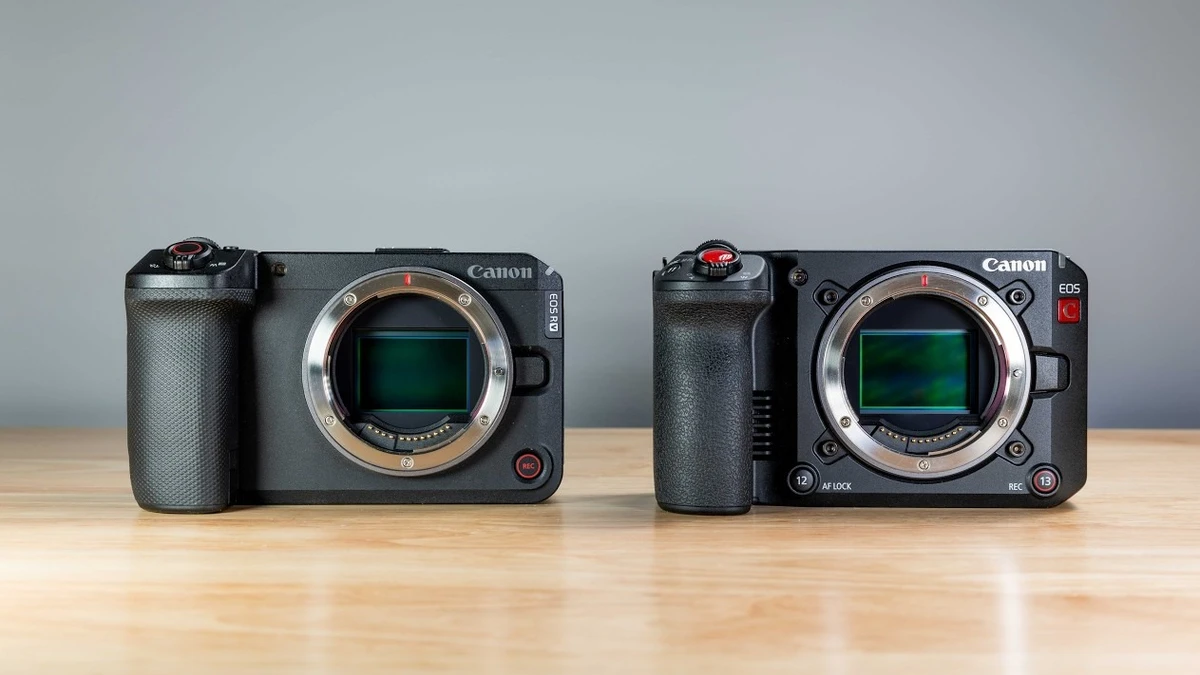
Canon has strategically introduced two new compact full-frame video cameras, the EOS C50 and the EOS R6 V, both built around an identical 32.5-megapixel 7K sensor. With a price difference ranging from $1,200 to $1,400, contingent on promotional pricing for the C50, the decision for professional cinematographers and advanced videographers extends beyond mere image quality, resting instead on crucial operational distinctions such as thermal management, integrated audio solutions, stabilization capabilities, and overall suitability for demanding production environments. This dual-camera approach highlights a deliberate market segmentation by Canon, offering specialized tools that share a common imaging core but cater to distinct workflow priorities.
Both the C50 and R6 V are engineered to deliver high-performance video, featuring 3:2 open gate recording, internal raw capture, and oversampled 4K resolution at up to 60 frames per second (fps). Additionally, both models are capable of capturing 4K at a high frame rate of 120 fps, providing versatile options for slow-motion cinematography. Independent testing conducted by industry professional Josh Sattin demonstrates that the Canon Log 2 footage produced by these cameras is remarkably consistent. Using the same lens and identical settings, a color grade developed for one camera can be applied to the other with minimal adjustments, primarily limited to minor white balance corrections. Sattin noted that the daylight preset on the R6 V typically registers around 5,200 Kelvin, while the C50’s preset is closer to 5,600 Kelvin. While easily rectifiable in post-production, such discrepancies underscore the importance of precise calibration when operating these cameras as A and B units in a multi-camera setup, as mismatched presets could lead to initial synchronization challenges that might overshadow the sensor’s inherent consistency.
Unpacking the Image: Subtle Nuances and Practicalities
Despite their shared sensor, a closer examination reveals subtle differences in image processing and capabilities. Dynamic range, a critical factor in challenging lighting conditions, emerges as one such area where a slight divergence is observable. In controlled window tests, where exposure was optimized for highlights and shadows were subsequently pushed aggressively in post-production, the C50 consistently demonstrated a marginal advantage in retaining shadow detail. This minor edge was present in both raw and compressed codecs, becoming apparent only when deliberately extracting information from severely underexposed areas and viewed at magnifications of 200% or higher. For most real-world scenarios, particularly where lighting is controlled or adequately managed, this difference might not be significant enough to impact final output. However, for productions demanding the absolute maximum latitude in post-correction, the C50 offers a marginally more robust foundation.
High ISO performance, often a point of contention and a key specification for low-light shooting, presents a fascinating case where practical testing challenges official specifications. Canon officially rates the C50 with dual base ISOs of 800 and 6,400 when shooting in Canon Log 2 and raw formats. Conversely, Canon’s mirrorless bodies, including the R6 V, do not typically list a second base ISO in their official specifications. However, Sattin’s "lens cap test"—a method involving shooting a completely dark frame at various ISOs and then brightening it in post to reveal noise patterns—showed that the R6 V exhibits a significant reduction in noise when transitioning from ISO 5,000 to ISO 6,400, mirroring the behavior of the C50. This suggests that the R6 V, despite unstated specifications, benefits from a similar dual-gain architecture, offering a "cleaner" ISO setting at 6,400 than at 5,000. This finding is invaluable for filmmakers working in dim environments, allowing them to optimize noise performance by selecting the empirically cleaner ISO point. The "lens cap test" itself is a practical methodology that can be applied to any camera, empowering users to discover hidden performance characteristics beyond manufacturer-published data.
Ergonomics and Workflow: The Hardware That Matters
The most pronounced distinctions between the C50 and R6 V materialize in their physical design, ergonomics, and the integrated features that directly impact on-set workflow. Audio capabilities, in particular, represent a clear dividing line. The C50, designed with professional cinema workflows in mind, ships with a robust top handle that integrates two XLR inputs, offering professional-grade audio connectivity. This handle also includes simple level controls, a dedicated record button, a lock mechanism, a zoom rocker, a cold shoe mount, a switchable tally light, and multiple additional mounting points. Crucially, it locks firmly to the camera body without requiring an external cage, streamlining rigging and enhancing reliability.
In contrast, the R6 V, as a more compact and hybrid-oriented body, necessitates external accessories for professional audio capture. Users would typically add an adapter like the Tascam CA-XLR2d-C, which connects via the camera’s hot shoe and delivers excellent audio quality. However, Sattin noted that the single shoe mount of such adapters can feel less sturdy compared to the C50’s integrated, purpose-built handle, potentially introducing a point of failure or instability in dynamic shooting scenarios. This difference underscores the C50’s design philosophy: an all-in-one solution for serious video production, minimizing external add-ons, versus the R6 V’s modular approach, allowing users to customize their rig as needed, albeit often at the cost of integrated convenience and robustness.
Thermal Management: The Unseen Divide
Perhaps the most critical operational difference, especially for extended shoots and demanding codecs, lies in thermal management. Modern digital cinema cameras generate significant heat, particularly when recording high-resolution, high-bitrate video such as raw or oversampled 4K at elevated frame rates. Effective cooling is paramount to prevent overheating, which can lead to automatic shutdowns, compromised footage, and potential long-term damage to internal components. Canon is transparent about recording limits in its specifications, and Sattin’s extensive field testing over many years consistently validates these figures.
The R6 V, while a highly capable video camera, is subject to these inherent thermal limitations. Rated at 73 degrees Fahrenheit (approximately 23 degrees Celsius), the R6 V can record raw at 60 fps and oversampled 4K at 60 fps for durations of 120 minutes or longer. For modes like oversampled 4K at 30 fps, 4K at 120 fps, and non-oversampled modes, Canon states no explicit recording limit under ideal conditions. However, these limits are significantly affected by ambient temperature and humidity. Sattin, who operates in the hot and humid climate of North Carolina for much of the year, anticipates that any mode with a listed limit will see its maximum recording time shrink considerably in summer conditions. While he expects oversampled 4K at 24 and 30 fps to generally remain stable, the risk of thermal shutdown concentrates on higher frame rates and raw recording, especially outdoors.
The C50, by virtue of its thicker body and more substantial internal volume, houses a "more serious cooling system." This dedicated thermal architecture is a hallmark of Canon’s EOS Cinema line. Sattin’s experience with Canon’s cinema cameras confirms their exceptional thermal resilience; none have shut down on him, even under the most punishing environmental conditions. This distinction is vital for productions where uninterrupted recording is non-negotiable, such as live events, documentaries, or any scenario where a reshoot is impossible or prohibitively expensive. The C50 prioritizes reliability and sustained performance above all else, a clear advantage for professional film sets.
Strategic Positioning and Market Implications
Canon’s release of the C50 and R6 V without integrated viewfinders, following a trend seen in models like the EOS R50 V, signifies a strategic shift towards bodies optimized for external monitoring and rigging. This design philosophy aligns with industry trends pioneered by competitors such as Sony with its FX3 and Nikon with its Z-series cameras (like the Z8/Z9, which, while having viewfinders, emphasize video features in compact bodies). These camera designs prioritize ergonomics for gimbals, drones, and complex camera rigs, where an integrated viewfinder can be cumbersome or unnecessary, as operators often rely on larger, more detailed external monitors. The absence of a mechanical shutter in these models further underscores their video-centric design, simplifying internal mechanisms and potentially aiding in cost reduction and thermal efficiency. The EOS R6 Mark III, mentioned in the context of a 32.5-megapixel sensor, is noted to retain the electronic viewfinder (EVF) and mechanical shutter, catering specifically to stills photographers who demand those features, indicating Canon’s continued commitment to diverse user needs.
This market segmentation, where core imaging technology is shared but external design and integrated features diverge, reflects a mature camera market. Once the sensor’s fundamental image quality ceases to be the primary differentiating factor, the choice between cameras becomes a decision about the "operating system"—encompassing user interface, menu logic, and control layout—the efficiency of the cooling design, and the breadth and integration of the accessory ecosystem. Canon’s robust lens lineup (EF and RF mounts), extensive support network, and established color science provide a significant advantage in this ecosystem battle.
The introduction of the C50 and R6 V caters to distinct professional needs. The C50 is clearly positioned for dedicated cinematographers, rental houses, and high-end production companies that prioritize reliability, professional audio integration, and uncompromised thermal performance in a body designed from the ground up for cinema workflows. Its slightly higher price reflects these specialized capabilities and the robustness required for demanding sets. The R6 V, while sharing the same powerful sensor, appears to target advanced content creators, documentary filmmakers, and hybrid shooters who require exceptional video capabilities in a more compact, potentially more agile form factor. Its design implies a user base comfortable with external accessories for audio and monitoring, valuing portability and a slightly lower entry cost.
This dual-camera strategy underscores Canon’s adaptability in a rapidly evolving market where the lines between traditional cinema cameras and advanced mirrorless hybrids are increasingly blurred. By offering two distinct, yet technologically linked, solutions, Canon aims to capture a broader segment of the professional video market, ensuring that whether the priority is ultimate reliability on a feature film set or versatile high-performance for independent content creation, there is a Canon full-frame option designed to meet the specific demands. The ultimate decision for professionals will therefore hinge not on which camera captures a better image, but on which camera best integrates into their specific production pipeline and withstands the rigors of their working environment.
