
 By Nila Kartika Wati
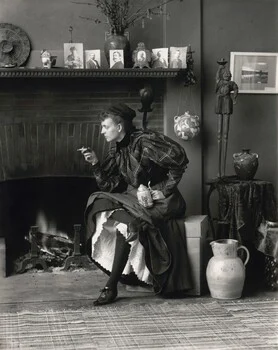
In 1896, a defiant act of self-portraiture unfolded in a Washington, D.C. studio, permanently etching Frances Benjamin Johnston into the annals of photographic history. Settling into a chair before her fireplace, she audaciously hiked her petticoats, crossed her legs in a manner then considered exclusively masculine, and aimed her own camera. One hand provocatively cradled a lit cigarette, the other a stein of beer. This single image, a bold declaration of the "New Woman," was a calculated challenge to Victorian sensibilities and a visual manifesto from a woman who would, over a nearly fifty-year career, talk her way into the White House, board a U.S. Navy warship in a foreign harbor, and ultimately become America’s first woman to earn a living pointing a camera at the news.
Johnston’s journey was not merely a personal triumph but a groundbreaking narrative that reshaped the possibilities for women in professional life. Born into a world where public roles for women were severely circumscribed, she forged a career that, by all accounts of the 1890s, should have been impossible. Her success was built on an potent combination of audacious nerve, invaluable family connections, and an evolving mastery of the camera. For almost five decades, she gained unparalleled access to subjects previously beyond the reach of her contemporaries, meticulously building an archive that she understood would be her enduring legacy. Today, this monumental collection—comprising more than 20,000 prints and approximately 3,700 glass and film negatives—resides in the Library of Congress, a testament to a life lived deliberately and a record preserved on purpose through copyright deposits, gifts, and significant purchases, including her papers and the extensive Carnegie Survey negatives acquired posthumously in 1953.
The Genesis of a Visionary: Early Life and a Revolutionary Gift
Frances Benjamin Johnston’s story began on January 15, 1864, in Grafton, West Virginia, amidst the tumult of the Civil War that had carved her home state from Virginia just a year prior. Her family enjoyed a comfortable lifestyle and possessed significant social and political connections, factors that would prove crucial to her later professional endeavors. Her mother, Frances Antoinette Benjamin Johnston, had herself worked as a newspaper correspondent in Washington, D.C., an early example of female journalistic ambition that likely influenced her daughter. The household moved with ease within the capital’s influential political circles, laying a foundation of access that few could rival.
Johnston pursued a formal education, graduating from the Notre Dame of Maryland Collegiate Institute in 1883. Demonstrating an early artistic inclination, she then traveled to Paris to study drawing and painting at the Académie Julian, a progressive institution notable for being one of the few serious art schools of the era to admit women. Upon her return to the United States, she continued her artistic training at the Art Students League in Washington. Her initial ambition was to become an illustrator, a common artistic pursuit for women at the time.
However, destiny intervened in the form of a revolutionary technological advancement and a family friend: George Eastman. Around 1888, Eastman, whose name would become synonymous with photography through the Kodak company, gifted Johnston one of his new roll-film cameras. This was a pivotal moment in photographic history, as Kodak was transforming photography from a cumbersome, chemistry-intensive process requiring a tripod into something portable and accessible to the masses. The original Kodak camera, introduced in 1888, held enough film for approximately 100 exposures. Its ingenious marketing pitch—"You press the button, we do the rest"—democratized photography. For Johnston, this small, handheld camera was not just a novelty; it was a door opening to an unforeseen future.
Her foray into photography quickly moved beyond amateur curiosity. Displaying her characteristic tenacity, Johnston talked her way into the darkroom of Thomas Smillie, the Smithsonian Institution’s first official photographer. Under his tutelage, she meticulously learned the intricate chemistry and craft of professional photography, acquiring the foundational knowledge essential for a serious practitioner. Within a few years, her skills propelled her into the world of illustrated journalism. She began writing and photographing for prominent magazines, producing illustrated stories on diverse subjects such as the U.S. Mint and the intricate machinery of the Washington bureaucracy. Johnston had not merely stumbled upon photography; she had identified and seized the nascent intersection between journalism and this powerful new visual medium, planting herself firmly at its forefront.
Establishing a Professional Footing: D.C. Studio and White House Access
By 1894, Frances Benjamin Johnston had established her own professional photographic studio in Washington, D.C., on a block of V Street between 13th and 14th. Contemporary accounts confirm that she was, remarkably, the sole woman operating such a business in the city. Her studio quickly evolved into a vibrant salon, a social hub as much as a commercial enterprise. Here, she captured the likenesses of the Washington elite: cabinet wives, influential society hostesses, and celebrated visiting writers. Her portraits were distinguished by a keen artistic eye, skillfully reflecting how her subjects wished to be perceived, a testament to her talent for both technical execution and psychological insight.
Her extensive network of connections proved to be an invaluable asset. Across five presidential administrations—Benjamin Harrison, Grover Cleveland, William McKinley, Theodore Roosevelt, and William Howard Taft—Johnston held an unprecedented standing pass to the White House. This level of access was unmatched by any other photographer of her era, effectively making her the closest thing to an official White House photographer decades before such a position formally existed. She meticulously documented the White House grounds, its grand interiors, official ceremonies, and the daily lives of the presidential families. Beyond the presidents themselves, she created iconic portraits of the era’s most prominent figures: Alice Roosevelt, the incomparable writer Mark Twain, the tireless suffragist Susan B. Anthony, and the influential educator Booker T. Washington. Indeed, if one encounters a photograph of a celebrated American from that turn-of-the-century Washington world, there is a significant probability that Johnston was its creator. Her mastery of the studio portrait, a discipline demanding patience, control, and an understanding of light and composition—skills still taught and refined today, akin to modern courses on perfecting a studio portrait—combined with her unparalleled access, cemented her status.
Challenging Conventions: The Iconic "New Woman" Self-Portraits
The 1896 self-portrait, depicting Johnston by her studio fireplace, remains arguably her most recognized image, and its impact derives precisely from its deliberate artifice. Far from a spontaneous snapshot, it was a carefully constructed argument, a visual thesis on the emerging "New Woman" of the 1890s. This archetype represented an independent, educated, and often professionally ambitious woman who challenged traditional gender roles and societal expectations. Johnston, in this image, embodied the very characteristics that polite society found alarming: a woman smoking a cigarette, drinking beer, and crossing her legs in a masculine pose. Every element within the frame was meticulously controlled to convey this message.
Laura Wexler, a professor of American studies at Yale University and a prominent scholar of Johnston’s work, has extensively analyzed this photograph, describing it as a "deliberate construction rather than a slice of life." Wexler noted, "She would not have actually sat that way and done all of those things at one time." Johnston frequently engaged in such photographic experimentation, producing several self-portraits that playfully explored themes of gender and identity. These sometimes involved her posing as invented characters or adopting masculine attire and postures. For a professional woman in Washington, whose business clientele was largely drawn from respectable society, publishing such a provocative image of herself was a calculated risk. It was a conscious choice to align herself with the progressive, even radical, spirit of the "New Woman" movement, which advocated for greater female autonomy and social freedom, often met with public disapproval. Her private life mirrored this commitment to independence. Johnston never married, a significant departure from societal norms for women of her time. Her longest and most significant partnership, both personal and professional, was with fellow photographer Mattie Edwards Hewitt. Their surviving correspondence hints at a deeply romantic as well as a productive working bond, reflecting
