
 By Layla Zulfa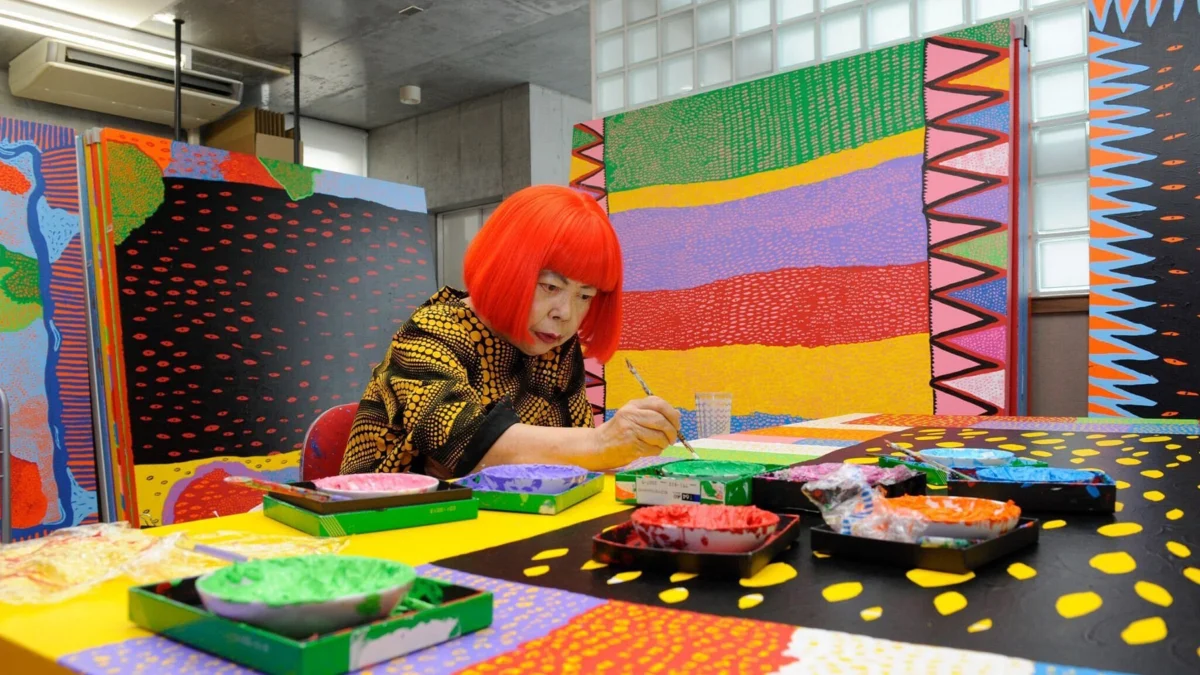
Yayoi Kusama, the revered Japanese avant-garde artist whose distinctive psychedelic polka dots, immersive "Infinity Mirror Rooms," and deeply personal narratives transcended the boundaries of art, fashion, and popular culture, has passed away at the age of 97. Her death marks the end of an extraordinary life dedicated to translating profound inner visions into a universally recognized artistic language, solidifying her status as one of the most important and top-selling contemporary artists in history. Kusama’s prolific career spanned more than seven decades, during which she navigated psychiatric challenges to produce a groundbreaking body of work encompassing painting, sculpture, installation, performance art, film, fashion, and literature.
A Life Forged in Hallucination and Artistic Defiance
Born in Matsumoto, Nagano Prefecture, Japan, in 1929, Yayoi Kusama’s artistic journey began early, deeply influenced by vivid hallucinations she experienced from childhood. These visions, characterized by flashing lights, auras, and endless fields of dots and flowers, became the foundational elements of her unique aesthetic. Far from being a mere stylistic choice, the repetitive patterns and infinite motifs in her work served as a means for Kusama to cope with and externalize her internal world, particularly her struggles with obsessive-compulsive disorder and depersonalization. She famously described her polka dots as a way to "self-obliterate" into the universe, a concept she termed "self-obliteration."
Her early artistic inclinations faced significant opposition from her conservative family, who wished for her to conform to traditional Japanese societal roles. Despite this, Kusama pursued art, studying Nihonga painting (traditional Japanese style) in Kyoto in the early 1950s. However, she quickly found the traditional art world stifling and yearned for greater freedom and expression. This yearning led her to correspond with American artist Georgia O’Keeffe, who encouraged her move to the United States. In 1957, Kusama relocated to Seattle, and by 1958, she had settled in New York City, a move that would prove pivotal in shaping her career.
New York: The Crucible of Avant-Garde Innovation
Upon arriving in New York, Kusama immersed herself in the burgeoning avant-garde scene, quickly gaining recognition for her radical and unconventional approach. Her early work in the city included the monumental "Infinity Net" paintings, vast canvases covered in countless meticulously rendered small arches, creating an illusion of infinite space and pattern. These works, often monochrome, captivated critics and fellow artists alike, drawing praise from figures such as Donald Judd and Frank Stella for their minimalist yet deeply psychological intensity.
The 1960s saw Kusama at the forefront of the Pop Art, Minimalism, and Feminist art movements, though her work often defied easy categorization. She experimented with soft sculpture, creating phallic-like protrusions that covered furniture and everyday objects, exploring themes of sexuality, obsession, and anxiety. Her "Accumulation" series, featuring these phallic forms, challenged societal norms and patriarchal structures.
Perhaps most famously, Kusama became a prominent figure in the performance art scene, staging provocative "happenings" that often involved nudity, body painting, and anti-war statements. These public performances, such as "Anatomic Explosion" and "Grand Orgy to Awaken the Dead," took place in iconic locations like Central Park and the Museum of Modern Art, generating both acclaim and controversy. Her "Love-In" and "Nude Happening" series, in particular, protested the Vietnam War, advocating for peace and free love with a distinctive, often playful, yet deeply serious undertone. These performances not only pushed artistic boundaries but also cemented her reputation as a fearless and outspoken artist.
Return to Japan and Global Resurgence
By the early 1970s, struggling with her mental health and feeling increasingly disillusioned with the commercial pressures and personal challenges of the New York art scene, Kusama returned to Japan in 1973. In 1977, she voluntarily checked herself into a psychiatric hospital in Tokyo, where she chose to reside for the remainder of her life, maintaining a studio nearby to continue her artistic practice daily. This period saw her explore new mediums, including writing poetry and novels, and further develop her signature motifs.
While she continued to exhibit in Japan, her international recognition waned somewhat during this period. However, a significant resurgence began in the late 1980s and early 1990s. In 1989, a major retrospective at the Center for International Contemporary Arts in New York reignited interest in her pioneering work. This was followed by her representation of Japan at the Venice Biennale in 1993, where she presented her now-iconic "Mirror Room (Pumpkin)," featuring an installation filled with pumpkins adorned with polka dots, reflecting her long-standing fascination with the gourd as a symbol of comfort and self-portraiture. This moment marked her triumphant return to the global art stage.
The "Kusama Effect": A Global Phenomenon
The 21st century witnessed an explosion of Kusama’s popularity, transforming her into a true global cultural icon. Her "Infinity Mirror Rooms," first conceived in the 1960s, became viral sensations, drawing unprecedented crowds to museums worldwide. Exhibitions at institutions like the Tate Modern in London (2012), the Whitney Museum of American Art in New York (2012), and the Hirshhorn Museum and Sculpture Garden in Washington D.C. (2017) consistently broke attendance records. The Hirshhorn exhibition, for instance, drew nearly 500,000 visitors in its limited run, leading to widespread public demand and extended viewing times. These immersive installations, which transport viewers into kaleidoscopic universes of infinite reflections, dots, and lights, offered a unique blend of visual spectacle and profound psychological experience, resonating deeply with contemporary audiences, particularly in the age of social media.
Supporting Data: Market Dominance and Cultural Impact
Kusama’s commercial success paralleled her critical acclaim. She consistently ranked among the top-selling contemporary artists globally, often holding the title of the highest-selling living female artist. In 2008, her 1959 painting "White No. 28" sold for $5.1 million at Christie’s, a record at the time for a living female artist. This record was repeatedly broken by her own works, with pieces like "No. 2" (1959) selling for $7.1 million in 2014 and "Pumpkin (LPASG)" fetching $11.7 million in 2022. Her market appeal extended across all mediums, from early paintings to sculptures and even editions, demonstrating robust demand from collectors worldwide. According to Artnet’s market reports, Kusama’s cumulative auction sales frequently placed her among the top five contemporary artists, male or female, by value, a testament to her enduring appeal and significant market liquidity.
Beyond the auction house, Kusama’s influence permeated the luxury and fashion industries. Her highly successful collaborations with Louis Vuitton, first in 2012 and then again in 2023, brought her iconic polka dots to handbags, ready-to-wear, and accessories, introducing her art to an even broader global audience. These collections were not merely commercial ventures but significant cultural events, blurring the lines between high art and high fashion. Other collaborations included projects with Lancôme, Veuve Clicquot, and UNIQLO, further solidifying her status as a mainstream cultural force.
Official Responses and Tributes
The news of Kusama’s passing elicited an outpouring of tributes from across the art world and beyond. Major museums and galleries that championed her work released statements acknowledging her profound impact. "Yayoi Kusama was a singular force whose artistic vision transcended categorization and inspired generations," read a statement from The Museum of Modern Art, where her work is held in the permanent collection. David Zwirner Gallery, which represented Kusama for many years, expressed deep sorrow, noting, "Her relentless pursuit of expressing her inner universe through art has left an indelible mark on art history and touched millions globally. She taught us to see the world differently." Curators, critics, and fellow artists lauded her courage, originality, and the therapeutic power of her art. Fashion houses and designers who collaborated with her also paid homage, recognizing her unparalleled ability to infuse luxury goods with artistic depth and popular appeal.
Broader Impact and Enduring Legacy
Yayoi Kusama’s legacy is multifaceted and profound. Art historically, she is celebrated as a pioneer who contributed significantly to numerous movements, often ahead of her time. Her explorations of infinity, repetition, and the human psyche laid groundwork for subsequent generations of conceptual and installation artists. She challenged the male-dominated art world of the 1960s, using her body and voice to create powerful, feminist statements.
Culturally, Kusama became a global icon whose work transcended the traditional confines of galleries and museums. Her distinctive image, often featuring her in a bright red wig and polka-dotted attire, became synonymous with her brand, making her instantly recognizable worldwide. Her ability to connect with diverse audiences, from seasoned art collectors to young visitors discovering art through social media, speaks to the universal appeal and accessibility of her work. The "Kusama effect" on museum attendance demonstrated the immense public hunger for immersive, experiential art, influencing how institutions now design and market exhibitions.
Furthermore, Kusama’s openness about her mental health struggles through her art played a crucial role in destigmatizing such conditions. Her art became a powerful testament to the resilience of the human spirit and the transformative potential of creative expression, offering a unique perspective on how one can live with and channel mental illness into something beautiful and meaningful. She created a visual language for experiences that are often hidden or misunderstood, fostering empathy and understanding.
In the art market, her passing is likely to intensify interest in her work, potentially leading to further appreciation of her existing pieces. Her prolific output ensures a rich body of work for future study and exhibition. The Yayoi Kusama Museum in Tokyo, which opened in 2017, stands as a permanent testament to her enduring vision and will undoubtedly continue to be a vital center for preserving and promoting her legacy.
Yayoi Kusama’s life was a testament to the power of imagination and perseverance. From her hallucinatory childhood visions to her global superstardom, she carved out a unique space in art history, inviting viewers into her endlessly dotted, infinitely reflective worlds. Her passing leaves an irreplaceable void, but her vibrant, groundbreaking, and deeply personal art will continue to captivate, inspire, and challenge audiences for generations to come, forever transforming how we perceive art, mental health, and the boundless possibilities of human creativity.
