
 By Nila Kartika Wati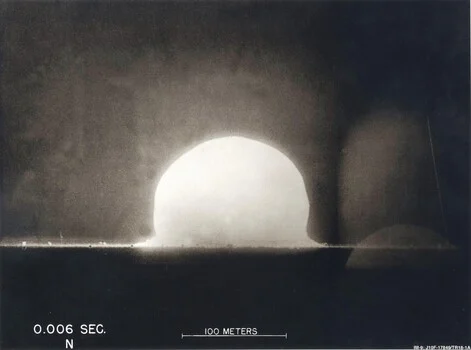
At 5:29:45 in the morning on July 16, 1945, in a stretch of New Mexico desert the Spanish called the Jornada del Muerto, the sky above a 100-foot steel tower erupted in a flash brighter than the noon sun. This was the Trinity test, the world’s first detonation of an atomic weapon, marking the definitive entry into the nuclear age. To document this unprecedented event, approximately fifty cameras, some tucked into steel-and-lead bunkers, others in buried instrument boxes, were meticulously aimed at the epicenter. Most were unmanned, triggered automatically by an elaborate countdown sequence, though physicist Berlyn Brixner personally occupied a tracking-camera position at North 10,000 yards. Each camera had been focused, loaded, and left in the dark hours earlier, wired to fire with inhuman precision, recognizing that no human eye could be trusted to catch the ephemeral spectacle and no photographer could survive standing close enough to try. This sophisticated photographic array was designed not merely to witness history, but to transform an instantaneous cataclysm into a quantifiable scientific record, an undertaking that would later allow a British physicist to reverse-engineer the bomb’s secret yield from published pictures alone.
The Manhattan Project’s Ultimate Test: Background and Imperative
The Trinity test was the culmination of the top-secret Manhattan Project, a massive wartime research and development undertaking by the United States with the support of the United Kingdom and Canada. Initiated in 1942, its objective was to develop the world’s first atomic bomb before Nazi Germany. The primary research and development facility was the Los Alamos Laboratory in New Mexico, under the scientific direction of J. Robert Oppenheimer. By mid-1945, scientists had developed two distinct designs for an atomic bomb: a uranium-based gun-type device, later dropped on Hiroshima, and a more complex plutonium-based implosion device. The implosion design, deemed more efficient but also more technically challenging, required an intricate arrangement of conventional explosives to compress a subcritical sphere of plutonium into a supercritical state. Doubts about its reliability necessitated a full-scale test, code-named Trinity. The test was not merely an exercise in destructive power; it was a crucial scientific experiment designed to confirm theoretical calculations, understand the physics of an implosion, and accurately determine the yield of the device, which scientists dubbed "the gadget." The photographic mission was central to these scientific objectives.
Confronting the Unquantifiable: A Subject No One Had Ever Metered
The core challenge for the photographic team was an almost comically simple yet profoundly difficult problem: nobody knew how bright the explosion would be. Theorists at Los Alamos estimated the flash would reach an intensity roughly ten times that of the sun, but this was a prediction, a mathematical model, not a measurable reality. The entire purpose of the test was to observe physics at an unprecedented scale, making bracketing exposures around a known value impossible. There would be no second take.
The team, led by physics professor Julian Ellis Mack from the University of Wisconsin, and motion-picture specialist Berlyn Brixner, adopted a strategy of "educated guessing at industrial scale." Their reasoning was elegantly pragmatic: if the flash was expected to be roughly ten times brighter than the sun, then set cameras as if photographing the sun, achieve a workable exposure, and then stop down the lens by another ten stops or so. Beyond this baseline, they spread cameras across every conceivable permutation of speed, aperture, distance, and angle. This blanket approach ensured that even if most frames were ruined – a highly anticipated outcome – a sufficient fraction would capture usable data. The sheer scale of the light was difficult to comprehend; when detonated, the flash was observed over 150 miles away, and its reflected glow was seen as far as Amarillo, Texas, approximately 280 miles distant, across a mountain range. To an observer 50 miles away, a nuclear fireball appears many times more brilliant than the noonday sun, a subject whose detail the cameras were tasked to preserve.
The Architects of Documentation: Mack, Brixner, and the Array’s Design
Julian Mack, an instrument builder by nature, spearheaded the optics and photographic-measurements group. His prior invention, a rotating-mirror streak camera (later known as the Mack streak camera), capable of resolving events down to about a ten-millionth of a second, had already proven instrumental in perfecting the implosion lens design for Trinity. Under Mack, Berlyn Brixner, a former landscape photographer, managed the motion-picture aspect, overseeing the construction, placement, hardening, and synchronized firing of the cameras. By his own meticulous count, Brixner had "nearly fifty motion picture cameras in operation or ready to operate." Mack’s official report detailed a precise inventory of 52 cameras: three Fastax 8mm, three Fastax 16mm, three slow Fastax 16mm, three Fastax Primacord 16mm, four Mitchell 35mm, twenty-four Kodak Cine "E" 16mm, a pair of standard Fairchild aerial cameras and four more rigged for stereo, two pinhole cameras, one still camera, and three shock-switch units. Los Alamos National Laboratory records, reconciling various accounts, suggest that over 52 cameras were indeed deployed, collectively exposing an astonishing 100,000 individual frames.
The device itself, "the gadget," was positioned atop a 100-foot steel tower, designated Zero, its legs anchored 20 feet into concrete. The height served multiple purposes: it improved the imaging geometry, minimized ground-level fallout, and simulated the airburst typical of an operational weapon. The device had been hoisted onto its platform by an electric winch over a stack of mattresses, a poignant contingency against cable failure. When detonated, yielding approximately 21 kilotons of TNT equivalent (a 2021 reanalysis of residual trinitite suggests closer to 24.8 kilotons), the tower was entirely vaporized.
Fortifying Against Annihilation: Shelters and Strategic Placement
Housing these invaluable instruments required extraordinary measures. Brixner had to innovate, rejecting standard concrete-and-earth bunkers for his crucial close-in stations. He designed and built custom "steel and lead shelters," two of which replaced the conventional bunkers. At these near positions, cameras were not aimed directly at the blast but viewed it through mirror systems, shooting through thick glass portholes. This sacrificial design ensured that the intense blast, heat, and radiation would destroy the mirror and glass, sparing the lens and the film behind them.
The geographic layout of the camera array was painstakingly deliberate. Brixner described sites "north of the Zero and two sites west of the Zero, one at 800 and one at 10,000 yards." Ten thousand yards, or 5.68 miles, hosted three reinforced, earth-covered shelters housing scientists, soldiers, and instruments. Unmanned camera boxes were positioned closer, at 800 yards and beyond, with crews fully anticipating the destruction of the gear or radiation fogging of the film before the shutter ever mattered. Human observers were stationed further afield, at Base Camp roughly ten miles to the southwest and Compania Hill about twenty miles to the northwest. These distinct distances are crucial: the instrumented camera ring was at 5.68 miles, not the 10 or 20 miles of the human observation posts.
Brixner himself oversaw the North 10,000 station. His actual involvement during the critical moment was remarkably minimal, a testament to the meticulous automation. "Everything was operated from the central control station," he recalled. This central bunker at South 10,000 housed the sequence timer, managed by Joe McKibben, who initiated the automatic run at twenty minutes before detonation, throwing the switch to the precise automatic timer at 45 seconds. Physicist Samuel Allison provided the final countdown. A separate circuit, designed by Ernest Titterton, synchronized the many special instruments and cameras with electronically timed pulses, ensuring that every rig, from North 10,000 to West 800, tripped in a precisely known relation to ground zero. The countdown was not merely dramatic; it was the synchronized shutter release for dozens of cameras simultaneously.
Freezing a Fireball: Camera Technologies and Their Roles
The workhorses of the Trinity photographic mission were the Fastax cameras. Unlike conventional cameras with intermittent claws and mechanical shutters, a Fastax employs a continuously moving film past a rotating prism that steers the image, allowing for speeds unachievable by traditional designs. Trinity’s Fastax cameras, using 100-foot rolls of 8mm and 16mm film, operated at speeds ranging from a well-documented 8,000 frames per second to widely cited popular accounts of 10,000 frames per second. Brixner relied heavily on them because the fireball’s most critical initial growth occurred in the thousandths-of-a-second range, and these ultra-high-speed cameras transformed what would otherwise be an unreadable blur into a measurable sequence of events.
Two Mitchell 35mm movie cameras at Brixner’s North 10,000 station, operating at approximately 100 frames per second, yielded what many consider the finest overall footage of the test. This material later enabled Los Alamos scientists to make some of the earliest quantitative measurements of a nuclear explosion’s behavior. Julian Mack’s specialized instruments filled the extremes of time resolution: his rotating-drum streak camera, using a moving slit, smeared the event across film to achieve roughly ten-microsecond resolution. Electro-optical shutters pushed towards a microsecond, while oscilloscope-trace photography, which captured electrical signals rather than the visible fireball, reached down to the hundred-nanosecond range. The array also included spectrograph cameras, which dispersed the fireball’s light into its component wavelengths to infer its temperature from its spectrum, and pinhole cameras, designed to capture not visible light but the potent gamma and high-energy flux emanating from the reaction.
It is important to correct common misconceptions regarding Trinity’s imagery. A British framing camera, sometimes called the Marley, capable of taking up to 100,000 frames per second (though only about 59 images in a burst), was considered outdated by July 1945 and was not deployed. Furthermore, the iconic microsecond stills of a spiked, warty fireball, often mistakenly attributed to Trinity, were actually captured by Harold Edgerton’s magneto-optic Rapatronic cameras during the Nevada and Pacific tests of the early 1950s, nearly a decade later. Trinity’s frozen fireball imagery consists primarily of high-speed film from Fastax, Mitchell, and Mack streak cameras.
Unforeseen Challenges and Redundant Success
The morning of July 16, 1945, did not entirely cooperate. Rain and lightning had already forced a delay from the original pre-dawn slot. In the humid, predawn darkness, Brixner and his technicians were still frantically wiping water and dust from lenses shortly before the final countdown. When the explosion concluded, the failure rate was, as expected, brutal. An IEEE Spectrum report on a later restoration of the footage noted that only about eleven of the fifty-two cameras returned fully satisfactory images. Brixner was more candid about the close-in stations: "Only about two of the Fastax cameras at the near stations ran and got pictures. All of the more distant cameras worked okay." The rigs closest to ground zero, despite their steel-and-lead protection and mirror systems, were the first to succumb to the immense blast.
Yet, these eleven good sets of frames proved sufficient, precisely because of their strategic arrangement. Cameras spanned distances from approximately half a mile to fourteen miles, staggered in distance, angle, frame rate, and focal length. This redundancy allowed the fireball to be triangulated in space and pinned in time from several independent viewpoints simultaneously. The design principle was clear: blanket the event thoroughly enough, and even a two-thirds loss still yields a complete and scientifically valuable record.
From Souvenirs to Science: Measuring the Bomb’s Yield
The photographs transcended mere documentation; they became invaluable scientific instruments. Because Mack’s cameras recorded the fireball against a known length scale (often a 100-meter bar printed on the film) and stamped each frame with a known elapsed time, the films were not merely images of an explosion. They constituted a precise data table of the fireball’s radius against time, recorded in light. Critically, the rate at which a blast wave expands directly encodes the energy that generated it.
Years earlier, in a classified 1941 report, the brilliant British physicist Geoffrey Ingram Taylor had mathematically derived the underlying relationship. He openly published his findings in 1950. Taylor demonstrated that a point-source blast wave expands such that its radius (R) grows proportionally to the energy (E) and time (t) according to the formula: R = C (E / ρ)^(1/5) t^(2/5), where C is a constant and ρ is the surrounding air density. Rearranging this, R^(5/2) grows in lockstep with time. Taylor applied this formula to the Trinity fireball images, confirming the relationship held from roughly 20 meters to about 185 meters of growth.
The most remarkable aspect of Taylor’s work reads like a magic trick. He did not have access to the classified yield figure. Instead, he worked solely with the publicly published photographs – specifically, a sequence released in Life magazine in 1947 – which included a scale bar and a time stamp. From a single well-chosen frame, showing a fireball approximately 100 meters in radius at 16 thousandths of a second after detonation, and using an approximate air density of 1.1 kilograms per cubic meter, his arithmetic returned an energy of roughly 40 trillion joules. Since one kiloton of TNT is approximately 4.2 trillion joules, this single frame yielded an estimate of about ten kilotons. Incorporating the entire sequence refined his estimate. Taylor’s photograph-derived figure ultimately came in near 16.8 kilotons, within a few kilotons of the still-secret truth. His open publication of this figure, derived entirely from pictures available to the public, reportedly caused considerable embarrassment in official circles on both sides of the Atlantic, as it exposed highly classified information through publicly accessible means. Taylor was not alone in this theoretical breakthrough; John von Neumann in the United States and Leonid Sedov in the Soviet Union reached similar solutions independently around the same time, which is why the result is now known as the Taylor, von Neumann, Sedov blast wave. These careful, calibrated, time-stamped photographs allowed outsiders to measure a weapon whose specifics they were never briefed on.
The Human Touch: Jack Aeby and the Only Good Color Photograph
Amidst the array of fifty-two scientific cameras, the single most reproduced still image of the Trinity test was captured by a civilian physicist who was not officially assigned to photograph anything. Jack Aeby, working in Emilio Segre’s physics group and measuring delayed gamma rays, carried a personal 35mm Perfex camera. He had secured rare permission from Segre, a privilege under the intense secrecy of the Manhattan Project. Loaded with perhaps three feet of leftover Anscochrome color movie film, the tail end of a roll, he had only about four frames remaining. When the fireball ascended, Aeby propped his camera on the back of a chair at Base Camp, roughly ten miles south of the tower, and shot it. "It was there so I shot it," he later recounted, emphasizing, "I wasn’t a photographer, that wasn’t my job, except I did carry a camera."
Aeby’s method was bracketing by instinct. He opened his aperture wide for the first frame, then, as he described, "cranked the diaphragm down, changed the shutter speed and fired three times in succession," stopping down hard to smaller apertures. His correct exposure was a blend of luck and a serendipitous equipment malfunction: a crack in his issued dark welding goggles allowed a sliver of the immense blast light to leak through. This unintended visual cue seems to have prompted him to continue stopping down, preventing overexposure. The middle exposure of his burst yielded the iconic, well-exposed color image; the others were usable but less pristine. He developed the film himself that night through the lengthy color process, and Segre noted that Aeby’s pictures were ready even before the official ones.
Aeby’s photograph remains the only well-exposed color still image of the Trinity detonation. While official color motion-picture footage existed, the fireball’s extreme intensity overexposed, solarized, and even blistered much of it, and time further degraded the rest. Several points about this image are frequently muddled: the exact camera model is debated (Perfex 44 or 33, best described simply as a Perfex 35mm); the film stock was 35mm movie film, not "33mm film" as some accounts erroneously state; when the image was first publicly printed in the New York Sunday Mirror on October 7, 1945, after the Hiroshima and Nagasaki bombings, it was misattributed to the U.S. Army, despite Aeby being a civilian. Furthermore, the photograph is almost always printed reversed left to right, a deliberate choice to align the asymmetric cloud formation with official images shot from the north, whereas Aeby captured it from the south. Tragically, the original negative, entrusted to Los Alamos for safekeeping, was later lost.
It is also important to clarify the role of William L. Laurence, the New York Times science reporter embedded with the Manhattan Project. Laurence was the sole journalist to witness Trinity, and he is sometimes mistakenly credited with capturing images. However, Laurence was a writer, hired to produce the prose and pre-written press releases; he took no famous photographs. The visual record was the meticulous work of Mack’s instrument team and, in the case of the singular color still, an amateur physicist guided by instinct and a broken pair of goggles.
Legacy and Declassification: The Enduring Impact of Trinity’s Imagery
Most of the high-speed stills from Trinity were stamped "SECRET" and remained classified for a quarter-century. However, a single scaled fireball sequence, comprising the very frames Taylor later used, was released earlier and published in Life magazine in 1947. When the remainder were declassified in 1970, the prints bore a blue ink strike-through on their security stamp. As work products of the U.S. government, they entered the public domain, becoming freely reproducible. Since then, these images—the growing hemisphere with its flattened skirt of light along the desert floor, frames labeled in milliseconds—have been endlessly reproduced, serving as an enduring visual lesson in the power of calibrated photography to document the previously unseen.
The entire approach to photographing Trinity resonates with a remarkably modern sensibility. Faced with an unmeterable subject of unpredictable light and a solitary chance for exposure, Mack and Brixner eschewed the pursuit of a single perfect frame. Instead, they spread their bets, deploying the fastest instruments available across a spectrum of speeds and distances. They hardened critical components, accepted a high rate of failure, and ultimately placed their trust in redundancy and precise calibration. Their faith was justified. Despite four-fifths of the cameras failing to yield fully satisfactory images, the surviving footage provided an extraordinarily complete scientific record. The next time the iconic Trinity fireball appears, that perfect, glowing dome frozen sixteen thousandths of a second into the atomic age, it serves as a powerful reminder that it was not captured by a singular genius with a quick shutter finger. It was engineered, in the dark, by a collective of brilliant minds who assumed widespread failure but built an array robust enough to succeed anyway. This meticulous documentation, born of scientific necessity, not only chronicled a pivotal moment in human history but also provided critical data that informed subsequent nuclear weapons development and our understanding of blast physics, forever changing the course of warfare and international relations.
