
 By Nila Kartika Wati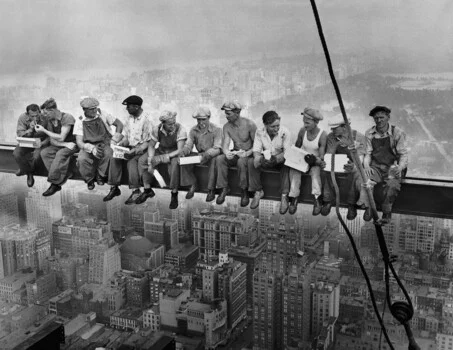
Eleven men sit shoulder to shoulder on a steel beam, more than 800 feet above Manhattan, eating sandwiches and lighting cigarettes as if the precarious drop beneath their boots were nothing more than a curb. There is no visible safety line, no net, and certainly no discernible fear etched on their faces. This arresting tableau, titled "Lunch atop a Skyscraper," has become one of the most reproduced and recognized images of the twentieth century, yet almost everything the average person assumes about it is either incomplete or entirely mistaken. Far from a candid snapshot, the photograph is a meticulously orchestrated publicity stunt, its true authorship remains a subject of intense debate, and the identities of the brave men it immortalizes have only recently begun to emerge from the mists of time, largely through the determined efforts of researchers and filmmakers.
The Great Depression and the Birth of a Modern Marvel
To fully appreciate the photograph, one must first understand the tumultuous era in which it was created. The year was 1932, a time when the United States was three years deep into the throes of the Great Depression, an economic catastrophe that saw unemployment rates soar to over 25% nationally, widespread poverty, and a near-complete halt in construction and industrial development. Amidst this bleak landscape, one monumental project stood as a defiant symbol of progress and prosperity: Rockefeller Center. Conceived by John D. Rockefeller Jr., this ambitious urban complex was one of the largest private construction projects ever undertaken, an estimated $250 million investment (equivalent to over $4 billion today) that employed tens of thousands of workers throughout its decade-long construction.
Rockefeller Center was more than just a collection of buildings; it was a beacon of hope, a tangible expression of American resilience and ingenuity during a period of profound national despair. Its construction provided vital employment for skilled tradesmen, many of whom were immigrants, in a city where jobs were scarce. The centerpiece of this grand vision was the 70-story RCA Building, now known as 30 Rockefeller Plaza, an Art Deco masterpiece designed to house offices, studios, and retail spaces. As the steel skeleton of the RCA Building climbed skyward, dominating the midtown Manhattan skyline, it became a potent symbol, and its developers were keen to ensure it remained in the public eye. This desire for sustained public attention, rather than a serendipitous moment, was the true catalyst for the iconic photograph.
A Calculated Coup: Staging an Iconic Moment
The image was captured on September 20, 1932, during the final months of the RCA Building’s construction. The workers, genuine ironworkers known for their daring and skill, are perched on a steel beam more than 800 feet (over 240 meters) above the bustling streets. Behind them, Central Park and the sprawling cityscape recede into a hazy panorama, emphasizing their dizzying elevation. For decades, the photograph circulated with minimal reliable information, often misattributed to renowned social documentarian Lewis Hine, who famously photographed the construction of the Empire State Building. However, Hine was not the photographer. The truth, as later revealed, points to a deliberate marketing strategy.
The lunch break depicted was not a spontaneous event. It was orchestrated as a publicity stunt, one of several frames captured during a planned photoshoot designed to generate buzz and sell commercial space in the burgeoning Rockefeller Center. Ken Johnston, who managed historical photo collections for Corbis (which once owned the image archive), plainly stated that the event was organized with a clear promotional purpose. Multiple photographers were present, indicating a professional setup rather than a casual observation. While the men were indeed real ironworkers and the height was undeniably authentic and dangerous, the specific moment was posed and composed for the camera. This distinction is crucial: the men’s courage was real, but their "lunch break" was a performance for the lens.
Evidence supporting the staged nature of the shot includes a companion image from the same session, far less famous, which shows several of the same men stretched out and seemingly napping on an identical beam, their boots dangling over the void. This parallel photograph underscores that the entire sequence was a controlled shoot, planned and executed to create dramatic, eye-catching imagery. The intent was to convey an impression of fearless labor and monumental achievement, reinforcing Rockefeller Center’s image as a symbol of progress and defiance against the economic downturn. Such elaborate publicity efforts were not uncommon in the nascent field of public relations during that era, as corporations sought novel ways to capture public imagination and media headlines.
The Elusive Hand Behind the Shutter: A Decades-Long Attribution Battle
Despite its global recognition, one of the most astonishing facts about "Lunch atop a Skyscraper" is the enduring uncertainty surrounding its authorship. For years, the negative resided in the vast commercial collection of the Bettmann Archive, often with a generic or even incorrect credit. The question of who pressed the shutter has fueled a decades-long detective story, spanning corporate archives, family lore, and meticulous historical research.
The name most frequently associated with the photograph is Charles C. Ebbets (1905–1978), an American photographer who worked extensively on the Rockefeller Center publicity operation in 1932. In 2003, Ebbets’ daughter, Tami Ebbets Hahn, brought forth a compelling case for her father’s authorship. Her evidence included professional receipts on Ebbets’ letterhead, photographs of him working at similar heights on the construction site, and original 1932 newspaper clippings featuring the image, carefully preserved in his personal scrapbook.
However, the path to definitive attribution proved complex. Corbis, then the owner of the Bettmann Archive, commissioned a research firm to investigate, but the inquiry yielded complications rather than a clean answer. Historical records indicated that credit for such images was sometimes assigned to the head of the features syndicate—in this case, Hamilton Wright, for whom Ebbets worked—even if staff photographers were the actual creators. More critically, the investigation established that Ebbets was not the sole photographer on the beam that day. Documentation confirmed the presence of two other photographers, Thomas Kelley and William "Lefty" Leftwich, during the same shoot.
This revelation introduced a layer of uncertainty that persists to this day. With multiple cameras operating at the same height, on the same setup, on the same afternoon, surviving records have been unable to conclusively prove which photographer’s exposure became the famous negative. Later research by Christine Roussel, the longtime Rockefeller Center archivist, further narrowed the field to Ebbets and Leftwich as the principal possibilities, with Kelley’s claim less prominent. While Roussel leans towards Ebbets, citing substantial circumstantial evidence, no single document definitively links his camera to the iconic negative. Corbis, too, eventually favored Ebbets in their attribution, but the uncertainty remains, leading to the image frequently being published without any photographer credit at all—a peculiar fate for one of the world’s most recognizable photographs. The precision surrounding the building, the date, and the purpose stands in stark contrast to the anonymity of its creator.
Chasing the Men on the Beam: Recovering Lost Identities
If the photographer’s identity remains largely a mystery, the identities of the eleven men on the beam were, for an even longer time, a complete enigma. Eleven faces, no names, no records tying individuals to their perilous perch. This profound anonymity became the driving force behind the 2012 documentary Men at Lunch, directed by Irish filmmaker Seán Ó Cualáin and produced by his brother Éamonn Ó Cualáin, with narration by actress Fionnula Flanagan.
The Ó Cualáin brothers’ investigation began serendipitously in 2010. They stumbled upon a copy of the photograph hanging in a pub in Shanaglish, a small village in County Galway, Ireland. Accompanying the image was a note from a local man, Pat Glynn, who claimed that his father and a relative were among the figures on the beam. This scrap of family lore ignited a transatlantic quest, leading the filmmakers from rural Ireland to the towering archives of New York, determined to put names to the anonymous faces.
The documentary powerfully argues for a significant Irish presence on the beam, a fact consistent with the immense wave of Irish and other immigrant labor that built much of modern Manhattan’s infrastructure. The film explored family claims that the two men at the extreme ends of the beam were Matty O’Shaughnessy and Sonny Glynn, both linked to Shanaglish. However, despite compelling oral histories and physical resemblances, these identifications remain unconfirmed due to the absence of definitive employment records from that specific day or photographic comparison databases of the era.
More firmly, archival comparisons and later research have tentatively connected two men to the photograph: Joseph Eckner, third from the left, and Joe Curtis, third from the right. Even these identifications, however, are subject to ongoing reassessment by newer research, highlighting the challenges of definitively identifying individuals from nearly a century ago. The man on the far right, tipping a bottle, has also been claimed as Gustáv Popovič, a Slovak worker, based partly on an inscribed copy of the photograph found among his possessions. This claim, however, conflicts with the Glynn family’s assertion that the same figure is their relative. The documentary candidly acknowledges the difficulty of achieving absolute certainty decades later, where family memory, physical resemblance, and a handful of fragmented documents can only point towards, but rarely nail down, a name.
What the Ó Cualáin brothers’ extensive research truly recovered was the crucial human layer that the initial publicity campaign had inadvertently flattened. These were working immigrants, many fleeing poverty and seeking opportunity, risking their lives on raw steel for wages during the harshest economic crisis in American history. The very campaign that immortalized their daring left most of them nameless for eighty years. The effort to put even a few names back on the beam represents a significant act of historical reclamation, restoring dignity and individual narratives to those who were once mere figures in a grand corporate spectacle.
The Enduring Power of a Staged Truth
"Lunch atop a Skyscraper" has never truly left public circulation. Time magazine included it in its 2016 selection of the 100 most influential images ever made. It adorns dorm rooms, diners, and pubs across continents, a universal symbol of courage, grit, and the human spirit of endeavor. Rockefeller Center itself has embraced the image, incorporating it into the "Top of the Rock" observation deck experience, where visitors can pose on a replica beam, safely anchored, several hundred feet up, recreating their own version of the iconic moment.
The staged nature of the photograph, far from diminishing its impact, is a significant part of why it endures. A truly candid, perhaps grainy, frame of tired men eating a hurried lunch would likely have been forgettable. What the 1932 shoot produced instead is a masterclass in composition: eleven figures perfectly balanced along a strong horizontal line, the boundless city stacked in soft focus behind them, the entire arrangement organized to simultaneously convey immense danger and effortless ease. It is a designed picture that, paradoxically, happens to be profoundly true. The men were genuinely up there. The risk was absolutely real. The frame, however, was meticulously constructed.
This potent combination—genuine subject matter and deliberate construction—is a paradox that modern photographers constantly pursue, often without explicitly naming it. A great deal of what is perceived as "authentic" imagery, particularly in documentary or commercial contexts, is often arranged or enhanced. The 1932 beam shot stands as an early, extreme, and openly commercial example of this principle, and its enduring resonance still outperforms many contemporary attempts. The execution, with the slow, deliberate large-format gear of the 1930s (likely bulky Graflex cameras using glass plates or sheet film), further underscores the intentionality. Each exposure required meticulous preparation; there was no "chimping" (reviewing images instantly) or burst mode. Every shot cost real time and money, which is precisely why the day was so tightly planned and executed.
Ultimately, the lesson embedded within this powerful image transcends equipment or spontaneous luck. It demonstrates that the most enduring and impactful images are often the most thoughtfully engineered. This engineering is not a deceptive secret but a fundamental aspect of visual communication. Someone made a conscious decision for those men to sit on that beam, framed in that precise way, and meticulously executed the exposure. Ninety years later, while we still cannot definitively agree on that person’s name, their work continues to captivate, inspire, and provoke contemplation about the nature of truth, art, and the forgotten labor that built our world. The enduring mysteries surrounding "Lunch atop a Skyscraper" only deepen its allure, cementing its place not just as a historical artifact, but as a timeless testament to human courage and the persuasive power of a well-crafted image.
