
 By admin
The alchemy of transforming a beloved book into a compelling visual narrative is a challenging yet often rewarding endeavor for filmmakers and audiences alike. What constitutes a truly great adaptation can vary wildly: some productions achieve acclaim through meticulous fidelity to their source material, while others boldly reinterpret the narrative, unearthing latent themes and delivering fresh perspectives. Regardless of the approach, a successful adaptation elevates both the original text and its screen counterpart, fostering a deeper appreciation for the art of storytelling across different mediums. This exploration delves into 28 of the most celebrated book-to-screen adaptations, highlighting their unique contributions and enduring legacies.
Defining Excellence in Adaptation
The journey from page to screen is fraught with interpretive decisions. A direct translation can feel flat without the internal monologue that defines a novel, while too much deviation risks alienating loyal readers. The most impactful adaptations often strike a delicate balance, capturing the essence and spirit of the original work while leveraging the unique strengths of visual storytelling. This can involve expanding on minor characters, streamlining complex plotlines, or even shifting historical or cultural contexts to resonate with a contemporary audience. The following selections exemplify this diverse spectrum of successful adaptation.

Literary Classics Reimagined
The Age of Innocence (1993)
Martin Scorsese, a director primarily known for his gritty portrayals of urban life and morally complex characters, made an unexpected yet masterful pivot with his 1993 adaptation of Edith Wharton’s 1920 Pulitzer Prize-winning novel, The Age of Innocence. Wharton’s ravishing account of forbidden romance and societal strictures in 1870s New York society provided a stark contrast to Scorsese’s usual milieu. The film, starring Daniel Day-Lewis, Michelle Pfeiffer, and Winona Ryder, was lauded for its breathtaking cinematography, which rendered every frame with the precision and beauty of a classical painting. Released on October 1, 1993, the film garnered critical acclaim, achieving a 93% approval rating on Rotten Tomatoes and earning five Academy Award nominations, including Best Supporting Actress for Winona Ryder, and winning for Best Costume Design. Its meticulous attention to period detail, from the opulent costumes to the elaborate dining rituals, served not merely as backdrop but as an integral part of the narrative, emphasizing the suffocating elegance of the Gilded Age. Scorsese’s direction highlighted the unspoken emotional turmoil and the subtle power dynamics within Wharton’s world, proving his versatility as a filmmaker and enriching the understanding of a literary classic.
Rebecca (1940)
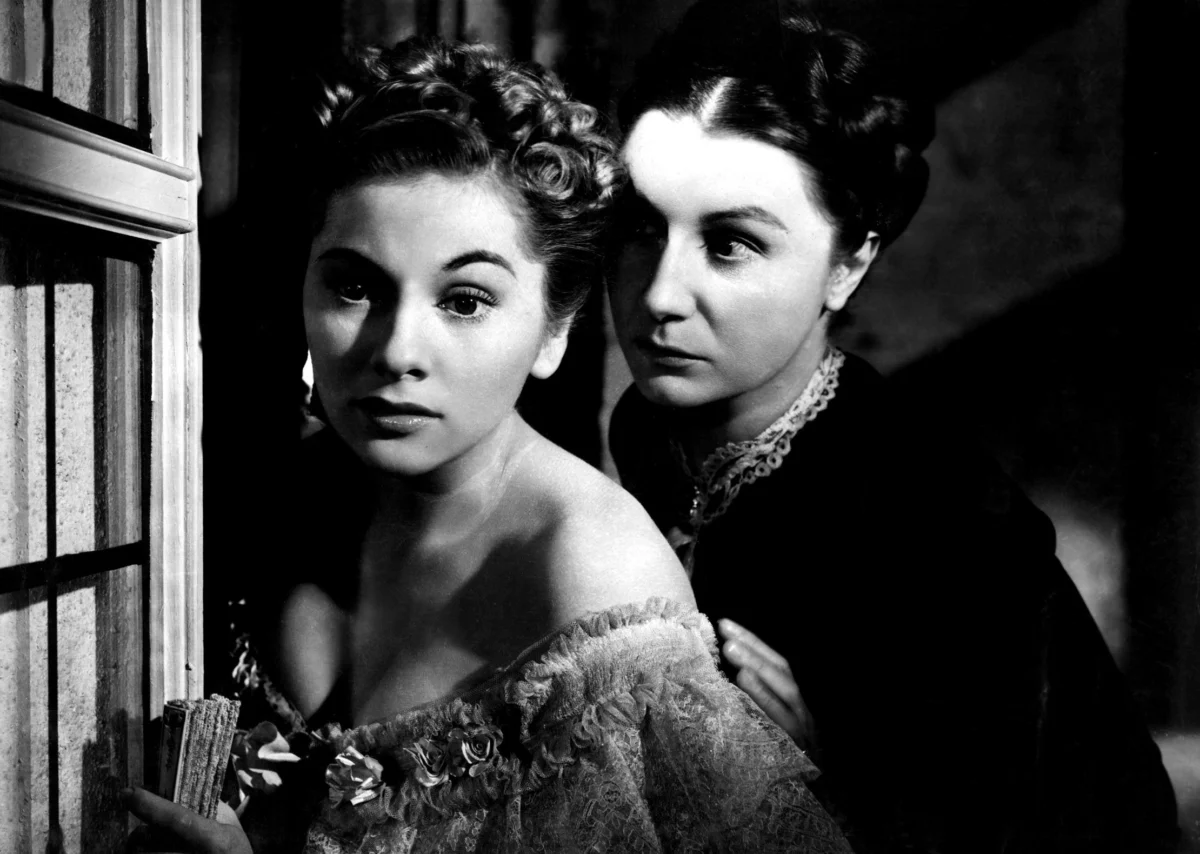
Daphne du Maurier’s 1938 gothic psychological thriller Rebecca found its definitive cinematic form in Alfred Hitchcock’s 1940 adaptation, a masterpiece that earned the Academy Award for Best Picture. Starring Joan Fontaine as the timid second Mrs. de Winter, Laurence Olivier as the enigmatic Maxim de Winter, and Judith Anderson as the chilling Mrs. Danvers, the film plunged audiences into the haunting atmosphere of Manderley. Released on April 12, 1940, the film was a critical and commercial success, securing an 83% approval on Rotten Tomatoes and grossing over $6 million on a $1.28 million budget, a significant sum for its era. Despite Hollywood’s stringent morality codes necessitating certain narrative alterations – particularly regarding Maxim’s culpability – Hitchcock masterfully conveyed the novel’s psychological tension and pervasive sense of dread. Fontaine’s portrayal of a woman consumed by the specter of her predecessor, combined with Anderson’s iconic, terrifying performance as the devoted housekeeper, established Rebecca as a genre-defining classic. The film’s innovative camerawork, evocative score, and intricate plot twists continue to influence filmmakers, demonstrating Hitchcock’s unparalleled ability to translate literary suspense into visual terror.
Pride & Prejudice (2005)
Jane Austen’s enduring 1813 novel Pride & Prejudice has seen numerous adaptations, but Joe Wright’s 2005 film stands out for its vibrant energy and visual poetry. While the 1995 BBC miniseries with Colin Firth remains a beloved benchmark, Wright’s cinematic version, released on November 11, 2005, offered a fresh, more intimate take. Starring Keira Knightley as the spirited Elizabeth Bennet and Matthew Macfadyen as the brooding Mr. Darcy, the film achieved widespread critical and commercial success, earning an 86% approval on Rotten Tomatoes and grossing over $121 million worldwide against a $28 million budget. It garnered four Academy Award nominations, including Best Actress for Knightley. Wright’s adaptation is celebrated for its sun-drenched, naturalistic aesthetic, showcasing the glorious English landscapes and period costumes that perfectly complement Austen’s romantic drama. Rosamund Pike’s luminous portrayal of Jane Bennet and Judi Dench’s imperious Lady Catherine de Bourgh further cemented its appeal. By emphasizing the internal lives and emotional landscapes of its characters through nuanced performances and evocative cinematography, the film transcended mere historical romance to become a contemporary classic that continues to captivate new generations.

The Shining (1980)
Stephen King’s 1977 horror novel The Shining underwent a radical transformation in Stanley Kubrick’s 1980 film adaptation, a work that has since achieved legendary status despite initial controversy, particularly from King himself. Released on May 23, 1980, the film stars Jack Nicholson as Jack Torrance, a writer and recovering alcoholic who accepts a winter caretaker position at the isolated Overlook Hotel, bringing his wife Wendy (Shelley Duvall) and psychic son Danny (Danny Lloyd) into a spiraling nightmare. While diverging significantly from the novel’s plot and characterizations, Kubrick’s vision conjured a unique brand of psychological terror. The film, which grossed over $44 million on a $19 million budget, is renowned for its unsettling atmosphere, achieved through groundbreaking set design (the labyrinthine Overlook, the iconic carpet patterns), innovative Steadicam shots that create a sense of unease, and a haunting musical score. Nicholson’s unhinged performance, Duvall’s portrayal of escalating fear, and Lloyd’s eerie innocence are indelible. Kubrick’s genius lay in marrying supernatural dread with the insidious horrors of domestic abuse, isolation, and alcoholism, transforming King’s explicit scares into a more abstract, deeply disturbing cinematic experience. The Shining has become a cultural touchstone, widely imitated and referenced, standing as a testament to the power of artistic reinterpretation in adaptation.
Wuthering Heights (2011)
Emily Brontë’s 1847 tempestuous novel Wuthering Heights received a stark, visceral interpretation in Andrea Arnold’s 2011 film. While Emerald Fennell’s recent take offered a more stylized approach, Arnold’s version, released on November 11, 2011, is praised for its raw, grounded portrayal of Cathy and Heathcliff’s doomed love. The film marked a significant departure by casting Black actors, James Howson and Solomon Glave, as the older and younger Heathcliff, respectively, opposite Kaya Scodelario and Shannon Beer as Cathy. This casting decision brought a new layer of commentary to the character’s "otherness" and social displacement within the rigid class structures of the 19th-century Yorkshire moors. Critically acclaimed for its unflinching realism, the film achieved a 70% approval on Rotten Tomatoes. Arnold’s direction masterfully captured the desolate beauty and brutal bleakness of the landscape, making it an almost tangible character in the story. The mud, rain, and untamed wildness of the moors mirrored the characters’ untamed passions and destructive impulses, resonating deeply with the source material’s untamed spirit. Wuthering Heights is a notoriously difficult book to adapt due to its complex narrative layers and disturbing themes, but Arnold’s vision, with its acute observations and wild energy, comes remarkably close to echoing its unruly essence.
Modern Literary & Contemporary Adaptations
American Fiction (2023)
Percival Everett’s 2001 satirical novel Erasure, a biting critique of racial stereotyping in the publishing industry, was brought to the screen as American Fiction by filmmaker Cord Jefferson. Released on December 15, 2023, the film reimagined Everett’s sharp satire into a raucous, yet poignant, comedy. Starring Jeffrey Wright as Thelonious "Monk" Ellison, alongside Tracee Ellis Ross, Issa Rae, and Sterling K. Brown, the film navigated themes of racial identity, literary integrity, and familial dysfunction with remarkable wit and depth. American Fiction was a critical darling, earning an impressive 94% on Rotten Tomatoes and winning the Academy Award for Best Adapted Screenplay, a testament to Jefferson’s skillful translation of Everett’s complex themes. It also grossed over $23 million on a modest $10 million budget. The film’s blend of turbulent family drama and a scathing critique of the literary world made it a blisteringly funny roller-coaster, while still acknowledging the even sharper edge of its source material. Its success highlighted the ongoing relevance of Everett’s observations and Jefferson’s ability to make them accessible and impactful to a broader audience.

Atonement (2007)
Ian McEwan’s acclaimed 2001 novel Atonement, a poignant melodrama about the devastating consequences of a child’s careless mistake, found a powerful cinematic voice in Joe Wright’s 2007 adaptation. Released on December 7, 2007, the film starred Keira Knightley and James McAvoy as the tragically separated lovers, but it was the unbelievably poised 13-year-old Saoirse Ronan, in one of her earliest screen roles as Briony Tallis, who captivated audiences and earned an Academy Award nomination. The film was a critical and commercial triumph, achieving an 83% approval on Rotten Tomatoes and grossing over $131 million worldwide against a $30 million budget. It received seven Academy Award nominations, including Best Picture, and won for Best Original Score. Beyond its emotional depth and stunning performances, Atonement became iconic for "that green slip dress" worn by Keira Knightley, now considered one of the most memorable film costumes of all time. Wright’s visually lush direction and daring long takes (most notably the Dunkirk beach scene) powerfully conveyed McEwan’s themes of love, loss, and the subjective nature of truth, solidifying its place as a modern classic adaptation.
Carol (2015)
Todd Haynes’s 2015 romantic drama Carol, based on Patricia Highsmith’s groundbreaking 1952 novel The Price of Salt (later republished as Carol), is a masterclass in stylish, understated storytelling. Released on November 20, 2015, the film captivated audiences with its dreamy romance set against the backdrop of 1950s New York. Cate Blanchett delivered a magnetic performance as the sophisticated housewife Carol Aird, while Rooney Mara portrayed the watchful young aspiring photographer Therese Belivet. Highsmith’s novel was revolutionary for its frank depiction of a sapphic relationship with a relatively happy ending, a rarity for its time. Haynes meticulously recreated the era, with every frame exuding period authenticity and emotional restraint. The film was a critical darling, earning an astounding 94% on Rotten Tomatoes and receiving six Academy Award nominations, including Best Actress for Blanchett and Best Supporting Actress for Mara. It grossed over $40 million on an $11 million budget. Carol is celebrated not just as a superb adaptation but also as a landmark LGBTQ+ film, perfectly capturing the quiet longing and societal pressures of its time, making it ideal viewing (and reading) for any season.
Contempt (1963)
Alberto Moravia’s 1954 novel Contempt (Il disprezzo) found its cinematic counterpart in Jean-Luc Godard’s 1963 film, a meta-narrative exploring the complexities of artistic creation and marital breakdown. Both the book and the film follow a writer consulting on a doomed adaptation of Homer’s The Odyssey, only to witness his marriage unravel. Released on December 29, 1963, Godard’s film, starring Brigitte Bardot, Jack Palance, and Michel Piccoli, is a visually stunning and intellectually provocative work. While the film, by its nature, couldn’t replicate the novel’s deep psychological interiority, Godard brilliantly used the contentious interpretations of The Odyssey by the male characters as a reflection of their own egos and the decline of their relationships. The film, achieving an 89% approval on Rotten Tomatoes, became a landmark of French New Wave cinema, celebrated for its stylistic innovations and philosophical depth. Contempt continues to be studied for its exploration of artistic integrity, commercial compromise, and the inherent challenges of adaptation, particularly for an epic as profound and influential as The Odyssey, a text that, as The New Yorker recently noted, continues to defy and attract ambitious filmmakers.
Eileen (2023)
Ottessa Moshfegh’s distinctively strange 2015 debut novel Eileen, co-adapted for the screen by Moshfegh herself alongside her former partner Luke Goebel, became a gloriously weird cinematic experience. Directed by the precise William Oldroyd, the film, released on December 8, 2023, brought to life the story of a bored 1960s secretary who develops a perilous infatuation with an enigmatic new colleague. Thomasin McKenzie delivered a captivating performance as the mousy Eileen, while Anne Hathaway, with peroxide-blonde hair, embodied the unhinged charm of Rebecca. The film, praised for its dark humor and unsettling atmosphere, garnered an 83% approval on Rotten Tomatoes. While not a massive box office hit (grossing $1.5 million on a $4 million budget), it resonated strongly with fans of the book, capturing its unique blend of psychological thriller and black comedy. Eileen is a testament to the power of an author’s involvement in translating their vision, ensuring that the film retained the novel’s idiosyncratic voice and disturbing charm.

The Handmaiden (2016)
Park Chan-wook’s 2016 psychological thriller The Handmaiden is a dazzling and audacious adaptation of Sarah Waters’s 2002 novel Fingersmith. Park Chan-wook ingeniously transplanted Waters’s Victorian England sapphic love story to 1930s Korea under Japanese occupation, a stroke of genius that allowed for breathtaking visual extravagance and heightened dramatic tension. Released on October 21, 2016, the film, starring Kim Min-hee and Kim Tae-ri, was a critical sensation, achieving an exceptional 95% approval on Rotten Tomatoes and grossing over $38 million worldwide. It premiered at the Cannes Film Festival, where it competed for the Palme d’Or and won the Vulcan Award. The film is celebrated for its elaborate costumes, knife-edge suspense, and its bold, unapologetic depiction of sex and power dynamics. Park’s masterful direction weaves a complex narrative of deception, desire, and liberation, compelling viewers to revisit the original novel to untangle its intricate layers. The Handmaiden stands as a powerful example of how a skilled filmmaker can honor the spirit of a source text while creating an entirely new, culturally resonant cinematic experience.
Little Women (2019)
Louisa May Alcott’s timeless 1868 coming-of-age novel Little Women received a fresh, dynamic reimagining in Greta Gerwig’s 2019 film. While Gillian Armstrong’s 1994 adaptation holds a special place in many hearts, Gerwig’s version, released on December 25, 2019, quickly became an instant classic. Starring Saoirse Ronan as the spirited Jo March, Florence Pugh as the fiercely ambitious Amy, and Timothée Chalamet as the charming Laurie, the film was a critical and commercial triumph. It achieved a remarkable 95% approval on Rotten Tomatoes, grossed over $218 million worldwide on a $40 million budget, and received six Academy Award nominations, winning for Best Costume Design. Gerwig’s innovative non-linear structure, which deftly weaves between the March sisters’ childhood and adulthood, moved the narrative beyond its traditional wholesome image. Instead, it offered a profound meditation on the challenges faced by ambitious 19th-century women balancing artistic aspirations with societal expectations and economic realities. By drawing out these complex threads, which were always present in Alcott’s original text, Gerwig transformed the classic into a startlingly resonant and contemporary work, making it a definitive adaptation for a new era.
Nickel Boys (2024)
Colson Whitehead’s 2019 Pulitzer Prize-winning novel The Nickel Boys, a harrowing account of two Black boys in a brutal Florida reform school in the 1960s, was ingeniously adapted by RaMell Ross. Released on September 20, 2024, Ross’s film offered a remarkable feat of cinematic translation. The novel, Whitehead’s second Pulitzer after The Underground Railroad, presented a significant challenge for adaptation due to its devastating final twist. Ross tackled this by filming the entire story from a first-person perspective, immersing the audience fully in the experiences of the protagonists, Elwood Curtis (Ethan Herisse) and Turner (Brandon Wilson). This innovative approach not only created remarkable intimacy and poignancy but also provided an elegant solution to the narrative’s unadaptable ending. The film was praised for its powerful performances and its ability to convey the systemic brutality and resilience depicted in Whitehead’s work. The Nickel Boys stands as a profound coming-of-age tearjerker and a masterclass in adaptation, setting a new standard for filmmakers tackling challenging literary narratives.
Normal People (2020)
Sally Rooney’s 2018 bestselling novel Normal People became a cultural phenomenon during the early months of the pandemic, offering a deeply intimate and relatable love story that united global audiences. The Hulu/BBC Three adaptation, released on April 26, 2020, was meticulously crafted, with Rooney herself co-writing the screenplay alongside Alice Birch and Mark O’Rowe, and directed by Lenny Abrahamson and Hettie Macdonald. The series launched then-unknown actors Paul Mescal and Daisy Edgar-Jones into international stardom, their raw, vulnerable performances as Connell and Marianne earning widespread critical acclaim. The show garnered four Emmy nominations, including Outstanding Lead Actor for Mescal, and a Golden Globe nomination for Best Miniseries. Normal People was also credited with normalizing the role of intimacy coordinators on sets, setting a new standard for depicting authentic, consensual relationships. The series’ exploration of class, mental health, and the complexities of young love resonated deeply, becoming a definitive "will-they-won’t-they" romance for a generation. Its sublime execution cemented its place as one of the most beloved and impactful literary adaptations of recent times.

Pachinko (2022–2024)
Min Jin Lee’s extraordinary 2017 novel Pachinko, an epic multi-generational saga of a Korean family’s resilience and struggles, received a lavish and critically acclaimed adaptation by Apple TV+. Soo Hugh’s two-season series, which premiered on March 25, 2022, is a triumph of detailed world-building and historical narrative, spanning from the 19th century to the late 1980s. The series garnered widespread praise for its meticulous period detail, stunning cinematography, and powerful performances from an exceptional cast, including Oscar winner Youn Yuh-jung as the elder Sunja. Pachinko explores themes of identity, diaspora, and the enduring strength of family against a backdrop of war, colonialism, and discrimination. The show achieved an impressive 97% approval rating on Rotten Tomatoes and won a Peabody Award, lauded for its ambitious scope and profound emotional resonance. It stands as a testament to the power of prestige television to bring complex, globally significant stories to life with authenticity and grandeur.
Patrick Melrose (2018)
Edward St. Aubyn’s semi-autobiographical Patrick Melrose novels—Never Mind, Bad News, Some Hope, Mother’s Milk, and At Last—were adapted into a five-part miniseries in 2018, offering a searing portrayal of a moneyed Englishman grappling with the profound trauma of his past. Released on May 12, 2018, the Showtime/Sky Atlantic co-production starred Benedict Cumberbatch in the titular role, a performance that earned him widespread critical acclaim, including a BAFTA TV Award for Best Actor. The miniseries delves into themes of abuse, addiction, and class with unflinching honesty and dark humor. The series, which achieved an outstanding 90% approval on Rotten Tomatoes, was praised for its stylish direction, sharp dialogue, and Cumberbatch’s transformative portrayal of a man battling his inner demons through a labyrinthine journey of self-destruction and recovery. While the material is undeniably dark, the miniseries format allowed for a deep, nuanced exploration of St. Aubyn’s complex narrative, proving to be an ideal medium for the psychological intensity of the source material.
Say Nothing (2024)
Patrick Radden Keefe’s 2018 non-fiction book Say Nothing: A True Story of Murder and Memory in Northern Ireland, a sprawling and intricate account of The Troubles, was transformed into a gripping miniseries by Joshua Zetumer. Premiering on FX/Hulu on November 14, 2024, the series offered a compelling example of how to adapt celebrated non-fiction into a powerful screen narrative. The miniseries humanized the complex political conflict through a series of unforgettable, interlinked stories. Lola Petticrew delivered a star-making performance as Dolours Price, a teenage IRA recruit, alongside Anthony Boyle as Brendan Hughes and Josh Finan as Gerry Adams. The series was lauded for its ability to balance historical accuracy with compelling character drama, achieving an 88% approval on Rotten Tomatoes. Say Nothing offered a riotously entertaining yet profoundly thought-provoking ride, confronting audiences with crucial questions about the recent past, the present, and the future of political conflict and its human cost. Its success underscored the capacity of television to bring vital historical narratives to a broad audience.
Sharp Objects (2018)
Gillian Flynn’s 2006 debut novel Sharp Objects, a chilling Southern Gothic mystery, received a masterful eight-episode adaptation by Marti Noxon for HBO. Released on July 8, 2018, the miniseries proved to be every bit as engrossing as Flynn’s breathless read. Amy Adams delivered a mesmerizing performance as Camille Preaker, a big-city journalist returning to her intensely creepy Missouri hometown to investigate the brutal murders of young girls. Patricia Clarkson was equally powerful as Camille’s overbearing mother, Adora, and Eliza Scanlen was chilling as her mysterious half-sister, Amma. The series was a critical triumph, achieving a 92% approval on Rotten Tomatoes and garnering eight Emmy nominations, including Outstanding Limited Series and Outstanding Lead Actress for Adams. The hallucinatory cinematography and the imposing Victorian mansion, Wind Gap, served as a character in itself, providing an abundance of oppressive atmosphere. Sharp Objects was praised for its dark, intricate plotting, its exploration of intergenerational trauma, and its unflinching portrayal of psychological decay, solidifying its place as a standout in the modern prestige television landscape.

Shōgun (2024–Present)
James Clavell’s expansive 1975 historical fiction novel Shōgun, a bestselling work depicting warring clans in 16th- and 17th-century feudal Japan, received a spectacular new adaptation from Rachel Kondo and Justin Marks. Premiering on February 27, 2024, the FX/Hulu series elevated the epic saga to an unprecedented level, building upon the legacy of the 1980 miniseries. The production was lauded for its jaw-dropping sets, intricate costumes, stunning Japanese scenery, and barnstorming performances from a cast including Anna Sawai, Hiroyuki Sanada, Tadanobu Asano, and Cosmo Jarvis. Shōgun achieved universal critical acclaim, boasting an exceptional 99% approval on Rotten Tomatoes and quickly becoming a commercial success for Hulu. Its historical accuracy, meticulous cultural detail, and compelling narrative earned it an astounding 18 Emmy Awards, including Outstanding Drama Series, a record for a limited series. This unexpected triumph led to the commissioning of second and third seasons, expanding the story beyond Clavell’s original work and cementing Shōgun as a monumental achievement in television adaptation.
The Underground Railroad (2021)
Colson Whitehead’s 2016 Pulitzer Prize-winning novel The Underground Railroad, a powerful work of magical realism depicting an enslaved woman’s terrifying journey through 19th-century America, was transformed into one of the most critically acclaimed (and criminally underseen) television series of all time by Oscar winner Barry Jenkins. Premiering on May 14, 2021, the Amazon Prime Video series starred the captivating Thuso Mbedu as Cora, with a ferocious Joel Edgerton as the relentless slave catcher pursuing her. The series achieved widespread critical acclaim, earning an impressive 94% approval on Rotten Tomatoes and receiving seven Emmy nominations, including Outstanding Limited Series. Jenkins’s directorial vision brought Whitehead’s fantastical yet brutally real narrative to life with breathtaking cinematography, profound emotional depth, and an unflinching portrayal of the horrors of slavery. The Underground Railroad is a sweeping epic that, while harrowing, is ultimately life-affirming, offering a profound meditation on freedom, resilience, and the enduring human spirit. It stands as a monumental achievement in adapting a vital piece of American literature for the screen.
The Virgin Suicides (1999)
Jeffrey Eugenides’s 1993 debut novel The Virgin Suicides, a poignant and ethereal tale of adolescent melancholy, was sensitively adapted into Sofia Coppola’s
