
 By Nila Kartika Wati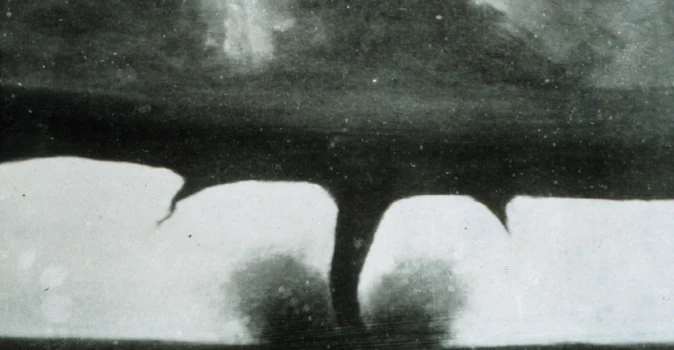
The dramatic tornado photograph widely circulated for over a century, depicting a thick central funnel with two thinner vortices spiraling from its flanks, has long been revered as the earliest photographic record of such a meteorological phenomenon. However, contemporary historical and meteorological analysis suggests this iconic image was likely retouched, its visually striking cloud base potentially painted in or composited from another negative to enhance its commercial appeal. The actual pioneering photograph, far less cinematic yet profoundly significant, emerged four months earlier on April 26, 1884. It captures a faint, ethereal gray thread against a muted sky, the diligent work of A. A. Adams, a Kansas fruit grower and former photographer who, by a stroke of both fortune and preparedness, possessed the necessary equipment and skill to document the rare event. This unassuming image, now widely recognized as the oldest surviving photograph of a tornado, was secured by Adams through the meticulous process of keeping a heavy, cumbersome camera perfectly still as the distant funnel cloud slowly traversed the plains of Anderson County.
The Genesis of Documenting Nature’s Fury: A. A. Adams’ Pioneering Lens
A. A. Adams’ journey to capturing this pivotal moment in meteorological history began long before the storm itself. Having relocated to Anderson County, Kansas, in 1867 to cultivate fruit, Adams carried with him a legacy from his previous profession: the robust equipment of a photography studio operator. This retained gear proved instrumental on the afternoon of April 26, 1884, when a tornado materialized approximately 14 miles west of Garnett, near the small settlement of Westphalia. Eyewitness accounts from the period describe a funnel cloud that drifted slowly toward the northeast, remaining visible for an astonishing period of close to half an hour. This extended visibility provided Adams with a unique window of opportunity, a luxury that would have been impossible with a faster-moving storm. He swiftly retrieved his camera, strategically positioned it on a corner near the United Presbyterian Church in Garnett, and proceeded to expose a photographic plate.
The resulting image, while historically invaluable, is visually understated. It reveals a slender, rope-like funnel, subtly bent, suspended beneath a flat, unassuming cloud base, with the silhouette of the town etched across the foreground. The photograph lacks the inherent drama often associated with depictions of powerful natural disasters; there are no swirling debris fields or ominous, dark skies. Yet, this very ordinariness lends the image its profound authenticity. It precisely reflects the appearance of a distant, dissipating tornado, a quality that has garnered the unwavering trust of historians and meteorologists alike. It is not a colossal black wedge dominating the horizon, but rather a pale, ambiguous line that demands careful observation. Adams, with an objective eye, recorded the phenomenon precisely as it presented itself, eschewing embellishment for factual representation.
Adams himself understood the significance of his capture. He meticulously printed the image onto cabinet cards and stereographs, selling them within the community. This entrepreneurial spirit capitalized on the parlor-stereoscope craze, which was then nearing its zenith in the 1880s, allowing individuals to view three-dimensional images in their homes. By the time of his passing in 1907, local newspapers had already begun crediting him with the distinction of having taken the first-ever photograph of a tornado. Today, prints made from his original negative are carefully preserved within the collection of the Kansas Historical Society, serving as tangible links to this groundbreaking moment.
Verifying History: The Unassailable Evidence
In the modern era, meteorologists and historians have moved beyond anecdotal claims, rigorously testing Adams’ assertion rather than accepting it on faith. This verification process has unearthed compelling evidence that solidifies the photograph’s status as the earliest authentic record. The date of the photograph aligns perfectly with the meteorological data of the era, specifically the Signal Corps weather maps. These maps, which provided crucial weather observations before the establishment of the U.S. Weather Bureau, clearly indicate a weather system capable of generating such a storm in the region on April 26, 1884. Furthermore, a detailed account published in a Garnett newspaper from that period describes a funnel cloud whose characteristics and trajectory precisely match those depicted in Adams’ photograph.
Crucially, a wider, less-cropped version of Adams’ image precisely positions the United Presbyterian Church in Garnett where historical records indicate it stood. This architectural detail unequivocally anchors Adams’ vantage point to a specific, verifiable location on a real street in Garnett, providing irrefutable proof of the photograph’s authenticity and context. This robust trail of evidence far surpasses the verification standards available for almost any other early tornado picture, which often suffer from vague dating, uncertain locations, or dubious origins. It is precisely this meticulous cross-referencing and factual integrity that has led to Adams’ faint, unglamorous photograph, rather than the more famous, dramatic image, receiving the rightful credit as the first. The scientific community’s endorsement underscores the enduring value of accuracy over sensationalism in historical documentation.
Photography’s Infancy: Technological Constraints and Artistic Choices
The technical capabilities of photography in 1884 played a significant role in defining the nature of Adams’ image and, indeed, the entire first generation of tornado imagery. By this time, the demanding wet collodion process, which required photographers to coat, sensitize, expose, and develop a glass plate while it was still wet and tacky, was slowly being phased out. The advent of factory-made gelatin dry plates, introduced at the start of the decade by innovators like George Eastman, represented a monumental leap forward. Dry plates offered unprecedented convenience and speed. A photographer could load a plate prepared months in advance, expose it, and store it for later development, eliminating the frantic race against a drying chemical bath inherent in the wet-plate method. While wet collodion exposures were typically measured in seconds, gelatin dry plates allowed for what contemporary photographers termed "instantaneous work," though the exact speed varied greatly depending on the plate’s sensitivity, the lens aperture, available light, and development process.
Despite these advancements, mass-market "snapshot" photography was still several years away. Handheld "detective" cameras existed in the early 1880s but remained niche curiosities. It wasn’t until 1888 that George Eastman would introduce the first Kodak roll-film box camera, a revolutionary device that came pre-loaded and was shipped back to the factory for development, democratizing photography for the amateur. Adams, in 1884, would have relied on a substantial, tripod-bound plate camera, requiring him to compose and focus the image under a dark cloth. Achieving a clean, sharp frame demanded absolute stillness from both the camera and, ideally, the subject. The slow-moving tornado, visible for half an hour at a distance of 14 miles, provided Adams with the crucial element of time – time to observe its approach, transport his heavy gear, meticulously set up the tripod, carefully focus under the dark cloth, and finally, trip the shutter. The primary limitation was not solely the photographic emulsion itself, but the laborious, multi-step process that had to be executed before the plate was ready for exposure.
Another significant technical constraint of the era was the spectral sensitivity of ordinary gelatin emulsions. These plates were primarily sensitive to blue light and largely "blind" to red, which had a profound impact on how they rendered landscapes. Bright skies, rich in blue light, tended to overexpose and wash out to a flat white, creating a high-contrast effect where darker elements, like a distant tornado funnel, appeared as stark strokes against a blank field. This characteristic bleached quality seen in early tornado photographs was not an artistic decision but a direct consequence of the film’s inherent spectral response, capturing the world through a different visual filter than the human eye. This technological limitation dictated that the funnels successfully recorded were predominantly distant, slow-moving, and well-lit. The close-range, violently destructive tornadoes that define modern storm photography were, for many years, simply beyond the capture capabilities of the available technology.
The Allure of the Dramatic: F. N. Robinson’s Contested Image
Just four months after Adams’ groundbreaking photograph, on August 28, 1884, another image emerged that would, for nearly a century, eclipse Adams’ achievement in public recognition. F. N. Robinson, a photographer in what was then Dakota Territory, captured a spectacular scene near Howard. His photograph depicts a menacing black funnel, seemingly accompanied by two smaller vortices swirling off its flanks. This was indeed a genuinely violent storm, later retrospectively rated as an F4 on the Fujita scale, indicating immense destructive power. The outbreak to which this tornado belonged was devastating, claiming the lives of at least six people, with some later reconstructions estimating the toll at seven. Robinson made at least two exposures, possibly a third, and shrewdly copyrighted his image through the Library of Congress. He then marketed it extensively as cabinet cards. Two of these original cards survive in the South Dakota State Archives, one bearing the unequivocal caption on its reverse: "The only cyclone ever photographed was taken by F. N. Robinson, Miner County, D.T. August 28, 1884." This inscription clearly illustrates how the misattribution regarding the "first" tornado photograph originated and perpetuated. For decades, this dramatic image was widely reproduced and celebrated, even residing in NOAA’s prestigious photo library, as the earliest photographic record of a tornado.
However, the authenticity of Robinson’s image, particularly its striking visual complexity, has come under scrutiny. Thomas P. Grazulis, the eminent authority whose encyclopedic reference work, "Significant Tornadoes," stands as the definitive chronology of American tornado history, has expressed significant reservations. Grazulis bluntly stated, "This photo was probably touched up or combined with another photograph that had a more interesting cloud base." He further elaborated on the common practice of the era: "Early photographs were frequently altered to make them more saleable commercially." The commercial imperative was clear: a visually arresting, dramatic funnel cloud sold cabinet cards and stereographs far more effectively than a faint, ambiguous gray thread. The marketplace rewarded photographers willing to enhance their images, even through artistic intervention like painting in a more dramatic cloudscape. Thus, Robinson’s image triumphed over Adams’ in commercial circulation precisely for the reasons it now falters in the archival assessment: the plainer, unadulterated photograph by Adams is recognized as the more honest depiction, while honesty was not necessarily the primary attribute nineteenth-century buyers sought. This historical confusion has proven remarkably persistent, with even major news outlets occasionally misidentifying the oldest image or date, underscoring the tangled nature of early photographic claims.
The Evolution of Tornado Documentation and Research
Before the advent of photography, tornado research relied heavily on subjective and often imprecise methods. Eyewitness testimony, while valuable, was prone to human error, exaggeration, and varying perspectives. Sketches, weather observations, and post-event damage surveys provided some data, but all left considerable room for uncertainty and interpretation. The introduction of photography, even with its early technical limitations, marked a pivotal shift. A photograph, regardless of its artistic merit, offered a verifiable, objective record. It pinned down the real shape and scale of a tornado in a way that a frightened eyewitness, struggling to recall details amidst chaos, simply could not. This objective evidence became a foundational element for more systematic meteorological study.
However, the early enthusiasm for tornado photography was not without its pitfalls. The demand for compelling tornado pictures often outstripped the supply of genuine ones, leading to a proliferation of fabricated or composited images. Several celebrated tornado photographs from the late 19th century have since been exposed as products of manipulation, featuring painted funnels meticulously integrated into real landscape negatives. A particularly clear example involves a pair of images depicting tornadoes at Waynoka, Oklahoma (dated May 17, 1898), and Kirksville, Missouri (dated April 27, 1899). Investigations have traced both back to the same forged funnel, painstakingly drawn in India ink on glass and then printed onto actual landscape negatives. Even at the time, the meteorological community detected these deceptions; the prestigious Monthly Weather Review published a debunking article under the blunt heading "Spurious Tornado Photographs." Another image, purporting to show a tornado in the Oklahoma City area on May 12, 1896, and credited by its holding archive as the "first known tornado photograph," also falls into this contested territory, further illustrating the pervasive ambiguity surrounding early photographic claims.
Verifiable storm photography gradually solidified through the turn of the century, driven by improved plates and, eventually, roll film, which captured funnels that could be cross-referenced with damage paths and eyewitness accounts. A significant 1984 study published in the Bulletin of the American Meteorological Society meticulously traced many of these early pictures back to their sources, effectively separating the genuine from the doctored. Decades earlier, the U.S. Weather Bureau had already begun integrating photographs into its damage assessment protocols, recognizing their unparalleled value. This systematic approach later formed the basis for Dr. Tetsuya Fujita’s revolutionary intensity scale, which still bears his name today. The Fujita scale, rated from F0 to F5 based on the severity of documented damage, allows for a standardized assessment of tornado intensity. Applying this scale retrospectively to reconstructed damage accounts is the only means by which a storm from 1884, like Robinson’s F4 tornado, can be assigned a modern intensity rating, albeit with an asterisk acknowledging the historical context. The modern national tornado database maintained by NOAA and the Storm Prediction Center systematically begins much later in the 20th century, though the Signal Corps and Weather Bureau documented tornadoes long before that, albeit not in a format that supports consistent modern ratings.
The Enduring Legacy and Modern Imperatives
Modern photographic equipment has effectively eliminated every technical limitation Adams faced. Any contemporary weather-sealed camera body can achieve in an instant what required Adams a heavy tripod, a dark cloth, and a precious half-hour of warning. Consequently, the constraints on tornado photography ceased to be purely technical a long time ago. Today, the primary consideration is one of judgment and safety. The honest and unequivocal advice from meteorological experts is to maintain a safe distance. Storm chasing, despite its scientific contributions and popular appeal, remains an inherently dangerous endeavor, claiming the lives of even the most qualified individuals in the field. The tragic events of May 31, 2013, serve as a stark reminder: the El Reno tornado, one of the widest and most erratic tornadoes ever recorded, rain-wrapped and fast-moving, claimed the lives of renowned storm researcher Tim Samaras, his son Paul, and colleague Carl Young, along with amateur chaser Richard Henderson. An intense subvortex hidden within the main circulation unexpectedly looped toward their vehicle, underscoring the unpredictable and lethal nature of these storms. The fundamental truth remains: if a funnel cloud is close enough to capture a detailed photograph, it is likely close enough to pose a mortal threat. The advice issued by the Signal Corps nearly a century and a half ago, and reiterated by NOAA today, has not changed: prioritize getting to shelter, not to a vantage point.
None of these modern realities, however, diminish the monumental achievement of a Kansas fruit grower on a quiet spring afternoon in Garnett. A. A. Adams stood on a street corner, held a wooden camera steady, and allowed a slow, distant gray funnel to meticulously burn its image onto a sheet of glass. The resulting picture is thin, unglamorous, and devoid of the dramatic flair that would later captivate the public imagination. Yet, it stands as the inaugural moment a tornado truly sat for a portrait, providing humanity with its first objective, verifiable glimpse into the elusive and awe-inspiring power of these atmospheric giants. Its enduring value lies not in its aesthetic appeal, but in its unwavering fidelity to a historical truth, forever marking a pivotal shift in our understanding and documentation of severe weather.
