
 By Nila Kartika Wati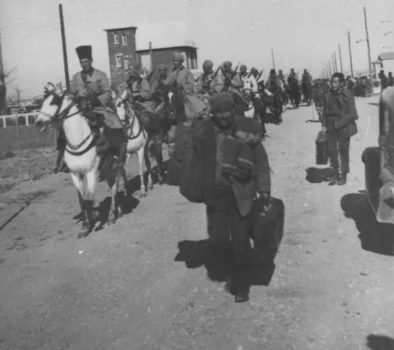
In December 2007, a profound moment in photographic history unfolded at the International Center of Photography (ICP) in New York, as three unassuming cardboard boxes arrived, containing a treasure trove that had been lost for nearly seven decades. Within these containers lay 126 rolls of 35mm film and approximately 4,500 negatives, a visual testament to the brutal realities of the Spanish Civil War. This extraordinary cache, known colloquially as "The Mexican Suitcase," brought to light the missing works of three pioneering photojournalists: Robert Capa, Gerda Taro, and David "Chim" Seymour. These young visionaries were instrumental in forging the very language of modern war reporting, embedding themselves in the heart of conflict, a proximity that would tragically claim all three of their lives on assignment in different wars. The collection also included several rolls of intimate portraits of Capa and Taro, captured in Paris by Fred Stein, along with crucial frames shot prior to the war’s outbreak, offering a rare glimpse into the personal lives of these figures before they became legends. The film had vanished from a Paris darkroom in the tumultuous period preceding World War II and resurfaced, almost miraculously, in a Mexico City apartment, after a circuitous journey whose middle stages remain shrouded in mystery. For generations, few believed this invaluable historical record still existed.
The Unlikely Survival: A Legacy Rescued from Oblivion
The material now famously referred to as the Mexican Suitcase is not, in fact, a single piece of luggage but three flat boxes, meticulously subdivided into small compartments. These held rolls of film predominantly exposed between May 1936 and the spring of 1939, encompassing the entirety of the Spanish Civil War. A few earlier frames, such as Stein’s evocative portraits of Capa and Taro in Paris and Chim’s poignant image of a mother nursing a baby near Badajoz – both captured months before the war ignited in July 1936 – underscore the chronological breadth of the collection. The rolls were organized within numbered compartments, accompanied by handwritten labels and detailed diagrams identifying many of the specific assignments. This meticulous production detail proved invaluable, allowing archivists and scholars to reconstruct the precise sequence of surviving exposures and, in numerous cases, the specific photographic assignments they belonged to.
This level of meticulous ordering profoundly amplified the significance of the find. A single, iconic print, while powerful, represents only what the photographer or editor ultimately selected for public consumption. A complete roll of film, by contrast, offers an unparalleled window into the photographer’s creative process: what frames they rejected, how close they positioned themselves to their subjects, how many exposures they "burned" before capturing the definitive shot that made it into a magazine, and, crucially, whether a seemingly spontaneous scene was, in fact, entirely unposed. For decades, scholars of the Spanish Civil War had grappled with the iconic images of the conflict but lacked the complete rolls from which they originated. The Mexican Suitcase provided these full rolls, and with them, the potential to create contact sheets and a far more comprehensive record of each assignment, reconstructible from the rediscovered negatives.
The International Center of Photography, recognizing the monumental importance of this recovery, proudly put the work on public view from September 24, 2010, through May 8, 2011, accompanied by the publication of a comprehensive two-volume study. Among the newly revealed frames were Capa’s harrowing coverage of exhausted Republican refugees being marched along the beach at the Le Barcarès internment camp in France in March 1939, capturing the tragic aftermath of the Republic’s collapse. Also included was Chim’s quiet, humanistic image of a mother nursing her baby at a land-reform meeting near Badajoz, a powerful counterpoint to the battlefield scenes. Furthermore, the collection yielded Capa’s remarkable photographs of Ernest Hemingway and the celebrated correspondent Herbert Matthews at Teruel in late December 1937, offering intimate glimpses of prominent figures amidst the conflict.
The Architects of Modern War Reporting: Capa, Taro, and Chim
To fully grasp the profound impact of these recovered boxes, one must understand the lives and revolutionary photographic practices of the individuals who exposed the film. The man the world would come to know as Robert Capa was born Endre Friedmann in Budapest in 1913. His professional and personal partner, Gerda Taro, entered life three years earlier, in 1910, as Gerta Pohorylle in Stuttgart. Both were Jewish émigrés in Paris in the mid-1930s, struggling to sell their work under their distinctly foreign-sounding names in an increasingly xenophobic and anti-Semitic market hostile to left-leaning artists. It was out of this necessity that they constructed a brilliant fiction. They invented a glamorous, successful American photographer named Robert Capa, selling Friedmann’s work under this alluring moniker, with Taro shrewdly presenting herself as his agent. The "Robert Capa" persona proved far more commercially viable than either of them had achieved individually, eventually leading Friedmann to permanently adopt the name.
The third pivotal figure, David "Chim" Seymour, was born Dawid Szymin in Warsaw in 1911. He signed his Spanish Civil War photographs simply "Chim," a playful nickname derived from the Polish pronunciation of Szymin, and only formally adopted the name David Seymour in 1942, after finding refuge in the United States. All three photographers converged on Republican Spain from 1936 onward, working in overlapping geographical areas, sharing professional networks, and moving within the same tight-knit personal circles. Their collective approach to photojournalism was nothing short of radical for its era. They worked with an unprecedented intimacy, on foot, employing small 35mm cameras (Capa and Chim primarily used rangefinders; Taro made much of her early Spanish work with a Rolleiflex, later also moving to 35mm), placing themselves directly in the midst of unfolding events rather than observing from a safe, detached distance. This deliberate proximity and raw honesty infused their pictures with a modern sensibility, creating a visceral connection between the viewer and the conflict. It was also this very intimacy that kept all three perpetually within the dangerous range of the wars they covered, ultimately leading to their deaths on assignment.
Gerda Taro was the first of the trio to perish. On July 25, 1937, while covering the Republican retreat from the brutal Battle of Brunete, she was riding on the running board of a car when an out-of-control Republican tank tragically collided with it. Taro was thrown to the ground and run over, succumbing to her catastrophic injuries the following day. At just 26 years old, she is widely recognized as the first woman photojournalist killed while covering combat at the front lines, a tragic testament to her courage and dedication. Robert Capa, despite surviving Spain’s crucible, continued to cover major conflicts, notably photographing the D-Day landings in Normandy, France, in 1944. In 1947, he co-founded the legendary Magnum Photos cooperative with Henri Cartier-Bresson, Chim, George Rodger, and others, an agency that would redefine photojournalism. Capa’s own life ended on May 25, 1954, when he stepped on a landmine in Thai Binh, in what was then French Indochina, while on assignment for Life magazine. Chim, who assumed the presidency of Magnum after Capa’s death, was himself killed by machine-gun fire near the Suez Canal on November 10, 1956, while covering the Suez Crisis. Of the three extraordinary photographers whose film filled those long-lost boxes, only Taro did not outlive the Spanish Civil War that propelled them to prominence; Capa and Chim both survived that conflict, only to meet their ends years later while covering other global struggles.
The Unfathomable Journey: A Rucksack, a Chilean Consul, and a Mexican General
The incredible journey of these negatives began in the chaotic autumn of 1939. Robert Capa had already departed for the United States in October of that year, leaving his negatives in the care of his trusted darkroom manager, a Hungarian named Imre Weisz, universally known as Csiki. As German forces inexorably closed in on Paris in the spring of 1940, Csiki faced a desperate choice. His actions form the poignant human core of this entire saga. Decades later, in a letter dated 1975 (though misdated by a year in his recollection), Weisz recounted the pivotal moment with stark clarity: "In 1939, when the Germans approached Paris, I put all Bob’s negatives in a rucksack and bicycled it to Bordeaux to try to get it on a ship to Mexico. I met a Chilean in the street and asked him to take my film packages to his consulate for safekeeping. He agreed."
While Csiki’s account provides a vital first-person perspective, the exact route of the film’s escape remains somewhat debated, with some historical accounts suggesting a path through Marseille in addition to Bordeaux. The middle stages of the negatives’ journey are indeed genuinely murky, a testament to the wartime chaos and the clandestine nature of their transit. What is clearer, however, is their eventual destination. At some indeterminate point, the boxes came into the possession of General Francisco Aguilar González, a distinguished Mexican diplomat who served as ambassador to the Vichy government around 1941 and 1942. General Aguilar González, perhaps recognizing their intrinsic value or simply acting on a humanitarian impulse to preserve cultural artifacts, transported them to Mexico City. There, they lay, largely forgotten and undisturbed, for the better part of half a century, a silent repository of history awaiting rediscovery.
Remarkably, Imre Weisz himself would also eventually find his way to Mexico. After being interned in North Africa during the war, he ultimately reached Mexico, where he married the renowned surrealist painter Leonora Carrington and lived out the remainder of his life. Tragically, Csiki passed away in early 2007, just months before the very boxes he had so bravely endeavored to save finally arrived in New York. He never witnessed their triumphant homecoming.
The negatives resurfaced through the efforts of Benjamin Tarver, a Mexican filmmaker who had inherited them from an aunt whose family had long-standing ties to General Aguilar González. Tarver, keenly aware that he possessed something extraordinary, initiated contact with various scholars and, eventually, with the ICP. However, negotiations for the collection’s transfer proved protracted. The deadlock was ultimately broken by the persistent mediation of Trisha Ziff, a dedicated curator and filmmaker based in Mexico City. Ziff tirelessly worked to bridge the gap between Tarver and the institution, eventually physically transporting the boxes to New York. On December 19, 2007, the material was formally handed to Cornell Capa, Robert Capa’s younger brother, who had founded the ICP in 1974 with the express mission of preserving precisely this kind of historically significant photographic work. Ziff later meticulously chronicled the full, captivating story in her 2011 documentary, also titled The Mexican Suitcase.
Beyond the Icon: Re-evaluating Authorship and the Falling Soldier Debate
The most quietly profound impact of the Mexican Suitcase was its ability to dramatically sharpen the attribution of photographs. Because Robert Capa and Gerda Taro had shared a byline and a closely intertwined professional and personal life, and because Taro’s early death and subsequent gradual erasure from historical narratives meant that much of her genuinely groundbreaking work had been erroneously absorbed into the broader "Capa legend." The recovered rolls, when meticulously examined alongside their accompanying notebooks and assignment records, finally allowed researchers to definitively separate Taro’s frames from Capa’s with a precision that had previously been impossible. This critical work was already underway even before the boxes landed in New York; the ICP had opened the first major American retrospective of Taro’s photographs on September 26, 2007, almost three months prior to the Suitcase’s arrival. Thus, what arrived in December was not the initial moment of her authorship’s recovery, but rather a massive new body of incontrovertible evidence that solidified it.
While photographic format had previously offered some clues – in Taro’s earliest Spanish work held in other collections, her square Rolleiflex frames cleanly differentiated from Capa’s rectangular 35mm exposures – this distinction did not apply to the Suitcase, which contained exclusively 35mm film. By 1937, both photographers were primarily shooting 35mm. Inside these boxes, the crucial evidence for attribution lay in the meticulous notebooks, the handwritten assignment labels, and the sequential order of frames along each roll. This granular data allowed, for instance, Taro’s extensive coverage of the training of the new People’s Army near Valencia in early 1937 to be credited to her with a far greater degree of confidence. However, it is also important to acknowledge that the boxes did not settle every single question. In instances where two photographers worked the same ground using the same film stock, some frames still rely on informed scholarly judgment rather than absolute, irrefutable proof.
Then there is the photograph that everyone hoped the Mexican Suitcase would definitively explain: Robert Capa’s iconic Falling Soldier. This powerful image, depicting a Republican militiaman at the very instant of death, first appeared in the French magazine Vu on September 23, 1936, and later in Life on July 12, 1937, swiftly becoming the defining visual symbol of the Spanish Civil War. Yet, for over half a century, it has been the subject of intense debate and scrutiny. Was the man truly shot at that precise moment, or was the scene staged or arranged during a lull in fighting? Was he indeed at Cerro Muriano on September 5, 1936, as was long claimed?
Many assumed that the arrival of the Mexican Suitcase would finally put an end to this enduring debate by producing the original negative of the Falling Soldier. It did not. That specific, crucial frame is not present within the boxes. While the Suitcase does hold related Capa film from the same broader period and geographical area, the critical exposure, and the sequence of frames immediately surrounding it, remains conspicuously absent. Separately, the researcher José Manuel Susperregui, through a meticulous analysis of the landscape visible in the background of associated pictures, concluded that the actual location was likely near the town of Espejo, approximately 50 kilometers from Cerro Muriano – the site long asserted for the image. This geographical discrepancy, if true, would significantly reduce the likelihood of an accidental combat death and, conversely, make a staged scenario more plausible. Despite these findings, the late Richard Whelan, Capa’s definitive biographer, staunchly defended the picture’s authenticity until his death. The honest scholarly position today is that the question remains open. The Mexican Suitcase deepened the available evidence and provided invaluable context, but it did not deliver the single, definitive frame that would have irrevocably closed the case, and that very absence constitutes its own small, enduring drama.
The Enduring Relevance: Lessons in Preservation and the Pursuit of Truth
While this might appear as a captivating museum story, the practical lessons embedded within the narrative of the Mexican Suitcase resonate powerfully with our contemporary reality, particularly concerning digital preservation. These pioneering photographers shot on film, a tangible, physical object that, as demonstrated, could be stashed in a rucksack, bicycled out of a war zone, entrusted to a complete stranger, and then, against all odds, rediscovered in a drawer 68 years later. Yet, film also has its own inherent vulnerabilities. It can burn, flood, mold, fade, and indeed, vast quantities of historical film have been irretrievably lost, often discarded by individuals unaware of its priceless content. These specific negatives survived not because film is inherently safer than a hard drive, but because a succession of individuals, at each critical juncture of its journey, consciously chose to preserve them and pass them on.
This underscores a vital lesson for the digital age: a digital archive possesses the potential to outlive any single physical copy, but only if it is underpinned by the same deliberate intent and proactive strategies. This includes maintaining redundant copies in multiple, geographically diverse locations, regularly testing backups to ensure they can actually be restored, embedding metadata that will remain meaningful and interpretable decades into the future, and consistently migrating files forward before their original formats become obsolete or unreadable.
The other profound lesson imparted by the Mexican Suitcase concerns the crucial distinction between a curated "picture" and a comprehensive "record." For the better part of a century, the world primarily knew Capa, Taro, and Chim through a select handful of prints, carefully chosen and presented by editors and, indeed, by the photographers themselves. The recovery of the complete negatives and their accompanying notebooks transformed that meticulously curated legend back into raw, verifiable evidence. It restored Gerda Taro to her rightful place as an independent, influential artist, attributing to her a significant body of work that had long been miscredited. Furthermore, it forced a more nuanced and careful conversation about one of the most reproduced and debated images ever made, Capa’s Falling Soldier. The message is clear and resonates with contemporary journalistic practice: "Keep your outtakes. Keep your metadata. Somewhere down the line, the frames you did not publish may be the ones that tell the truth." The Mexican Suitcase stands as a powerful testament to the enduring value of primary sources, the fragility of historical memory, and the unwavering importance of truth in an age saturated with images.
