
 By Jia Lissa
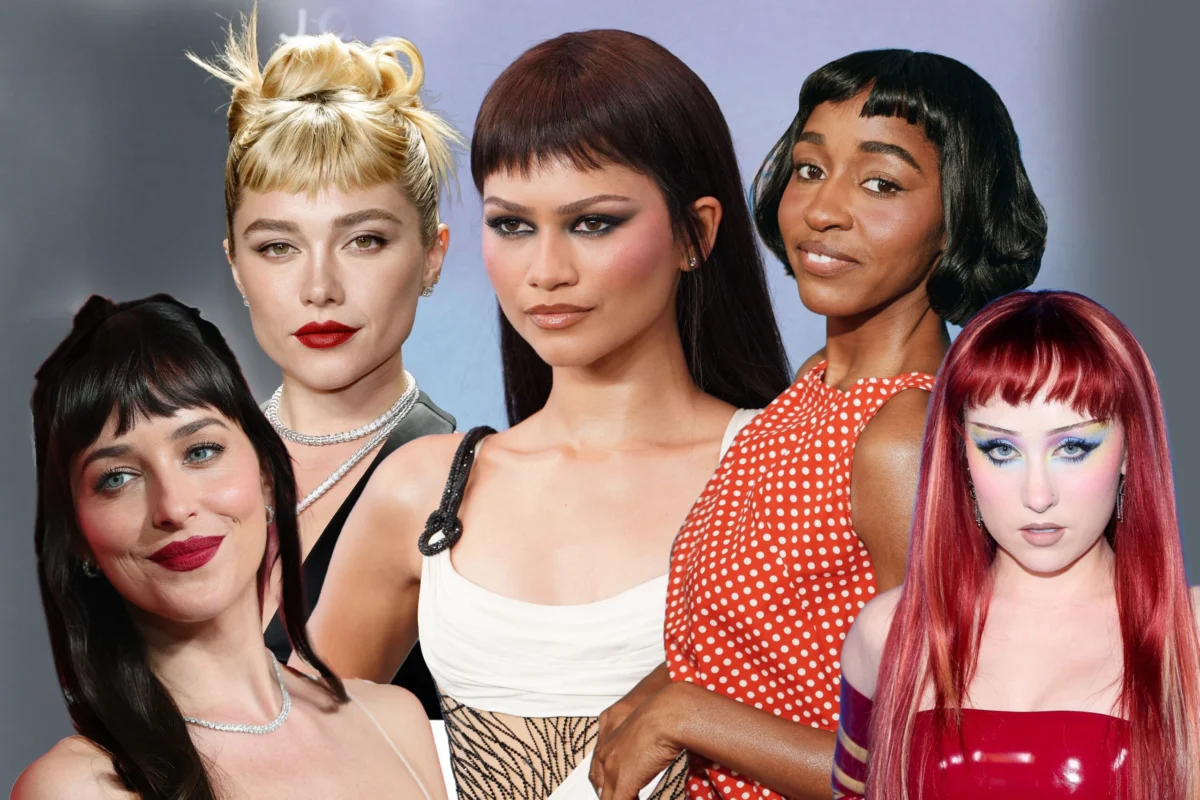
Move over, curtain bangs—there’s a new celebrity-loved fringe trend in town. Well, OK, that might be a bit of hairstyle hyperbole. It’s not actually new, but after several years of long, coquettish curtain-esque fringe à la Sabrina Carpenter dominating the conversation, a noticeable shift in how stars are snipping (or clipping) their bangs has emerged. Re-enter the baby bang, which is experiencing an exciting red carpet resurgence. Prominent figures like Florence Pugh, Ayo Edebiri, Zendaya, Zoë Kravitz, and Dakota Johnson have all experimented with this distinct fringe style, in variations that range from subtly short to strikingly brief.
This trend could signal a broader cultural pivot, mirroring the resurgence of bold lip color. The baby bang’s ascent suggests a pendulum swing back towards higher-maintenance or more statement-making glam. Following a half-decade largely dominated by low-key, minimal, and seemingly “effortless” hair and makeup, the natural progression points towards styles that are more deliberate and impactful—such as short bangs that boldly bare the brow and a significant portion of the forehead.
A Reaction to the "Lived-In" Aesthetic
Celebrity hairstylists are observing this shift as a conscious departure from the prevailing "lived-in" trend. Charles Love, an Austin-based celebrity hairstylist, posits, "I think people are wearing baby bangs right now as a reaction to the ‘lived-in’ trend. Baby bangs make a statement, and if you’re using a clip-in to create a look, it’s totally noncommittal—so why not?" This sentiment is echoed by Franck Izquierdo, co-founder of IGK, who notes, "For a few years, everything was about the lazy-girl or lived-in look: long layers, curtain bangs, hair that looks like you didn’t try. Baby bangs are the opposite. It’s a move from low-maintenance to intentional, where people want their hair to have a point of view again."
Defining the Baby Bang: Beyond the Micro Fringe
The distinction between a baby bang and its even shorter counterpart, the micro bang, is crucial for understanding the nuances of this trend. According to Love, a baby bang is typically cut one to two inches above the brow, with its texture contributing to a "more specific personality." These bangs can manifest in various forms: blunt, wispy, choppy, piecey, or a combination thereof, adaptable to individual hair textures and face shapes. While the terms are often used interchangeably, Love clarifies that micro bangs are generally cut closer to the hairline, often with a rougher, more defined, and punk-inspired texture.

The "Pow" Factor: Red Carpet Impact and Statement Hair
Shorter fringe inherently possesses a "pow" factor that amplifies drama, explaining its enduring presence on the red carpet. Adam Federico, a hairstylist and vice president of creative development at R+Co, observes, "They create an immediate disruption. You can take a beautiful, classic haircut, introduce a short fringe, and suddenly it has an entirely different energy. There’s something both innocent and rebellious about them." Federico characterizes the baby bang trend as "a return to intentional haircutting with less reliance on styling and more emphasis on the actual shape—that beautiful intersection of precision, individuality, and rebellion."
The visual impact of baby bangs is undeniable. When Zendaya sported strikingly short, choppy baby bangs in July 2026, the look garnered significant media attention, highlighting the style’s ability to instantly transform a celebrity’s appearance and command a photographic presence. Similarly, Florence Pugh’s pairing of choppy short bangs with an updo and a bold red lip at a Jaguar event in early October underscored the trend’s versatility and its ability to add a touch of edgy sophistication to classic styling. These instances exemplify how the baby bang can serve as a focal point, drawing attention to the eyes and framing the face in a bold new way.
A Historical Perspective: Decades of Daring Fringes
The baby bang is far from a new phenomenon; it boasts a rich history of cultural significance and stylistic evolution. Antoinette Beenders, a renowned hairstylist and senior vice president of global artistry at Aveda, points to Audrey Hepburn’s iconic short ’50s fringe, a pivotal element in her portrayal in the film Roman Holiday, as a key moment in bringing baby bangs to mainstream consciousness. Izquierdo further cites Bettie Page as another foundational figure, whose vixenish fringe continues to inspire rockabilly enthusiasts to this day. The shorter style also made its mark during various influential periods, including the mod ’60s, the punk ’80s, and the grunge-influenced ’90s. "For me, baby bangs coming back is a good sign," Izquierdo remarks. "It means people are ready to have fun with hair again." This historical recurrence suggests that the baby bang embodies a spirit of playful rebellion and individuality that resonates across generations.
The Rise of the Clip-In: Experimentation Without Commitment
In an era where celebrity hairstyling often involves the strategic use of wigs and hairpieces, many stars can embrace the baby bang trend without permanently altering their hair. This accessibility through clip-in extensions plays a significant role in the trend’s popularity. Izquierdo explains, "It’s the fastest way to change your whole look without touching the rest of your hair. One small piece and suddenly the face reads totally different: more fashion, more editorial. And with clip-ins, there’s zero commitment. You get the drama for one night and take it out the next morning." Beenders highlights the aesthetic appeal of juxtaposing a classic, polished updo with slightly imperfect short bangs, a combination that offers a sophisticated yet daring contrast.

Navigating the Length: Finding Your Perfect Baby Bang
For those considering a more permanent commitment to the baby bang, expert advice is available. Beenders suggests a simple method for determining the most flattering length: place your hand horizontally over your forehead and move it up and down to gauge which position best complements your facial structure. She notes that baby bangs can have an elongating effect on the face, which may contribute to their current popularity.
For individuals experiencing "fringe-related cold feet," Jennifer Lawrence and Dakota Johnson’s slightly longer fringe offers a gentler introduction. Izquierdo describes these as "the bridge between a classic fringe and a baby bang," possessing a "cool, slightly French, ’60s feeling" that is more manageable and easier to style. This length also provides the flexibility to sweep the bangs to the side when a break is desired. "If you’re curious about baby bangs but nervous, start [with that longer length]," Izquierdo advises. "You can always go shorter next time."
Maintaining the Statement: Regular Trims for Precision
The maintenance of short bangs requires diligence to preserve their intended impact. Federico recommends regular trims every three to four weeks, emphasizing that "a few millimeters really change everything with a bang this short." This consistent upkeep ensures that the precision and sharp lines of the baby bang remain intact, preventing them from becoming unruly or losing their signature definition.
Broader Implications: A Symbol of Confidence
Beyond their aesthetic appeal, baby bangs are increasingly viewed as a sartorial statement. Charles Love articulates this sentiment by stating, "Baby bangs are a statement of courage and bravery. They say, ‘Look me in the eyes. I am here.’" This interpretation suggests that the trend transcends mere fashion, evolving into a symbol of self-assurance and a willingness to be noticed. The visual boldness of baby bangs commands attention, projecting an aura of confidence and a distinct personal style. As the trend continues to gain traction, its influence may extend beyond celebrity circles, inspiring a wider audience to embrace more daring and expressive hairstyles as a means of personal declaration. The ongoing resurgence of this historically significant fringe indicates a broader cultural embrace of individuality and a renewed appreciation for statement-making beauty choices.
