
 By admin
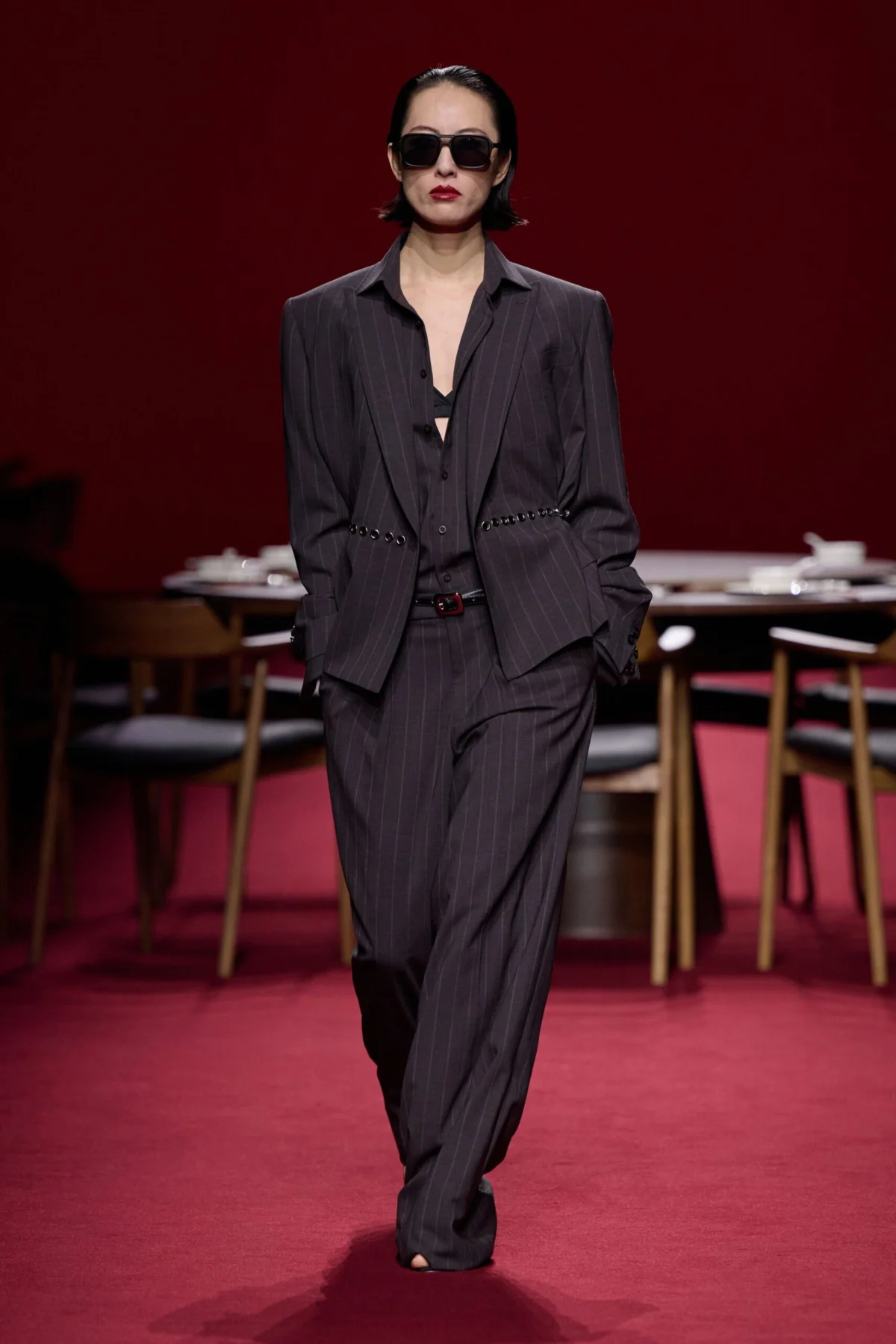
Shanghai recently bore witness to a compelling sartorial narrative as designer Shao Yang presented "Underworld Royale, Part 2: Softness in the Shadows," a collection that meticulously weaves together the gritty allure of 1990s Hong Kong gangster cinema with the designer’s deeply personal Taiwanese-American experience. This presentation followed an earlier, more intimate chapter staged as a performance at New York’s venerable Chinese Tuxedo restaurant, marking a significant evolution in the collection’s storytelling and thematic exploration. The Shanghai iteration, set against a red-lit, carpeted runway with a singular round restaurant table at its core, transformed the conventional fashion show into an immersive theatrical experience, inviting attendees to step into a world where toughness and vulnerability coalesce with sophisticated tailoring.
The Shanghai Staging: An Immersive Theatrical Experience
The choice of Shanghai for "Part 2" was strategic, leveraging the city’s dynamic fashion landscape and its status as a global hub for emerging design talent. Shanghai Fashion Week (SFW), renowned for its innovative approach and its role in fostering cross-cultural dialogue, provided an ideal platform for Yang’s nuanced vision. Unlike a traditional runway, Yang’s setup deliberately created an atmosphere of clandestine intimacy, reminiscent of the secretive gatherings often depicted in the gangster films that inspired her. The deep red lighting cast long shadows, imbuing the space with a sense of both danger and seductive mystery, while the plush carpeting softened the industrial edge typically associated with such narratives. At the very heart of this dramatic tableau, the round restaurant table served as a powerful symbolic anchor—a place where alliances are forged, betrayals unfold, and emotional truths are often laid bare, mirroring the complex human interactions central to the collection’s theme. This carefully orchestrated environment was not merely a backdrop but an active participant in conveying the collection’s underlying narrative, drawing the audience into Yang’s "Underworld Royale."
"Underworld Royale": A Cinematic & Personal Narrative
The "Underworld Royale" series is a testament to Shao Yang’s unique ability to translate complex cultural memories and personal histories into tangible, wearable art. "Part 1," showcased as a performance in the historical setting of New York’s Chinese Tuxedo, introduced the foundational elements of her vision: the juxtaposition of power and vulnerability within a culturally specific context. The Chinese Tuxedo, a landmark establishment with its own rich history connected to the Chinese diaspora in America, served as an evocative setting for the collection’s genesis, hinting at the hidden layers of identity and belonging. This initial chapter focused on establishing the mood and the cinematic references, presenting a raw, performative exploration of the gangster archetype.
The transition to Shanghai for "Part 2" allowed Yang to expand upon these nascent ideas, refining the "Softness in the Shadows" theme with greater sartorial depth and narrative clarity. While "Part 1" explored the initial confrontation with the "tough guy" persona, "Part 2" delved into the emotional latitude granted to these characters, peeling back layers to reveal an underlying sensitivity. This evolution mirrored Yang’s own journey of self-discovery, navigating the complexities of her Taiwanese-American heritage—a bicultural experience that often involves reconciling disparate cultural expectations and identities. The collection’s progression from performance to a more structured runway presentation underscored a maturation of the concept, transforming an evocative mood into a fully articulated fashion statement.
Deconstructing Toughness: The Collection’s Signature
At the core of "Softness in the Shadows" is Yang’s masterful deconstruction of traditional masculine archetypes, particularly the stoic, impenetrable figure of the gangster. She achieves this by meticulously challenging the very fabrics and silhouettes associated with such toughness. Leather jackets, iconic symbols of rebellion and rigidity, shed their conventional stiffness, re-emerging with a more pliable, almost fluid quality. Denim, another staple of ruggedness, was rendered softer, its texture inviting touch rather than asserting an unyielding exterior. Even sharp tailoring, historically synonymous with strictness and authority, loosened its grip, embracing a more relaxed, adaptable form.
Yang’s collection showcases a range of innovative pieces that embody this softened aesthetic. Asymmetrical three-piece suits in classic Prince of Wales checks and pinstripes reimagined formal wear with a subversive twist, disrupting conventional symmetry and introducing an element of controlled disarray. Cropped blazers, worn boldly over bras, played with notions of exposure and vulnerability, challenging traditional gendered dressing. Wrapped shirts cinched into peplums offered a delicate, sculptural silhouette that contrasted sharply with the implied aggression of their inspiration. Pinstriped waistcoats, stripped of their backs, exposed skin, injecting a sensual vulnerability into an otherwise formal garment. Slit satin skirts and strategically placed black leather added undeniable sex appeal, underscoring the collection’s exploration of multifaceted allure. Yet, the underworld’s inherent edge was not entirely abandoned; coated denim jumpsuits and broad, airbrushed denim suits maintained a sense of streetwise grit, demonstrating Yang’s ability to balance contrasting elements. For a designer whose career was founded in the exacting precision of made-to-measure tailoring, this approach to deconstruction is not arbitrary but rather a highly controlled and deliberate process, executed with an intimate understanding of garment construction. Each cut, drape, and seam is a calculated move to subvert expectations while maintaining impeccable craftsmanship.
Bridging Worlds: Cultural Memory and Street Codes
Shao Yang’s design philosophy is profoundly rooted in her bicultural identity, acting as a crucial bridge between distinct cultural realms. Her Taiwanese-American experience provides the personal "undertow" for her stories, infusing the cinematic inspirations with a lived authenticity. Growing up between Taipei and Brooklyn, Yang was uniquely positioned to absorb and synthesize diverse cultural influences, from the bustling street life of New York to the rich cinematic traditions of East Asia.
The 1990s Hong Kong gangster movies, such as those directed by Wong Kar-wai or John Woo, are not merely aesthetic references but deep wells of emotional and narrative complexity for Yang. These films, celebrated for their stylized violence, intricate plots, and profound explorations of brotherhood, loyalty, and existential angst, offered a blueprint for characters grappling with internal and external conflicts. Yang draws from their visual language—the dramatic lighting, the sharp suits, the melancholic gazes—but reinterprets them through a lens of contemporary vulnerability. This is then seamlessly blended with New York street codes, incorporating the raw energy, practicality, and rebellious spirit of urban fashion. The result is a unique synthesis: garments that speak to a globalized identity, where Asian cultural memory meets the assertive individualism of New York street style, creating a dialogue between tradition and modernity, East and West.
AAPI Design + Innovation Grant: Acknowledgment and Catalyst
Shao Yang’s rising prominence has been further solidified by her recent recognition as one of the recipients of the prestigious CFDA | Genesis House AAPI Design + Innovation Grant. This grant, a collaborative initiative between the Council of Fashion Designers of America (CFDA) and Genesis House, is designed to champion and support Asian American and Pacific Islander (AAPI) designers, fostering innovation and diversity within the fashion industry. The CFDA, a non-profit trade association of over 500 of America’s foremost fashion and accessory designers, plays a critical role in promoting American design on a global scale. Genesis House, a cultural hub for Korean artistry and innovation, partners with the CFDA to amplify AAPI voices, recognizing their significant yet often underrepresented contributions to the creative landscape.
Being named a recipient of this grant is not only a profound validation of Yang’s artistic vision and entrepreneurial spirit but also a significant catalyst for her brand’s growth and visibility. It provides crucial financial support, mentorship, and access to industry resources, enabling designers to overcome common hurdles in an increasingly competitive market. For Yang, this recognition underscores her unique position in bridging Asian cultural memory and New York street codes, signaling to the industry that her cross-cultural narrative and innovative approach are both relevant and vital. This grant is part of a broader industry movement to address systemic inequalities and celebrate the rich tapestry of global talent, ensuring that diverse perspectives are not just acknowledged but actively nurtured and integrated into the mainstream fashion discourse.
Shanghai Fashion Week: A Global Platform
Shao Yang’s decision to present "Underworld Royale, Part 2" at Shanghai Fashion Week (SFW) was a strategically astute move. SFW has rapidly evolved into one of the most dynamic and influential fashion events globally, distinguishing itself from its European counterparts by its embrace of innovation, digital integration, and a strong focus on emerging talent, particularly those with a unique East-meets-West perspective. The platform offers unparalleled access to a burgeoning Asian market, while also drawing significant international media attention.
For a designer like Yang, whose work intrinsically weaves together Asian cultural narratives with Western fashion sensibilities, SFW provides a naturally resonant environment. It allows her to connect with an audience that deeply understands and appreciates the nuances of her cultural references, from the specific tropes of Hong Kong cinema to the complexities of the Asian diaspora experience. Presenting in Shanghai not only amplified the collection’s reach but also served to strengthen the narrative’s authenticity, staging the "Underworld Royale" in a city that embodies the very essence of urban dynamism and cultural fusion that defines her brand. The strategic choice of SFW positions Yang at the intersection of global fashion trends and culturally specific storytelling, reinforcing her role as a significant voice in contemporary design.
Industry Perspectives and Critical Reception
The unveiling of "Softness in the Shadows" has elicited considerable interest within the fashion industry, particularly for its innovative approach to deconstructing traditional archetypes. Industry critics and observers are likely to highlight Yang’s bold reinterpretation of masculinity, noting how her "soft gangster" paradigm challenges conventional notions of power and vulnerability in fashion. The collection’s ability to infuse typically rigid garments with fluidity and emotional depth is a significant talking point, pushing boundaries beyond mere aesthetic changes to a more profound commentary on identity.
Fashion critics are expected to commend her precise execution of deconstruction, a testament to her foundational training in made-to-measure tailoring. This precision distinguishes her work from more haphazard attempts at deconstruction, ensuring that even the most "loosened" garments retain an air of sophisticated craftsmanship. The collection’s seamless integration of disparate cultural influences—Hong Kong cinema, Taiwanese-American heritage, and New York street style—is also anticipated to be a strong point of praise, positioning Yang as a leading voice in the growing movement of designers who authentically bridge global cultures through their work. The collection’s narrative depth, coupled with its innovative design, signals a significant contribution to the ongoing dialogue about gender fluidity, cultural identity, and the evolving landscape of contemporary fashion.
The Future Trajectory of Shao Yang’s Brand
With the momentum generated by the successful Shanghai presentation and the prestigious CFDA | Genesis House AAPI Design + Innovation Grant, Shao Yang’s brand is poised for significant future growth and influence. The grant not only provides financial backing but also invaluable mentorship and industry connections, which are crucial for scaling a nascent brand in the competitive fashion world. This dual recognition validates her unique vision and provides a robust platform for expanding her global reach.
Yang’s distinctive design philosophy—her ability to craft garments that are both emotionally resonant and impeccably tailored—positions her as a significant voice shaping new narratives in design. Her ongoing exploration of identity, culture, and gender fluidity through fashion offers a compelling alternative to more conventional aesthetics. Leveraging this momentum, Yang is likely to pursue further international presentations, explore new collaborations, and potentially expand her brand’s presence in key global markets. Her work stands as an inspiring example for other emerging designers, particularly those from diverse cultural backgrounds, demonstrating that authentic storytelling and innovative design can create a powerful and resonant brand identity that transcends geographical and cultural boundaries. Shao Yang is not merely creating clothes; she is crafting a compelling new language for contemporary fashion, one stitch at a time.
