
 By Nana Wu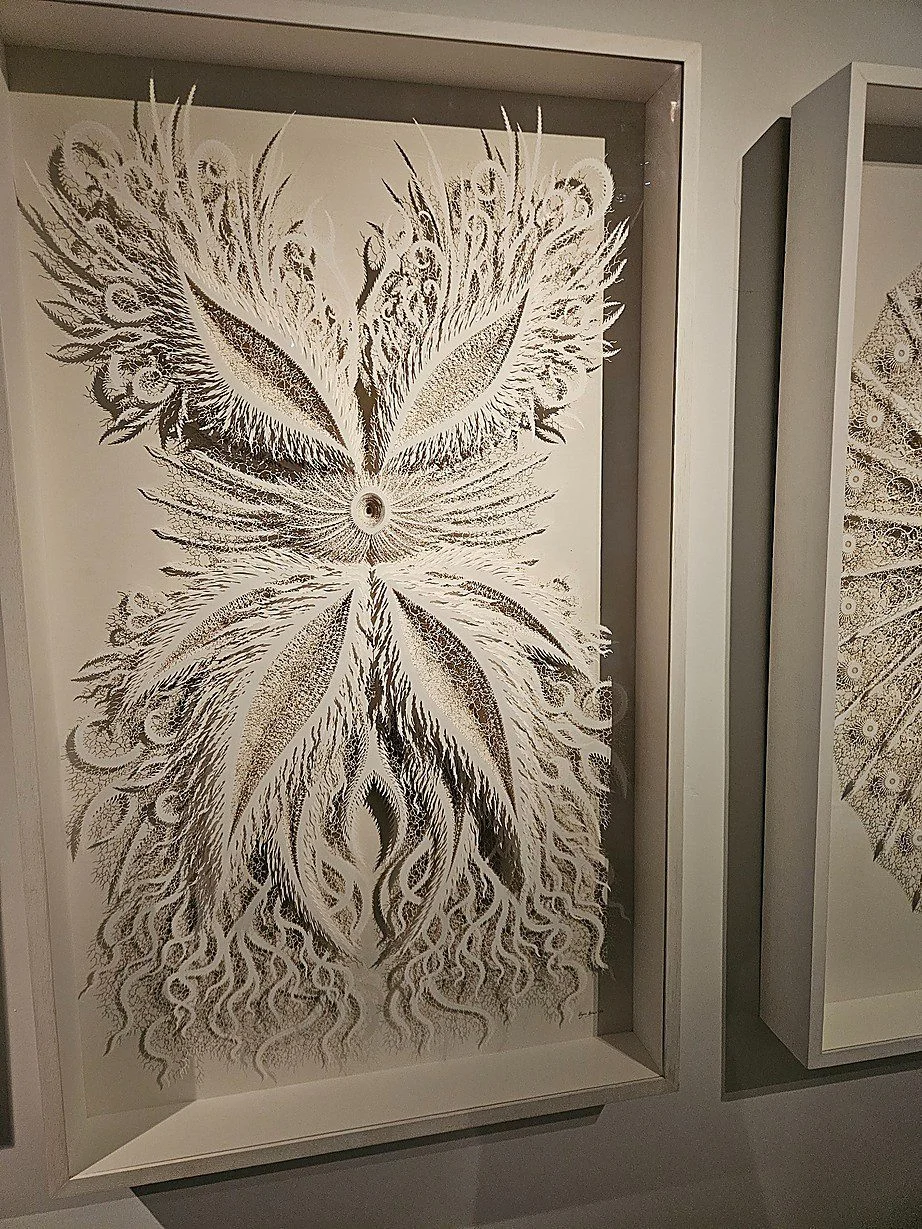
The Brooklyn Museum has officially opened its latest major retrospective, a comprehensive exploration of the work of Dutch fashion designer Iris van Herpen. Titled Sculpting the Senses, the exhibition departs from traditional chronological fashion displays, opting instead for an interdisciplinary immersion that situates van Herpen’s haute couture within the broader contexts of contemporary art, marine biology, and technological innovation. On view through December 6, 2026, the exhibition features over 140 garments and accessory pieces, curated alongside a diverse array of scientific specimens and design objects that have informed the designer’s nearly two-decade career.
Since founding her eponymous label in 2007, van Herpen has gained international recognition for bridging the gap between traditional craftsmanship and pioneering technology. This exhibition, which originated at the Musée des Arts Décoratifs in Paris before traveling to New York, serves as a testament to her role as a leader in the "Couture 2.0" movement. By integrating 3D printing, laser cutting, and chemical molding with intricate hand-weaving and embroidery, van Herpen has redefined the possibilities of the human silhouette.
A New Paradigm for Fashion Exhibition Design
The organizational logic of Sculpting the Senses is thematic rather than linear. The exhibition is divided into nine distinct sections, each exploring a different facet of van Herpen’s creative process. Visitors are guided through galleries where garments are staged in direct conversation with the natural and artificial objects that inspired them. This includes partnerships with works by artists such as Philip Beesley, Courtney Mattison, and Rogan Brown, as well as fossils and anatomical models.
The immersive nature of the exhibit is amplified by a multi-sensory environment. Soundscapes designed specifically for the galleries accompany the visual displays, emphasizing the designer’s interest in the relationship between the body and its surroundings. The garments themselves often appear to be in a state of flux—floating, expanding, or growing across the walls of the museum. This presentation style underscores the "sculptural" quality of van Herpen’s work, suggesting that her creations are not merely clothing but are autonomous art objects that challenge the boundaries of the physical form.
Chronology and the Evolution of a Visionary
Iris van Herpen’s rise to the pinnacle of haute couture is marked by a consistent pursuit of the "impossible" in garment construction. After studying at the ArtEZ Institute of the Arts in Arnhem and interning with Alexander McQueen in London, she launched her studio in Amsterdam. In 2011, she became a guest member of the prestigious Chambre Syndicale de la Haute Couture in Paris, a milestone that cemented her status in the global fashion hierarchy.
A pivotal moment in this chronology occurred in 2010, when van Herpen presented her first 3D-printed garment. Created in collaboration with architect Daniel Widrig and the company Materialise, the "Crystallization" top demonstrated how digital fabrication could produce geometries unattainable through manual sewing. This breakthrough set the stage for subsequent collections that explored magnetism, cymatics (the study of visible sound), and fluid dynamics.
The Brooklyn Museum retrospective captures this evolution by showcasing key pieces from landmark collections. Among these is the "Skeleton" dress from the 2011 Capriole collection, which utilizes 3D printing to mimic the internal structures of the human body, and the "Water" dress from 2010, which uses heat-molded acrylic to capture the chaotic movement of a splash in mid-air.
The Intersection of Biology and Technology
Supporting the visual spectacle of the exhibition is a wealth of data regarding the materials and methods employed by the Iris van Herpen atelier. The designer is known for her extensive research into biomimicry—the practice of modeling designs on biological entities and processes.
Technical data highlights from the exhibition include:
- Material Diversity: The garments utilize a range of non-traditional materials, including soft silicone, stainless steel fabric, recycled ocean plastic, and dragon skin (a high-performance polymer).
- Fabrication Time: Many of the pieces on display represent thousands of hours of labor. For instance, some hand-pleated silk organza garments require the precise alignment of hundreds of laser-cut elements to achieve a "kinetic" effect when the wearer moves.
- Collaborative Innovation: The exhibition documents van Herpen’s frequent collaborations with the Massachusetts Institute of Technology (MIT) Media Lab and architectural firms. These partnerships have resulted in garments that react to environmental stimuli or utilize algorithmic patterns found in nature.
By placing these high-tech creations alongside 19th-century scientific illustrations and coral specimens, the curators illustrate that van Herpen’s futuristic aesthetic is deeply rooted in the observation of the natural world.
Institutional Context and Official Responses
The arrival of Sculpting the Senses at the Brooklyn Museum reflects the institution’s ongoing commitment to presenting fashion as a serious discipline within the fine arts. In recent years, the museum has hosted blockbuster exhibitions dedicated to Christian Dior, Thierry Mugler, and Jean-Paul Gaultier. However, the van Herpen retrospective is distinct in its emphasis on the intersection of science and art.
While official statements from the museum emphasize the educational value of the exhibit, industry analysts note the strategic importance of such programming. Large-scale fashion exhibitions have proven to be significant drivers of museum membership and attendance among younger, diverse demographics. By hosting a designer whose work appeals to fans of technology, architecture, and sustainability, the Brooklyn Museum continues to position itself as a contemporary cultural hub.
Inferred reactions from the design community suggest that van Herpen’s work serves as a necessary counterpoint to the "fast fashion" industry. Her focus on "slow tech"—using advanced tools to create unique, durable, and highly complex items—offers a potential blueprint for a more sustainable and artistic future for the garment industry.
The Ocean as a Central Motif
A recurring theme throughout the exhibition is the influence of aquatic life and the movement of water. Having grown up in the Netherlands, a country defined by its relationship with the sea, van Herpen has long been fascinated by the fluidity and unpredictability of the ocean.
In the "Sensory Seas" and "Earthrise" sections of the exhibit, garments ripple and curl in ways that evoke hydrozoa and jellyfish. These pieces are not literal representations of marine life but are instead abstractions of the mathematical rhythms found in the deep sea. The use of transparency and translucency in these designs creates an ethereal quality, suggesting a body that is partially dissolved into its environment. This focus on the "elemental" helps to ground the highly technical aspects of her work, ensuring that the technology serves the creative vision rather than overshadowing it.
Broader Impact and Future Implications
The implications of Iris van Herpen’s work extend far beyond the runways of Paris. Sculpting the Senses highlights how her experiments with 3D printing and sustainable materials are influencing broader fields such as architecture and industrial design. As the fashion industry faces increasing scrutiny over its environmental footprint, van Herpen’s use of on-demand digital fabrication—which minimizes material waste—presents a more efficient alternative to traditional manufacturing.
Furthermore, the exhibition challenges the traditional museum hierarchy that often relegates fashion to the decorative arts. By treating garments as "sculptures" and placing them on equal footing with contemporary painting and scientific inquiry, the Brooklyn Museum facilitates a more holistic understanding of human creativity.
As the exhibition continues its run through late 2026, it is expected to serve as a primary reference point for students of design and technology. The dissolution of boundaries between the organic and the mechanical, the ancient and the futuristic, remains the core of van Herpen’s legacy. Sculpting the Senses does not merely document a career; it invites the public to witness a fundamental shift in how we conceive of the "second skin" that is clothing.
In conclusion, the Iris van Herpen retrospective at the Brooklyn Museum is a landmark event in the cultural landscape of New York. Through its rigorous thematic structure, wealth of technical data, and immersive design, it provides a definitive look at a designer who has spent two decades redefining the human form. For those interested in the future of art, science, and the sustainable evolution of fashion, the exhibition offers a profound and unsettlingly beautiful glimpse into what lies ahead.
