
 By admin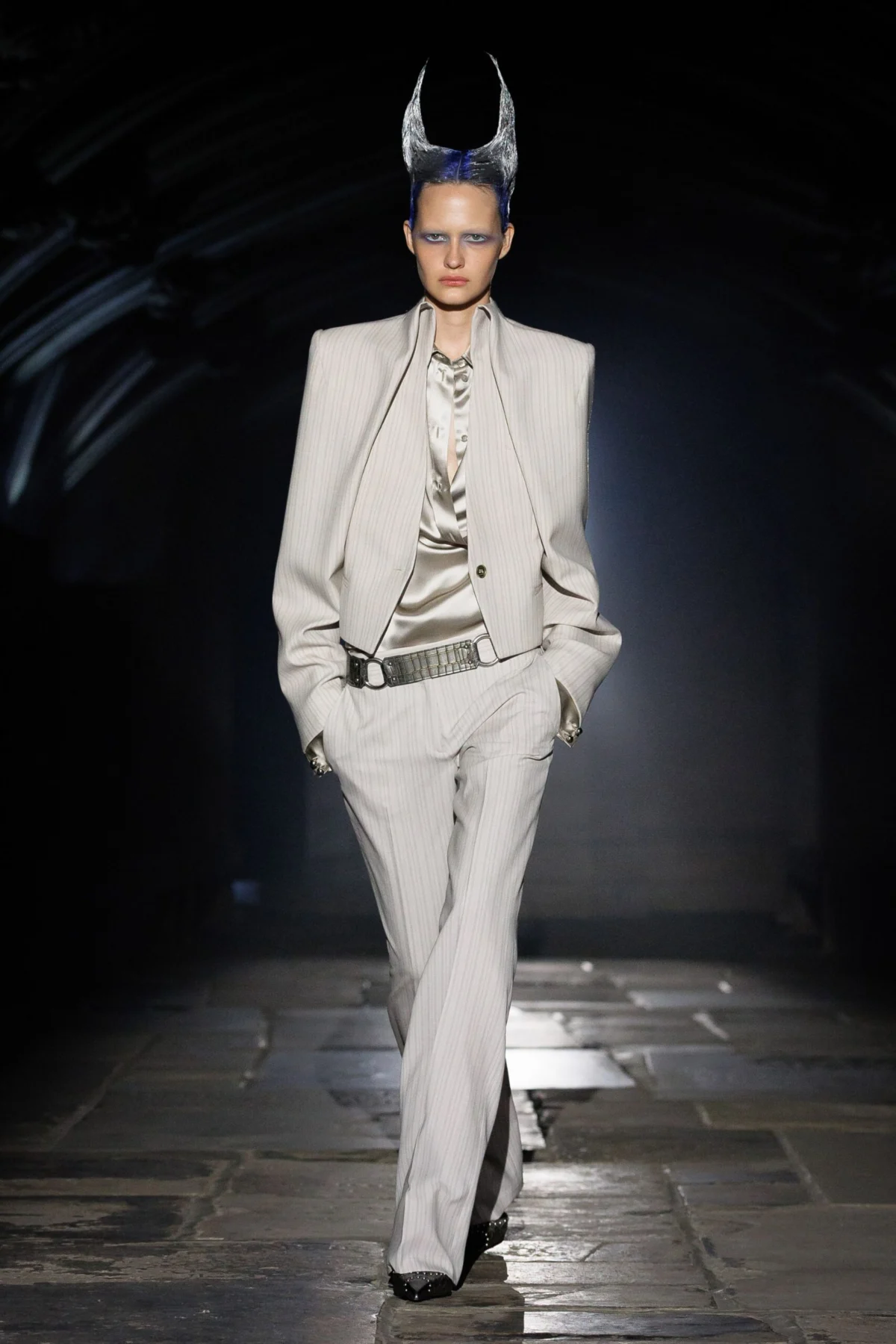
In a move signaling a profound strategic realignment and a powerful reconnection with its foundational identity, the luxury fashion house Alexander McQueen officially returned to its spiritual home in London to present its latest collection under Creative Director Seán McGirr. This pivotal decision by Kering Group’s strategic leadership, widely endorsed by CEO François-Henri Pinault, underscores a commitment to the brand’s authentic heritage, recognizing the British capital’s unique influence as the crucible of Alexander McQueen’s rebellious and innovative spirit. The show, McGirr’s second since his appointment in October 2023, unfolded within the historic and atmospheric Undercroft of Lincoln’s Inn Chapel, a 17th-century architectural marvel that served as a compelling backdrop for a collection designed to articulate the freedom and contradictions inherent to London itself.
The decision to bring Alexander McQueen back to London, following years of presentations predominantly in Paris, is more than a logistical shift; it is a profound narrative statement. London, with its "messily inspirational chaos," as articulated by fashion critics, embodies the raw, often confrontational, yet always creative energy that defined the house’s founder, Lee Alexander McQueen. Born and raised in London’s East End, McQueen honed his craft and developed his groundbreaking vision within the city’s vibrant, often subversive, subcultures and prestigious institutions like Central Saint Martins. His early shows, characterized by their theatricality, provocation, and deep emotional resonance, were intrinsically linked to London’s urban landscape and its diverse cultural tapestry. For Kering, a global luxury conglomerate, this relocation is a strategic affirmation of brand authenticity, aiming to reinforce McQueen’s distinct voice in a highly competitive market by grounding it firmly in its origins. This move is anticipated to resonate deeply with both long-standing aficionados and a new generation of consumers seeking genuine brand narratives and a connection to historical legacies.
Seán McGirr’s Artistic Direction and the Lincoln’s Inn Setting
Seán McGirr, who succeeded the esteemed Sarah Burton after her 26-year tenure with the house—13 of which were as creative director—has embarked on the challenging task of charting a new course for Alexander McQueen. His appointment was met with significant industry anticipation, given the monumental legacy of both Lee McQueen and Burton. For this London debut, McGirr chose the Undercroft of Lincoln’s Inn Chapel, a location imbued with centuries of history. Its flagstone floor, etched with the names of long-gone spymasters, lawyers, and preachers, lies above the bones of historical figures, creating an immediate sense of gravity and ancient presence. Above, the divinely beautiful star-pattern lierne vaulting of the Gothic ceiling soared, offering a striking counterpoint to the raw earthiness below. This juxtaposition of the sacred and the earthly, the ancient and the contemporary, served as a powerful metaphor for McGirr’s vision, which he described as "that clashing of things." Guests, seated on plain wooden benches, were enveloped in an atmosphere that was both reverent and expectant, perfectly setting the stage for a collection designed to bridge disparate worlds.
McGirr’s creative premise for the collection explicitly articulated his exploration of the divide between the "neoclassically sacred and the chemically profane." This ambitious duality found its specific inspirations in two seemingly disparate cultural touchstones: Piero della Francesca’s The Baptism of Christ and London’s vibrant rave culture. Piero della Francesca’s 15th-century masterpiece, with its serene composition, divine light, and profound theological themes, captivated McGirr as a student newly arrived in London. It represents an ideal of classical beauty, spiritual purity, and art historical significance. In stark contrast, the "chemically profane" refers to the pulsating, hedonistic energy of London’s rave scene, particularly from the late 1980s and 1990s. This subculture, characterized by its electronic music, psychedelic visuals, communal euphoria, and often illicit substances, represented a radical departure from traditional societal norms and aesthetics. McGirr’s genius lies in his ability to draw these two poles together, finding common ground in their respective forms of transcendence—one spiritual and contemplative, the other visceral and ecstatic.
The Collection: A Symphony of Contrasts
The garments themselves were a testament to McGirr’s "clashing" philosophy, meticulously crafted to embody this tension between the sacred and the profane. House suiting emerged with closed-over shoulders, sculpted to resemble furled angel wings, an immediate visual nod to the divine inspiration. These structured forms were then paradoxically paired with hair styled into twin peaks, deliberately recalling the demonically energized silhouette of Keith Flint, the iconic frontman of The Prodigy, a band synonymous with the raw energy of 90s rave culture. This initial pairing established the collection’s core dialogue: the angelic and the demonic, the ethereal and the earthbound, converging in a single, powerful aesthetic statement.
Tailoring, a cornerstone of Alexander McQueen’s heritage, was given a radical reinterpretation through a significant collaboration with Huntsman, the venerable Savile Row institution. Huntsman, known for its rigorous adherence to traditional bespoke craftsmanship and its storied history of dressing royalty and discerning gentlemen, represents the pinnacle of tailoring excellence. McGirr sketched these suits to recall the radically disruptive silhouette of Tommy Nutter, whom he lauded as "the first rebel of Savile Row." Nutter, a legendary tailor of the 1960s and 70s, famously broke from convention, creating flamboyant, wide-lapelled suits for rock stars and celebrities, injecting a subversive glamour into the staid world of Mayfair tailoring. This precisely fitted tailoring, a fusion of Huntsman’s legacy and Nutter’s rebellious spirit, was further lent an "extra dimension of discipline" by thick leather collars. These collars served as a symbolic transition, moving from the sophisticated defiance of Nutter to the uninhibited abandon of ‘off your nut’—a quaint yet potent English expression for being in an enhanced state of altered perception, typically in a nightclub environment. The leather collars, therefore, became a physical manifestation of the journey from sartorial rebellion to chemical transcendence, binding the collection’s contrasting themes.
McGirr’s approach to eveningwear was equally audacious. He shaped sometimes grandiosely classic gowns, reminiscent of haute couture’s most revered forms, only to spike them with "stimulatingly anarchic enhancements." Among these were harnesses crafted by Shaun Leane, an original McQueen collaborator whose pioneering work in jewelry and body adornment alongside Lee McQueen defined a generation of fashion. Leane’s intricate, often provocative, metalwork added a layer of dangerous beauty and subversive elegance to the gowns, echoing the house’s historical embrace of the dark and the fetishistic. Warped shapes, thrown in stretched fabric across the bodices of lacquered satin gowns, created a sense of tension and distortion, as if the garments were caught in a moment of visceral transformation. Open-backed corsets, flying dramatically above the shoulder-line, defied traditional notions of structure and support, adding an element of defiant sensuality. The collisions of diffuse color within the collection were described as recalling the "seared-retina glitching of a night in the lights"—a vivid, almost hallucinatory reference to the intense visual experiences of rave culture, where strobe lights and neon hues blur into a kaleidoscopic overload. A particularly striking piece was a fantastic dress composed of interlinked, hand-embroidered metal skulls, each as individual and meticulously detailed as the bodies lying beneath the models’ platformed feet, a chilling yet beautiful reminder of mortality and the enduring symbolism of the skull in McQueen’s oeuvre.
Further pushing the boundaries into ravewear, metallic leaves were embellished onto garments in random drifts, appearing as if flung against the tailoring and dresses by a sudden gust of wind—a nod to the unpredictable forces of nature and the chaos of urban life. Mesh fabrics, perforated leather, and color-piped sporty knitted shorts and skirts explicitly edged the collection towards the aesthetics of true ravewear, blending high fashion with street and club subcultures. Jacquards, traditionally associated with decorative integrity and intricate patterns, were "shadowed, overlaid, and interfered with until their decorative integrity seemed on the edge of collapse." This deconstruction of traditional fabrics and patterns underscored McGirr’s intent to disrupt established norms and embrace imperfection, reflecting the raw, often unpolished energy of his inspirations.
Thematic Depth: Darkness, Euphoria, and Legacy
Seán McGirr, while appearing "more angel than demon," demonstrated a profound understanding of the Alexander McQueen house’s enduring fascination with darkness. He recognized that for McQueen, darkness has often proved creatively generative, providing a rich vein for exploring the complexities of the human condition, challenging beauty standards, and provoking thought. His philosophy, as he articulated, is to embrace this creative darkness within the work, stating, "You can talk about the dark stuff. You can let it into your work, but you shouldn’t let it into your life: you should have a good time." This statement encapsulates the collection’s underlying drive: it dances in the shadows not to succumb to despair, but to actively search for euphoria. It’s a pursuit of catharsis through confrontation, finding beauty in the unsettling and joy in the rebellious.
The collection, therefore, serves as a complex dialogue between honoring the house’s dark, romantic, and often gothic heritage and injecting it with a contemporary, youthful vitality rooted in London’s subcultures. It’s an interpretation of McQueen that respects the past while resolutely looking forward, acknowledging that true innovation often lies in the audacious recombination of disparate elements. McGirr’s challenge is to navigate the immense legacy of Lee Alexander McQueen, whose visionary work fundamentally reshaped fashion, and Sarah Burton, who masterfully evolved the brand’s identity post-Lee. His approach signals a new chapter, one that is unafraid to reinterpret the brand’s codes through his own lens, emphasizing a raw, visceral connection to London’s dynamic cultural landscape.
Chronology and Broader Implications
The Alexander McQueen brand was founded by Lee Alexander McQueen in 1992, rapidly gaining notoriety for its provocative and emotionally charged shows. His ascent to global recognition was swift, marked by stints at Givenchy and the establishment of his own immensely successful label, consistently pushing boundaries until his untimely passing in 2010. Sarah Burton, his long-time right hand, took the helm, maintaining the brand’s artistic integrity and expanding its global presence with a distinct blend of romanticism and meticulous craftsmanship. Her departure in 2023, after a celebrated tenure, opened the door for Seán McGirr, whose appointment in October of that year marked a new era. This London show for Fall/Winter 2024 is a critical juncture in this new timeline, signaling a definitive statement about the brand’s future direction.
Kering Group’s strategic decision to bring McQueen back to London carries significant implications for the global fashion landscape. In 2023, the global luxury goods market, valued at approximately €1.5 trillion, continued its growth trajectory, with fashion and accessories remaining a dominant segment. For a brand like Alexander McQueen, with its unique artistic identity and strong heritage, strategic alignment with its roots can enhance brand equity and market differentiation. London Fashion Week, while a significant platform, often competes with the larger global pull of Paris and Milan. The return of a major luxury house like Alexander McQueen undoubtedly elevates London’s standing, attracting increased international media attention, buyer presence, and investor interest. This bolsters London’s reputation as a vital hub for creative talent and a crucible for innovative fashion.
The collection’s commercial viability will be closely watched. While McGirr’s artistic vision is clear, translating such avant-garde concepts into commercially successful products is the ultimate challenge for any luxury brand creative director. However, the strong narrative, the connection to authentic British cultural touchstones, and the collaboration with heritage brands like Huntsman and Shaun Leane provide a compelling story that can resonate with discerning consumers. The blend of high fashion with elements of ravewear also taps into a contemporary desire for authenticity, individuality, and a rejection of overly polished aesthetics, appealing to a younger demographic increasingly drawn to brands with genuine narratives and rebellious spirit.
In conclusion, Seán McGirr’s latest collection for Alexander McQueen, presented in London, is far more than a fashion show; it is a meticulously crafted statement of intent. It represents Kering Group’s strategic commitment to reinforcing the brand’s core identity by returning it to its inspirational source. It marks McGirr’s bold and nuanced interpretation of Lee McQueen’s legacy, fusing classical artistry with contemporary subculture, and darkness with euphoria. As the fashion world looks on, this collection sets the stage for a compelling new chapter for Alexander McQueen, firmly re-establishing its roots in the vibrant, contradictory, and eternally inspiring heart of London.
