
 By Nila Kartika Wati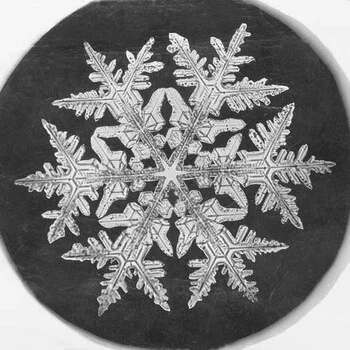
On January 15, 1885, a significant moment in both scientific observation and photographic history unfolded in a rudimentary, unheated shed behind a farmhouse in Jericho, Vermont, where nineteen-year-old Wilson Alwyn Bentley, just weeks shy of his twentieth birthday, captured the world’s first successful photograph of a single snow crystal. Working with a bellows camera meticulously bolted to a microscope on a frame he had painstakingly constructed himself, Bentley held the exposure with unwavering patience, allowing the delicate crystal to maintain its intricate form in the frigid air. The resulting developed plate presented an unprecedented image: a true, tangible photograph of a snowflake, a feat no one had ever achieved before. This singular image, however, was not the culmination of his ambition but merely the auspicious beginning of a lifelong odyssey into the microscopic wonders of winter, a journey that would profoundly reshape humanity’s understanding and appreciation of snow, ultimately cementing the popular belief that no two snowflakes are ever precisely alike. Over the subsequent 46 years, through every winter until his last, Bentley would venture into countless storms, meticulously photographing over 5,000 unique snow crystals, culminating in a definitive photographic record published just weeks before his death in 1931, a remarkably fitting conclusion to a project that had consumed his entire adult life.
A Lifelong Pursuit of Ephemeral Beauty
Bentley’s fascination with snow began in his formative years, growing up on a dairy farm in rural Vermont with minimal formal schooling. His education was primarily conducted at home by his mother, a former schoolteacher, who nurtured his intellectual curiosity. For his fifteenth birthday, she gifted him an old microscope, a pivotal present that steered his destiny. While most boys might have directed such a device towards pond water or insects, young Bentley immediately turned it towards the fleeting beauty of snow. He attempted to sketch the intricate patterns he observed, but the rapid melting of crystals under the warmth of his gaze and the ambient room temperature consistently foiled his efforts, making the race against time an impossible one. A snow crystal, under such conditions, lasts only mere seconds.
The turning point arrived when Bentley was seventeen. His mother, recognizing his profound dedication, managed to persuade his skeptical father to make a substantial investment: a bellows camera and a microscope objective, which together cost approximately $100. This was a considerable sum for a Vermont farm family in the early 1880s, roughly equivalent to several months’ wages for an average laborer, and his father openly expressed his doubts, viewing the endeavor as an impractical distraction for a farmer. Undeterred, Bentley ingeniously constructed a wooden frame to precisely integrate the camera with the microscope. However, the path to success was anything but straightforward. He endured two full winters of relentless failure, grappling with technical challenges such as overexposure, underexposure, and the agonizing frustration of crystals melting, sublimating, or shattering before he could secure them in front of the lens. It was a testament to his sheer perseverance that after nearly two years of ruined photographic plates and countless disheartening attempts, he finally achieved his first triumphant capture.
From Sketches to Silver Halides: A Historical Shift
Bentley’s photographic breakthrough was not merely a personal achievement but a monumental leap in a scientific quest that had spanned centuries. Long before Bentley, thinkers and scientists had been captivated by the mysterious geometry of snow crystals. Johannes Kepler, the renowned astronomer, famously pondered their consistent six-sided symmetry in his concise 1611 essay, "On the Six-Cornered Snowflake" (Strena, seu De Nive Sexangula), seeking to understand the underlying principles of their formation. Decades later, in 1637, the philosopher René Descartes meticulously sketched snow crystals, documenting their diverse forms. The most significant early scientific contribution came in 1665 from Robert Hooke, a polymath who, using one of the earliest compound microscopes, aimed its lens at fresh snow. His groundbreaking work, detailed in his seminal publication Micrographia, filled pages with remarkably intricate drawings of crystals, revealing their astonishing complexity to the scientific community for the very first time. For close to three centuries, the entire visual record of snowflakes relied solely on these hand-drawn interpretations.
This reliance on artistic rendition, however skilled, presented inherent limitations that Bentley’s photography sought to overcome. A drawing, by its very nature, is a subjective account, filtered through the artist’s perception and skill. Even Hooke himself acknowledged the challenge, admitting that crystals on a slide rarely appeared as pristine and orderly as an artist might wish to portray them. Photography, conversely, offered a far more compelling promise of objectivity and fidelity. It claimed that the crystal itself had directly imprinted its likeness onto the photographic plate, providing an unmediated portrait of nature’s design. This fundamental distinction underscores why the subsequent controversy surrounding Bentley’s retouching techniques became such a significant point of contention, touching upon the very essence of photographic truth in scientific documentation.
The Art and Science of the Snowflake Hunter
The methodology Bentley developed, honed over decades of solitary work in his unheated shed, remains remarkably similar to the techniques employed by snowflake photographers today. His deliberate choice to work in the bitter cold was crucial; it minimized the risk of his own body heat, or even the ambient warmth of a conventional room, causing the delicate crystals to melt or sublimate before they could be captured. When snow fell, he would venture out, catching individual crystals on a black-painted tray or a piece of black velvet. He would then swiftly examine them, meticulously selecting a single, perfectly formed, unbroken specimen. With the utmost precision and a steady hand, he would transfer the chosen crystal using a thin wooden splint and the fine tip of a turkey feather onto a pre-chilled glass slide. Every movement was calculated, every breath held back, to avoid disturbing the fragile subject. Once positioned under the lens, he would make the exposure with lightning speed, before the crystal could vanish. This entire handling process took mere seconds; a warm finger, an errant sigh, or a clumsy movement meant the immediate and irreversible loss of his subject.
Bentley articulated the profound driving force behind his lifelong dedication in a 1925 statement, revealing the poetic and philosophical underpinnings of his scientific pursuit. "Under the microscope, I found that snowflakes were miracles of beauty; and it seemed a shame that this beauty should not be seen and appreciated by others," he said. His words underscored not just a scientific curiosity, but an artistic sensibility. "Every crystal was a masterpiece of design and no one design was ever repeated. When a snowflake melted, that design was forever lost. Just that much beauty was gone, without leaving any record behind." This sentiment highlights his dual role as both a scientist documenting natural phenomena and an artist striving to preserve fleeting beauty for posterity. His work was a race against entropy, a tireless effort to capture the ephemeral before it disappeared forever.
The Uniqueness Debate: Craft, Ethics, and Scientific Scrutiny
While Bentley’s photographs were groundbreaking, they were not without controversy, particularly regarding his methods for presenting the images. A snow crystal, being white ice against a typically white or pale background, often appeared indistinctly in his early photographic plates, resembling faint, pale flakes swimming in a gray field. To enhance their visibility and make their intricate details "read" more clearly, Bentley employed a manual darkening technique. He would create a duplicate of each negative and, with a precision knife, meticulously scrape away the emulsion around the crystal’s outline, leaving the snowflake itself bright and starkly contrasted against a solid black background. His own documentation of this method was careful to emphasize one crucial point: the original negative was always preserved untouched, ensuring that an unadulterated record of the crystal existed.
However, this technique sparked a significant ethical debate that questioned the absolute fidelity of his photographic representations. The core of the accusation centered on whether the knife, in its precise work, ever inadvertently or intentionally crossed the outline into the crystal itself, subtly altering its natural form. German meteorologist Gustav Hellmann, who had his own photographer, Richard Neuhauss, attempting to capture snow crystals, found their results to be lumpier and less perfectly defined than Bentley’s. This led Hellmann to publicly accuse Bentley of having "mutilated the outlines" of his snowflakes, implying that he had enhanced them to appear more perfect than nature truly allowed. Bentley’s response, rather than a direct denial, was a robust defense rooted in his artistic-scientific philosophy. "A true scientist wishes above all to have his photographs as true to nature as possible," he stated, "and if retouching will help in this respect, then it is fully justified."
This charge of manipulation has never been definitively settled. The prevailing and perhaps kinder interpretation, which aligns with everything known about Bentley’s meticulous work ethic, suggests that the impossible perfection of his flakes stemmed not from alteration, but from an extraordinarily rigorous selection process. Bentley, it is believed, picked only the most pristine, unbroken crystals from thousands, discarding any that were chipped, lopsided, or imperfect. This exacting standard alone could explain why his plates appear so distinct from others. While this is a strong, logical case, it does not constitute irrefutable proof that the knife never crossed the line. The enduring tension between faithful representation and aesthetic enhancement, between documentation and artistic license, encapsulated by Bentley’s controversy, resonates powerfully even in the modern digital age, where tools like the "healing brush" raise similar questions about image integrity.
Solidifying a Scientific Truth: The "No Two Alike" Legacy
The concept for which Bentley is most widely remembered—the enduring assertion that no two snowflakes are alike—emerged organically from the sheer volume of his photographic work. As he tirelessly continued to photograph thousands upon thousands of crystals, he concurrently engaged in an equally rigorous process of comparison, consistently failing to discover any two that were identical. This empirical observation formed the basis of his groundbreaking claim. In 1898, he co-authored his first academic article, "A Study of Snow Crystals," with George Henry Perkins, a professor at the University of Vermont. This publication marked the official entry of the "no two snow crystals are the same" assertion into scientific discourse, from which it gradually permeated popular culture, eventually becoming one of those widely accepted "facts" repeated without question.
Modern science largely supports Bentley’s foundational observation, albeit with an important caveat. While it is true that very small, simple snow crystals can, under a microscope, appear virtually identical, larger and more complex branched crystals present an entirely different scenario. Dr. Kenneth Libbrecht, a distinguished Caltech physicist and widely recognized as the foremost modern authority on snow crystal formation, has calculated that the potential number of ways to assemble a complex snow crystal far exceeds the estimated number of atoms in the entire observable universe. This staggering figure renders the probability of two elaborate, multi-branched flakes matching perfectly, arm for arm and branch for branch, effectively zero. The Library of Congress, echoing this scientific consensus, similarly concludes that no two snow crystals of any significant complexity are ever truly identical. Bentley, therefore, was demonstrably correct about the precise type of intricate crystals he chose to photograph and meticulously document. His legacy is not just one of aesthetic wonder but of having empirically established a fundamental principle of crystallography and atmospheric science.
A Life’s Work Immortalized: "Snow Crystals" and Final Years
For the vast majority of his life, Wilson Bentley’s groundbreaking photographs offered little financial reward. He sustained himself through his dairy farm, supplementing his income by selling prints and lantern slides for modest sums. He also gave numerous lectures to eager audiences and supplied his remarkable images to prestigious publications such as National Geographic, Scientific American, and Nature, all while maintaining his demanding daily farm duties. His unwavering dedication persisted even as widespread recognition remained elusive.
It was only near the very end of his life that his extraordinary contributions received the full scientific and public acknowledgment they deserved. A collaborative effort by colleagues saw his entire life’s work compiled into a single, monumental volume. "Snow Crystals," published by McGraw-Hill in 1931 in collaboration with Weather Bureau physicist William J. Humphreys, served as the definitive testament to his decades of meticulous observation. The book reproduced an astonishing 2,453 of his photographs across 204 plates, encompassing not only snow but also a hundred images of frost and dew, creating the comprehensive visual record he had painstakingly built. Today, the Smithsonian Institution Archives proudly holds a significant collection of his original prints, preserving his pioneering legacy.
Tragically, the release of his magnum opus coincided with the final chapter of Bentley’s life. The book reached shelves in November 1931. Just weeks later, in December, Bentley, ever drawn to the subject of his life’s passion, walked six miles home through a severe snowstorm—the very weather phenomenon that had been his singular focus for nearly five decades. He fell gravely ill shortly thereafter, succumbing to pneumonia on December 23, 1931, at the age of sixty-six, in the same Jericho farmhouse where he had been born. His masterwork, the culmination of a lifetime’s dedication, had barely begun to circulate, marking a poignant and almost poetic end to the life of the "Snowflake Man."
An Enduring Inspiration for Photographers and Scientists
Wilson Alwyn Bentley’s profound impact extends far beyond his initial scientific discovery, resonating deeply within the realms of photography and scientific inquiry. As Kenneth Libbrecht succinctly put it, Bentley "did it so well that hardly anybody bothered to photograph snowflakes for almost 100 years." This statement underscores the extraordinary benchmark set by a self-taught farmer, operating with homemade equipment and a relatively modest $100 camera. His unparalleled standard remained largely unchallenged by professional scientists and photographers for nearly a century, a testament to the sheer quality and artistic merit of his work.
Bentley’s photographic plates endure not merely as historical artifacts but as enduring examples of profound craft. His success was rooted in fundamental, timeless virtues: immense patience, the ability to work effectively with cold-numbed hands, and an obsessive, uncompromising refusal to accept a flawed frame. These qualities, inherent to the artist and observer, are precisely what no advanced camera technology can ever supply. His work serves as a powerful reminder that true mastery in any field often stems from dedication and skill rather than mere technological prowess.
Today, the pursuit of snowflake photography is far more accessible and less physically demanding. Modern macro lenses, coupled with cold sheets of dark glass or wool, and sophisticated digital techniques like focus stacking, can yield images of single crystals with a sharpness and depth of field that Bentley could only dream of achieving with his glass plates. Courses dedicated to mastering macro photography technique now exist to teach the very fundamentals of working at such extreme magnifications. However, none of these advancements diminish the core challenge that Bentley definitively solved: the race against time to capture the crystal before it perishes, and the readiness to seize that fleeting moment. He lost that race for two grueling winters, triumphed on that serendipitous January morning in 1885, and then devoted the remainder of his life to ensuring he would never lose it again, leaving behind an indelible legacy that continues to inspire awe and scientific curiosity.
