
 By admin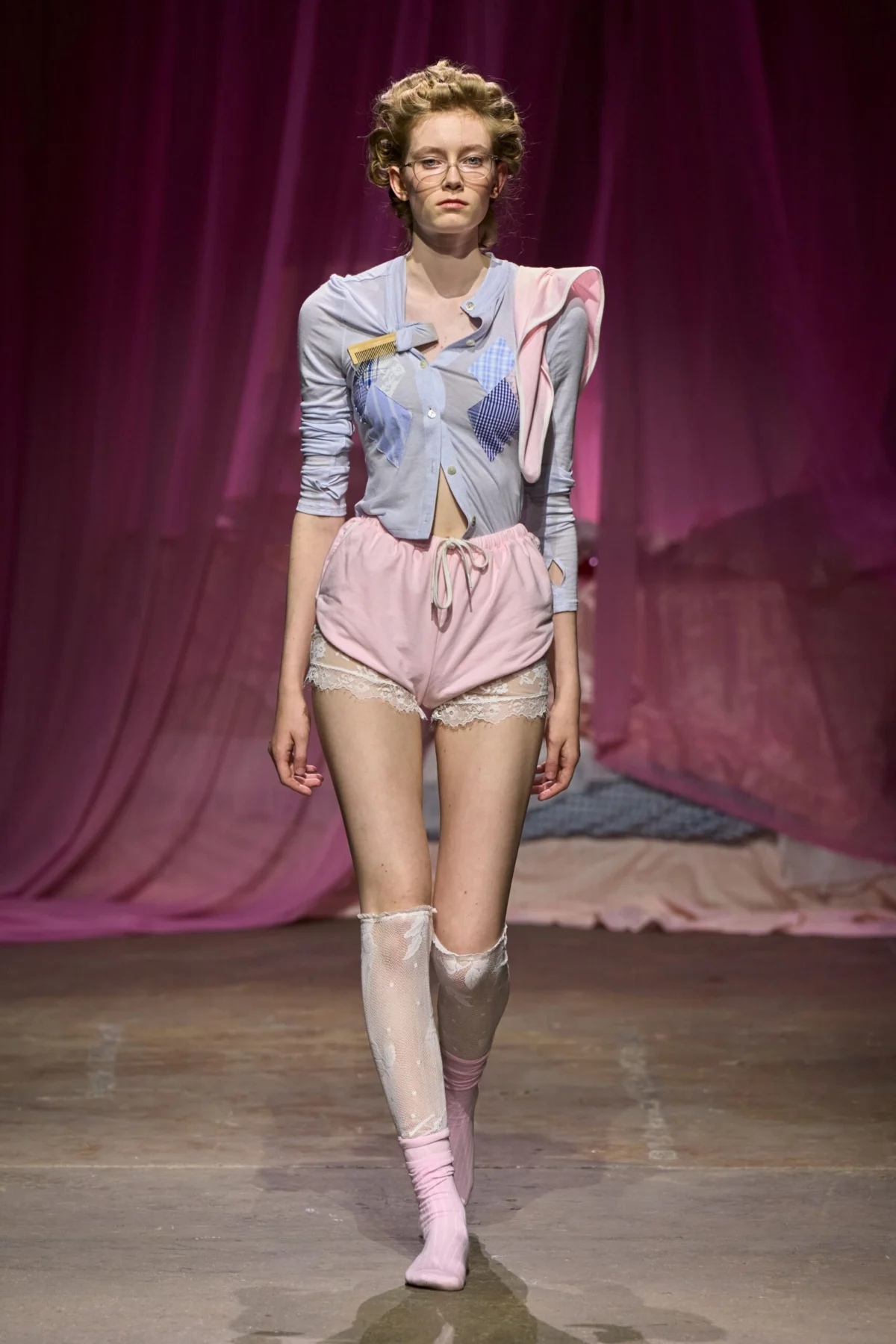
The Spring 2027 Ready-to-Wear season witnessed a profound exploration of the subconscious at Yuhan Wang’s latest presentation, where the designer masterfully delved into the ephemeral and often unsettling moments preceding sleep. From a stage dominated by four artfully stacked mattresses, the first model emerged, initiating a slow, deliberate procession that immediately telegraphed the show’s core theme: a hypnagogic daze. Wang, in her accompanying notes, explicitly articulated the collection’s reflection of the "strangeness to the moments before sleep," a conceptual framework that granted her extensive artistic license to reinterpret traditional boudoir attire through a lens of surrealism, injecting elements of disquiet and fantasy reminiscent of a waking dream. This sophisticated blend of the intimate and the bizarre not only captivated the audience but also underscored Wang’s evolving reputation as a designer who fearlessly navigates the psychological undercurrents of feminine expression.
Thematic Deep Dive: The Hypnagogic Unveiling
Yuhan Wang has consistently carved a niche for herself within the contemporary fashion landscape by marrying a delicate, often romantic aesthetic with subtle undertones of the unconventional or subversive. Her collections frequently explore themes of femininity, vulnerability, and strength, often drawing inspiration from historical references, art, and literature, recontextualized for the modern woman. For Spring 2027, the conceptual foundation pivoted around the hypnagogic state – the transitional period between wakefulness and sleep. This liminal space is renowned for its often vivid, dream-like hallucinations, fragmented thoughts, and altered perceptions, making it a fertile ground for artistic interpretation.
Wang’s decision to anchor her collection in this psychological phenomenon is particularly poignant in an era where mental well-being and the complexities of internal experience are increasingly discussed. By transforming the runway into a manifestation of this daze, she invited her audience not merely to observe garments but to immerse themselves in a narrative. The "uneasiness of a waking dream" became the collection’s guiding principle, allowing for a playful yet profound distortion of familiar domesticity and intimate apparel. This approach aligns with a broader trend in high fashion where designers are moving beyond purely aesthetic considerations to engage with deeper human experiences, using clothing as a medium for psychological exploration and cultural commentary. The choice of boudoir attire, typically associated with privacy, comfort, and vulnerability, further amplified the intimacy of the hypnagogic theme, drawing the viewer into a personal, almost voyeuristic, experience.
The Runway as a Dreamscape: A Chronological Journey
The show itself unfolded as a meticulously crafted sequence designed to emulate the progression into and through a hypnagogic state. The stacked mattresses, more than mere set dressing, functioned as a symbolic threshold, a physical representation of the boundary between consciousness and unconsciousness. As the first model gracefully descended, her slow, measured pace set a languid, almost ethereal rhythm for the entire presentation, immediately signaling a departure from conventional runway energy.
The initial looks introduced elements of traditional boudoir wear – slips, camisoles, nightgowns – but with subtle, almost imperceptible shifts that hinted at the distortions to come. Fabrics like delicate lace, lustrous satin, and soft silk were predominant, creating a sense of luxury and comfort associated with sleepwear. However, as the show progressed, the surrealistic twists became more pronounced, mirroring the escalating strangeness of a dream. What began as a gentle sway into the subconscious gradually intensified, culminating in garments that overtly challenged conventional form and function.
The soundscape played a crucial role in enhancing this immersive experience. The hushed ambiance was occasionally punctuated by the distinct, almost jarring, clinking of crockery, an element directly integrated into one of the ensembles. Later, a "woozy narrator" interjected with the command, "Don’t look at me," a phrase that resonated with the vulnerability and self-consciousness often experienced in dreams or states of altered perception. This auditory layer deepened the collection’s narrative, transforming the viewing experience into a multi-sensory journey through the designer’s oneiric vision.
Deconstructing the Dream: Key Silhouettes and Distortions
Wang’s genius lay in her ability to infuse crowd-pleasing, conventional silhouettes with unexpected jolts of disorder, turning the familiar into the fantastic. The collection showcased an array of dresses artfully constructed to resemble open bureau drawers, a literal manifestation of intimate contents spilling forth. These garments featured comprehensive underwear options seemingly tumbling from within, blurring the lines between external attire and internal foundation, a witty nod to the uninhibited nature of dreams.
A particularly striking moment featured a model in a cherry-print flyaway-skirt mini slip. As she traversed the runway, observed by an audience eager to capture the spectacle on their phones, she regarded her own reflection in a small hand mirror. This act introduced a layer of self-contemplation and detachment, mirroring the introspective quality of a dream state where one might observe oneself from an external vantage point. The cherry print, traditionally playful, took on a subtly subversive edge in this context, hinting at forbidden fruits or hidden desires within the subconscious.
Corsetry, a staple of historical underpinnings and contemporary fashion, was reimagined with a disorienting twist. An off-the-shoulder, lace-lined camisole featured its corsetry twisted at an irregular angle above French knickers. This deliberate asymmetry disrupted the garment’s expected structure, creating a visual tension that evoked a sense of disarray or a reality slightly askew. It was a subtle yet powerful statement on the imperfect, often fragmented nature of dreams.
One of the most memorable and audibly engaging pieces involved a cup and saucer tied to the belted waist of a puff-sleeve, lace-yoked satin blouse and matching skirt. As the wearer walked, the crockery clinked softly, a domestic sound transposed onto the body, creating an unexpected rhythm and a surreal juxtaposition. This piece humorously and poignantly externalized elements of a nightstand, making the intimate accouterments of the bedside table a part of the external ensemble. This concept was further explored with compacts, combs, and other nightstand staples migrating onto the body, transforming them into novel forms of adornment.
As the show progressed towards its "bedtime" climax, the distortions intensified. A black lace slip, a garment typically associated with delicate sensuality, was dramatically altered with wadding at the right shoulder and left hip, throwing the entire piece into a decoratively wonky asymmetry. This exaggerated form challenged the conventional silhouette, suggesting a body reshaped by the unconscious mind. The collection culminated in a baby blue lace nightgown fitted with dislocated-hip panniers, a final, audacious statement on the surreal transformation of the body in a dream state. The panniers, historical structures designed to expand the hips, were rendered as "dislocated," implying a detachment from their traditional function and a shift towards an almost alien, dream-logic form.
Yuhan Wang’s Evolving Aesthetic and Brand Identity
This Spring 2027 collection marks a significant evolution for Yuhan Wang. While her previous work has often explored romanticism with a dark twist, this presentation pushed her into more overtly conceptual and surreal territories. It demonstrates her growing confidence in manipulating form and narrative to evoke complex emotional and psychological states. Her brand, known for its intricate detailing, luxurious fabrics, and sophisticated take on femininity, now firmly embraces an intellectual curiosity, positioning her as a designer capable of engaging with profound themes.
Wang’s aesthetic, often characterized by delicate fabrics, intricate embroidery, and a blend of Eastern and Western influences, found new expression in the "oneiric dressing" theme. The attention to detail, from the perfectly placed wadding to the functional yet symbolic crockery, highlighted her commitment to craftsmanship even within a highly conceptual framework. This collection is likely to solidify her reputation not just as a creator of beautiful garments, but as a thought leader in contemporary fashion, capable of translating abstract ideas into wearable art. It also reinforces her distinct voice in an increasingly crowded luxury market, appealing to a clientele that values both aesthetic beauty and intellectual depth in their sartorial choices.
Critical Reception and Commercial Implications
The Spring 2027 collection is poised to generate substantial discussion among fashion critics and industry insiders. The overt surrealism and conceptual depth invite extensive interpretation, positioning Wang’s work at the forefront of avant-garde design. Critics are likely to laud her innovative approach to theme development and her ability to execute complex ideas with precision and artistic flair. The balance between the "crowd-pleasing convention" and the "little jolts of disorder" will be a key point of analysis, highlighting her skill in making challenging concepts accessible.
From a commercial standpoint, while some of the more extreme pieces, such as the crockery-adorned ensemble or the dislocated-hip panniers, may serve primarily as editorial statements and brand-building pieces, the underlying aesthetic offers significant commercial potential. The beautifully crafted lace slips, satin blouses, and mini dresses, even with their subtle distortions, remain highly desirable. The collection’s emphasis on luxurious boudoir wear, a category experiencing a resurgence in popularity as comfort and self-care become paramount, provides a strong commercial hook. Buyers are likely to gravitate towards the more wearable iterations of Wang’s dreamscape, appreciating the unique blend of romance, edge, and conceptual depth that defines her brand. The collection’s ability to transition seamlessly "from snooze button to rude awakening" suggests a versatility that resonates with the multifaceted lives of modern consumers.
Broader Fashion Context: Surrealism’s Resurgence and the Redefinition of Intimacy
Yuhan Wang’s Spring 2027 collection aligns with a broader resurgence of surrealism in fashion, art, and popular culture. This movement, characterized by its exploration of the subconscious, the juxtaposition of the ordinary with the extraordinary, and a challenge to rational thought, provides a potent lens through which to examine contemporary anxieties and desires. Designers are increasingly using surrealist elements to comment on the blurring lines between reality and fantasy, the digital and the physical, and the public and the private. Wang’s "oneiric dressing" is a sophisticated contribution to this trend, offering a feminine and introspective perspective.
Furthermore, the collection contributes to an ongoing redefinition of intimacy and private wear in public spaces. The increasing popularity of slip dresses, pajama sets, and corsetry worn as outerwear reflects a societal shift towards greater comfort, self-expression, and a blurring of traditional sartorial boundaries. Wang takes this trend a step further by not just making boudoir attire public, but by distorting it in a way that questions the very nature of intimacy and the private self when exposed. The theme of "Don’t look at me" juxtaposed with garments designed for public display offers a fascinating commentary on vulnerability and exhibitionism in the digital age. This collection serves as a poignant reminder that fashion, at its most compelling, acts as a mirror to our collective consciousness, reflecting and shaping the cultural zeitgeist.
In conclusion, Yuhan Wang’s Spring 2027 Ready-to-Wear collection was a triumph of conceptual design and artistic execution. By immersing the audience in a "hypnagogic daze," she offered a unique and thought-provoking exploration of the moments before sleep, transforming boudoir attire into a canvas for surrealistic expression. The collection, with its intricate details, deliberate distortions, and evocative soundscape, not only solidified Wang’s position as an innovative force in fashion but also provided a compelling commentary on intimacy, vulnerability, and the ever-shifting boundaries between dream and reality. It was a hazily skewed reverie that left a clear and lasting impression, marking a significant moment in the unfolding narrative of contemporary design.
