
 By admin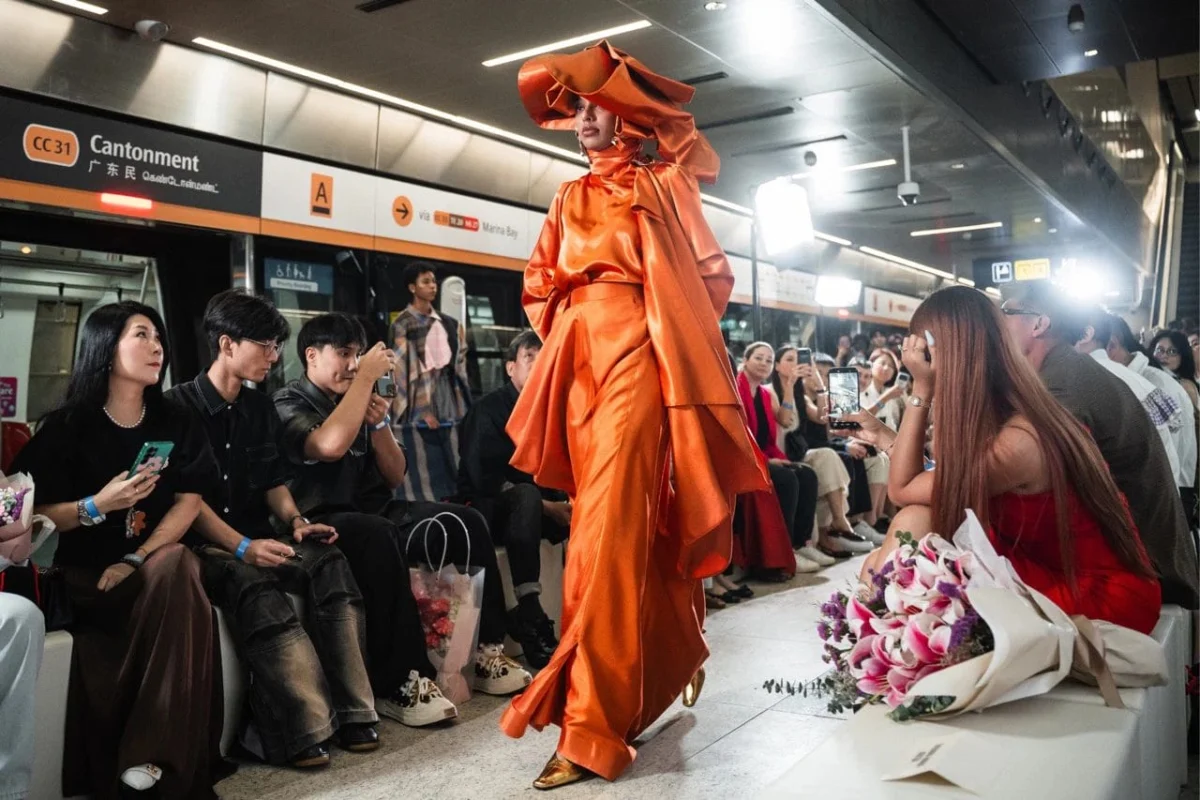
In a departure from the conventional high-glamour runways of Orchard Road, the basement levels of the unopened Cantonment MRT station were recently transformed into a high-concept fashion stage, hosting the LASALLE College of the Arts 2026 graduate fashion show. This event, which drew a capacity crowd comprising industry veterans, fashion editors, digital influencers, and government officials, served as a critical platform for the next generation of Singaporean designers to showcase their technical prowess and conceptual depth. The choice of venue was far from incidental; the stark, industrial atmosphere of the unfinished station provided a visceral backdrop for a collection of works titled De:Centering, a theme that challenged students to interrogate the dominance of Western fashion narratives and pivot toward a Southeast Asian-centric design philosophy.
The evening was characterized by a unique fusion of urban infrastructure and avant-garde aesthetics. As models traversed the concrete platforms, their movements were synchronized with the rhythmic arrival and departure of functional test trains, while the ambient soundtrack merged electronic beats with the familiar chime of MRT safety announcements. The presence of Minister for Transport Jeffrey Siow underscored the event’s significance, highlighting a rare intersection between national infrastructure and the creative economy. For the graduating cohort, the show represented more than an academic finale; it was a public declaration of intent in an industry grappling with its own identity in a globalized market.

The Theoretical Framework: De:Centering the Fashion Narrative
The conceptual anchor of the 2026 showcase was the "De:Centering" initiative, spearheaded by Dr. Circe Henestrosa, Head of LASALLE’s School of Fashion. This academic framework mandates a shift away from the Eurocentric standards that have historically dictated the global fashion industry—ranging from seasonal cycles to silhouette construction. According to Dr. Henestrosa, the objective is to reposition Singapore and the broader Southeast Asian region as a primary site of knowledge production and creative authority, rather than a secondary market for consumption or low-cost manufacturing.
By asking students to "unmoor" their designs from traditional Western norms, the program encouraged an exploration of local histories, materials, and socio-economic realities. This shift is particularly relevant as the global fashion industry increasingly looks toward the Global South for fresh perspectives on sustainability, craftsmanship, and cultural storytelling. The De:Centering theme forced designers to consider how Southeast Asian heritage can be translated into contemporary workwear, evening wear, and conceptual art without falling into the trap of superficial exoticism.
Chronology and Logistics: The Making of a Subterranean Runway
The execution of a large-scale fashion event within a restricted transit site required months of logistical planning and inter-agency cooperation. The Cantonment MRT station, part of the Circle Line Stage 6 (CCL6) extension, is currently under construction and slated for official opening in 2026. This extension is designed to close the loop of the Circle Line, connecting HarbourFront to Marina Bay. Utilizing the site while it remains under the jurisdiction of the Land Transport Authority (LTA) involved navigating rigorous safety protocols and bureaucratic approvals.

The timeline of the event began in late 2025, when LASALLE initiated discussions with the LTA and the Ministry of Transport to secure the space. The collaboration was framed as a way to utilize public infrastructure for community engagement and cultural promotion before its commercial commissioning. In the weeks leading up to the show, the basement level was outfitted with specialized lighting and sound equipment capable of operating within the cavernous, acoustically challenging environment of an underground station. The result was a seamless integration of fashion and function, proving that Singapore’s urban spaces can serve as versatile canvases for the arts.
Spotlight on Innovation: Cultural Heritage and Urban Irony
One of the most discussed collections of the evening was that of Eng Li Wen, whose workwear-inspired pieces opened the show. Eng’s collection drew heavily from the visual language of the Sungei Road Flea Market, a historic site of informal trade in Singapore that was permanently closed in 2017. His designs utilized oversized silhouettes and rugged materials to pay homage to the vendors who once populated the "Thieves’ Market."
In a poignant turn of irony, Eng noted during his research that the closure of the Sungei Road market was partially necessitated by the expansion of the MRT network, specifically the construction of the Jalan Besar station. By presenting his tribute to a displaced cultural site within the very infrastructure that contributed to its disappearance, Eng created a layered commentary on the cost of urban progress. His collection challenged the audience to consider what is lost when traditional spaces are sacrificed for modern efficiency, a theme that resonated deeply with the local attendees.

Another standout designer, Vanessa Lim, presented a collection titled "The Uneven Starting Line." Lim’s work explored the socio-economic barriers faced by young creatives in high-cost cities like Singapore. Her designs utilized complex layering and structural elements to symbolize the "baggage" and hurdles inherent in establishing a brand from the ground up. Lim’s perspective reflects a broader anxiety among the 2026 cohort regarding the transition from the protected environment of an arts institution to the volatile reality of the commercial fashion market.
The Economic Context: Supporting Singapore’s Fashion Ecosystem
The challenges highlighted by students like Lim and Eng are supported by broader industry data. The Singapore fashion market, while vibrant, remains highly competitive and dominated by international conglomerates. According to market research, Singapore’s fashion retail revenue is projected to grow, but local independent designers often struggle to capture a significant share of this expenditure due to high overhead costs, particularly in terms of rent and production.
Ting-Ting Zhang, CEO of the Singapore Fashion Council (SFC), attended the show and emphasized the importance of building a robust support network for these graduates. The SFC has been instrumental in creating pathways for local talent through initiatives like the Global Fashion Programme and the "Singapore Stories" showcase. Zhang noted that while Singapore possesses an "incredible depth of creativity," the primary hurdle remains the scaling of talent into sustainable business models. The SFC’s role is to bridge the gap between creative output and commercial viability by providing designers with access to manufacturers, international buyers, and digital marketing resources.

Rethinking the Tropics: The Equatorial Fashion Research Lab
A significant component of LASALLE’s long-term strategy is the Equatorial Fashion Research Lab, an initiative mentioned by Dr. Henestrosa as a natural evolution of the De:Centering theme. The lab focuses on the specific challenges and opportunities of designing for a tropical climate. Traditional fashion cycles are built around the four seasons of the Northern Hemisphere—Spring/Summer and Autumn/Winter—which have little practical relevance in the consistent humidity and heat of Southeast Asia.
The research lab encourages designers to experiment with "smart" textiles, traditional weaving techniques like songket and batik, and modular silhouettes that offer breathability and comfort without compromising on style. This focus on "Equatorial Fashion" is not merely about aesthetics; it is a sustainability-driven move to reduce the reliance on imported trends that are often unsuitable for the local environment. By championing a "seasonless" approach, LASALLE is positioning its graduates to lead a new movement in functional, culturally relevant apparel.
Broader Impact and Implications for the Future
The success of the 2026 graduation show at Cantonment station suggests a shifting paradigm for the arts in Singapore. It demonstrates a growing willingness on the part of government agencies to integrate creative expression into the fabric of daily life and public infrastructure. Furthermore, it signals a maturation of the local fashion scene, which is increasingly moving beyond the imitation of Western trends toward a self-assured, regional identity.

However, the long-term survival of this talent remains a critical question. The transition from a "promising graduate" to an "enduring brand" requires more than just creative vision; it requires a conducive economic environment. Industry analysts suggest that for Singapore to truly establish a definitive fashion identity, there must be a concerted effort from both the public and private sectors to prioritize local labels in retail spaces and to foster a culture of "buying local" among consumers.
As the attendees ascended from the depths of the Cantonment station back into the humid Singapore evening, the conversation centered on the potential of this new generation. The search for a "uniquely Singaporean" fashion brand continues, but the 2026 showcase at LASALLE has provided a compelling roadmap. By embracing the ironies of urban development, the realities of the tropical climate, and the richness of Southeast Asian heritage, these young designers are not just participating in the fashion industry—they are actively seeking to redefine it. The unopened station, once a silent shell of concrete and steel, served as the perfect metaphor for this burgeoning movement: a space of immense potential, waiting for the right moment to connect with the world.
