
 By admin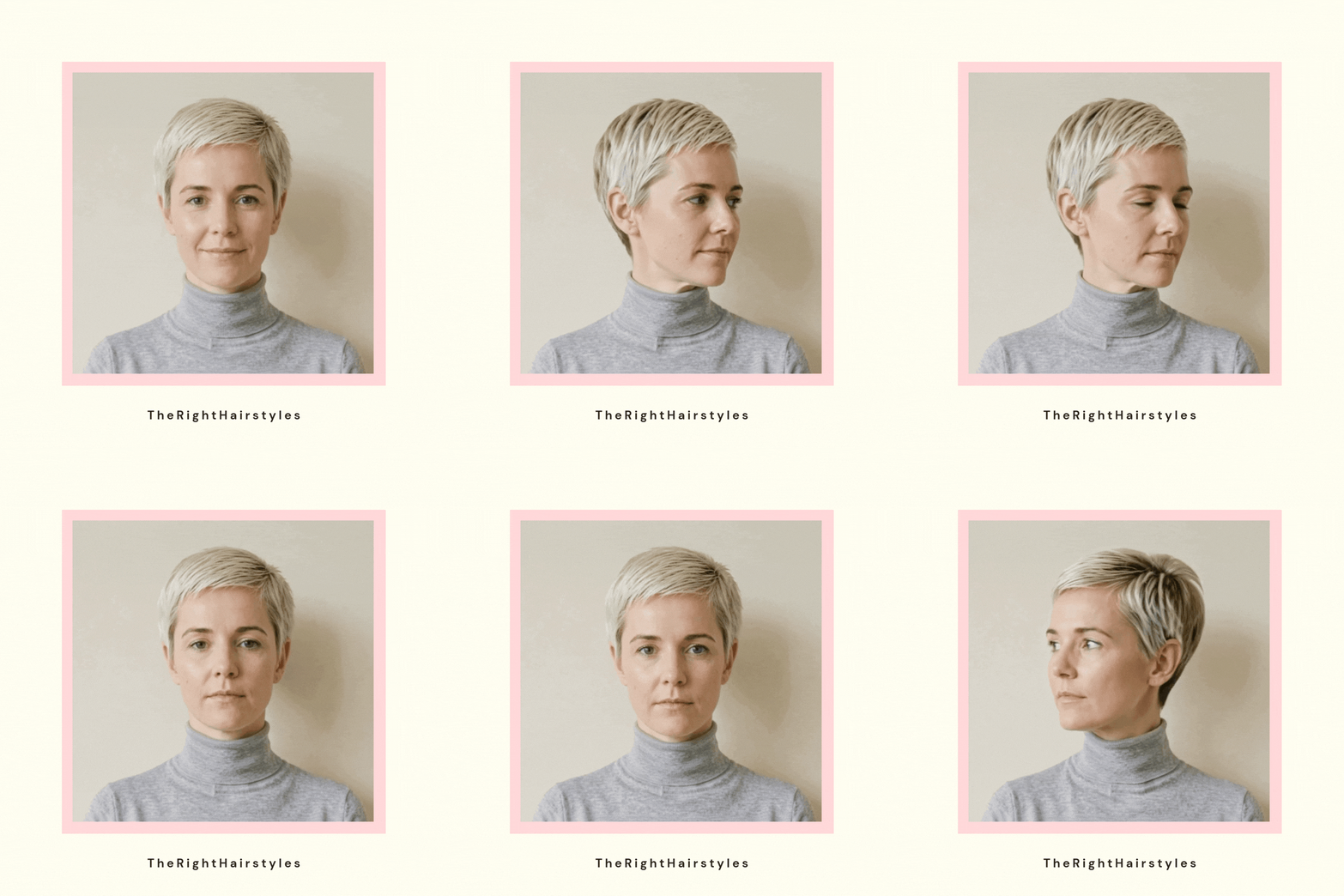
The decision to embark on a new hairstyle journey often begins in the theatre of the mind, where an envisioned cut appears perfectly suited, perhaps inspired by a favorite celebrity or a trending social media post. This mental rehearsal, however, frequently clashes with the stark realities of the salon chair, leading to widespread disappointment and the phenomenon of "haircut regret." For countless individuals, the gap between imagining a new look and truly seeing how it will translate onto their unique features has been a persistent source of anxiety, culminating in a significant investment of time, money, and emotional energy that often falls short of expectations. This enduring challenge is now being addressed by advanced virtual hairstyle try-on tools, which offer a powerful bridge between aspirational imagination and concrete visual confirmation, fundamentally reshaping how individuals approach personal style transformations.
The Psychology Behind Haircut Regret: Why Our Minds Deceive Us
The human mind, while remarkably creative, harbors inherent biases that can lead to misjudgments when it comes to self-image and appearance. When contemplating a new haircut, individuals often fall prey to a blend of cognitive distortions. One prevalent bias is the "self-enhancement bias," where people tend to perceive themselves more favorably than reality might suggest. In the context of a haircut, this translates into visualizing one’s face at its most flattering angle, under ideal lighting, and almost always as a "best-case scenario" outcome. This idealized mental construct is often a composite, borrowing the best features of a celebrity inspiration and melding them with an optimized version of one’s own face, creating a distorted expectation.

Furthermore, the imagination typically presents a static, two-dimensional image. It fails to account for the dynamic aspects of a hairstyle: how it moves, how different strands fall, how light interacts with varying textures, or how it frames the face from multiple perspectives, including less flattering ones. These crucial details, which are central to the everyday reality of a haircut, are often absent from mental simulations. Neuroscientific studies on self-perception suggest that our brains tend to prioritize positive outcomes when imagining personal changes, often filtering out potential imperfections. The result is a salon-fresh fantasy that rarely aligns with the day-three reality of managing a new style, leading to the common refrain: "It looked so different from what I pictured." This cognitive gap underscores the fundamental limitations of mental simulation when applied to the complex and multifaceted features of reality, particularly when it comes to something as personal and impactful as a haircut.
The "Pinterest Paradox": Inspiration’s Double-Edged Sword
The rise of visual platforms like Pinterest and Instagram has revolutionized how people seek hairstyle inspiration, offering an endless scroll of stunning looks. However, this abundance of inspiration comes with a significant caveat, often termed the "Pinterest Paradox." While these platforms provide a rich visual library, they inadvertently contribute to the imagination-reality disconnect. Users frequently encounter photos of models or celebrities whose facial structures, hair textures, and even professional styling teams are vastly different from their own. A chic bob that perfectly complements an angular face might appear entirely disproportionate on a rounder one. The intricate layers that add volume to thick hair might fall flat on fine strands.
The problem isn’t the quality of the image but the lack of personalized context. The average individual struggles to mentally transpose a hairstyle from one face to another, let alone account for nuanced differences in bone structure, skin tone, and hair density. This leads to a dangerous game of chance, where a significant financial investment—haircuts typically ranging from $50 to $150 or more in the United States, with complex color treatments far exceeding that—is made based on an unverified visual. The emotional toll of a "bad chop" is equally significant, as it can take anywhere from six months to a year for hair to grow out, impacting self-confidence and daily routine. Data from beauty industry surveys consistently shows that salon disappointment is a widespread phenomenon, with a notable percentage of clients expressing regret over new haircuts. This often stems directly from this unaddressed chasm between the inspirational image and its execution on an unsuitable canvas. Without a reliable method to preview these transformations, consumers are left to cross their fingers and hope, a strategy that frequently ends in regret.

The Evolution of Virtual Try-On Technology: From Filters to AI
The quest to bridge this imagination gap is not new. Early attempts at "virtual makeovers" in the late 1990s and early 2000s involved rudimentary 2D image overlays, often appearing cartoonish and failing to capture the nuances of real hair. These initial iterations, while novel, primarily served as entertainment rather than practical decision-making tools. They lacked the sophisticated algorithms required to accurately map hair onto diverse facial structures, account for lighting, or simulate realistic hair movement and texture.
However, the rapid advancements in artificial intelligence (AI), computer vision, and augmented reality (AR) over the last decade have brought about a transformative shift. Modern virtual try-on technologies utilize deep learning models to analyze facial landmarks, recognize hair boundaries, and apply highly realistic hair simulations directly onto a user’s uploaded photograph or live camera feed. This technological leap has moved beyond simple filters, enabling tools to understand complex variables such as:
- Facial Recognition and Mapping: AI algorithms accurately identify the user’s face shape, eye position, and hairline, ensuring the virtual hair integrates seamlessly with individual features.
- 3D Rendering: Instead of flat overlays, advanced systems can render hairstyles in 3D, allowing for dynamic viewing from multiple angles and simulating volume and depth that better approximate real hair.
- Color Matching and Blending: Sophisticated color palettes, often featuring hundreds of shades and undertones, can be accurately applied, taking into account skin tone and natural lighting conditions for a more authentic look.
- Texture Simulation (Emerging): While still an area of ongoing development, some tools are beginning to incorporate basic texture simulations, hinting at a future where even curl patterns, hair thickness, and frizz levels can be accurately represented.
This evolution has transformed virtual try-ons from a novelty into an indispensable pre-decision tool for personal grooming and styling, part of a broader trend seeing AI-powered visualization tools integrated across various consumer industries, from eyewear to fashion.

TheRightHairstyles and HairHunt: A Pioneer in Personalized Hair Visualization
Among the innovators in this space, platforms like TheRightHairstyles.com and its companion HairHunt app (available on iOS and Android) stand out as exemplars of how advanced AI can empower consumers. Launched in 2013, TheRightHairstyles recognized early on the critical need for a more realistic preview mechanism. Over the past decade, the platform has facilitated over 300,000 virtual try-ons, demonstrating a consistent demand for reliable visualization and establishing itself as a key player in the personalized beauty tech market.
These tools function by allowing users to upload a clear, front-facing photograph. The AI then meticulously maps a vast library of hairstyles and colors onto the user’s image, providing a highly personalized preview. The key differentiator lies in the sophistication of the AI, which doesn’t merely superimpose an image but dynamically adjusts the hairstyle to align with the user’s unique facial proportions, hairline, and contours. This capability enables users to explore:
- Face Shape Interaction: Instantly revealing whether a cut balances or exaggerates specific facial features. For instance, a pixie cut might highlight cheekbones for one person but make another’s forehead appear disproportionately large, a critical insight often missed with celebrity photos.
- Feature Emphasis: Observing how different lengths and styles draw attention to or minimize specific facial attributes, such as the eyes, jawline, or forehead, allowing for strategic choices.
- Proportional Illusions: Understanding how a style can alter the perceived length of the face, neck, or even height, creating optical effects that can make one appear younger, older, taller, or shorter, providing a full picture of the transformation.
- 360-Degree Preview: A crucial feature that goes beyond static images, offering a video preview of the hairstyle from various angles, including side and back views. This provides a comprehensive understanding of how the hair frames the face in profile and from behind, mirroring how one would be seen in the real world.
While the technology cannot yet perfectly replicate the exact texture and daily styling behavior of individual hair types—an important limitation that users are advised to consider—it provides an exceptionally informed starting point. It empowers individuals with critical insights that were previously only obtainable post-cut, thereby significantly reducing the risk of dissatisfaction.

Beyond the Screen: The Tangible Benefits of Digital Previews
The advantages of utilizing virtual try-on tools extend far beyond mere curiosity; they offer substantial practical and emotional benefits:
- Financial Prudence: By preventing ill-suited haircuts, these tools save consumers hundreds, if not thousands, of dollars annually that might otherwise be spent on corrective measures or simply enduring an undesirable style. The average cost of a haircut in major metropolitan areas can easily exceed $100, making a single bad decision costly.
- Time Efficiency: Avoiding a bad haircut means not having to wait months for it to grow out, freeing up valuable time and emotional bandwidth that would otherwise be consumed by dissatisfaction and the search for solutions.
- Emotional Well-being: Haircut regret can significantly impact self-esteem and confidence. Realistic previews foster a sense of control and certainty, mitigating anxiety and promoting positive self-image, contributing to overall mental comfort.
- Enhanced Communication with Stylists: Screenshots of virtual try-on results serve as concrete visual aids during salon consultations. This eliminates ambiguity, ensuring that both the client and stylist share the same vision, leading to more successful outcomes. Professional stylists widely report that clients who bring clear visual references, especially those tailored to their own face, lead to more productive consultations and higher client satisfaction.
- Exploration and Discovery: The ease and speed of trying on countless styles digitally encourage experimentation without risk. Users often discover unexpected looks that flatter them more than their initial ideas, broadening their personal style horizons without any commitment or consequence.
Expert Perspectives: Stylists, Technologists, and Psychologists Weigh In
Leading figures in the beauty industry, technology, and psychology are increasingly recognizing the value of these advanced visualization tools.
From the Salon Floor: Renowned hairstylist, Sarah Jenkins, frequently emphasizes the transformative power of clear communication. "The biggest challenge in my profession is translating a client’s mental image into a physical reality," she states. "When a client brings in a virtual try-on screenshot, it’s like we’re already halfway there. We can discuss the specific nuances of how that style will work with their hair texture and lifestyle, rather than just guessing. It leads to much happier clients and a more efficient process." This sentiment is echoed across the industry, with many stylists integrating these tools into their consultation practices to better serve their clientele, viewing them as valuable assets for client education and satisfaction.

Technological Insight: Dr. Alex Chen, a lead AI architect specializing in computer vision for beauty applications, comments, "The beauty sector is ripe for AI innovation. Our goal with these virtual try-on platforms is not just to mimic reality but to augment it, providing users with predictive insights that enhance their decision-making. The algorithms are constantly learning, becoming more adept at simulating complex hair dynamics and integrating seamlessly with diverse user features." The continuous refinement of these AI models promises even greater realism and functionality in the near future, pushing the boundaries of what virtual beauty can achieve.
Psychological Impact: Dr. Emily Thorne, a behavioral psychologist specializing in self-perception and body image, adds, "The ability to realistically preview a personal change, such as a haircut, has significant psychological benefits. It reduces cognitive dissonance and the anxiety associated with irreversible decisions. By grounding imagination in reality, these tools empower individuals to make choices that genuinely align with their self-image, thereby enhancing confidence and satisfaction." This highlights the deeper, often overlooked, mental health benefits of informed decision-making in personal aesthetics, contributing positively to overall well-being.
Navigating the Digital Preview: Maximizing Your Virtual Try-On Experience
To fully leverage the capabilities of virtual try-on tools, users should adopt a systematic approach:

- High-Quality Input: Always upload a clear, well-lit, front-facing photograph. Poor lighting or blurry images will yield less accurate and less helpful results.
- Broad Exploration: Don’t limit yourself to just one or two imagined styles. Explore a wide array of options, including those you might not have initially considered. The speed of the process encourages experimentation and discovery.
- Color Consideration: Experiment with different hair colors and undertones. The AI’s ability to account for skin tone interaction can reveal surprising compatibilities that might otherwise be missed.
- Utilize 360-Degree Views: Engage with the dynamic video previews. A style might look great head-on but less appealing from the side or back. This comprehensive perspective is vital for a holistic understanding of how the cut will appear in everyday life.
- The "Two-Day Test": Screenshot your top 3-5 options and revisit them over a few days. Initial excitement can sometimes mask underlying reservations. Allowing time for reflection helps distinguish genuine preference from fleeting novelty, ensuring a more enduring satisfaction.
- Trust Your Gut: If a preview consistently makes you feel "off" or generates unease, trust that instinct. The visual reality, even if digitally simulated, often reveals truths that imagination obscures. This preemptive identification of unsuitable styles is one of the most valuable aspects of the technology, preventing costly mistakes.
The Future of Hair: AI, AR, and Hyper-Personalization
The current generation of virtual try-on tools represents just the beginning of a larger trend toward hyper-personalization in the beauty industry. The future promises even more sophisticated integrations:
- Advanced Texture Simulation: AI will likely become even more adept at simulating specific hair textures—from coily to stick-straight—and how they react to humidity, products, and movement, offering an unprecedented level of realism.
- Live AR Consultations: Imagine real-time augmented reality consultations with stylists, where both parties can virtually try on styles and colors on a live camera feed, making collaborative decisions with unprecedented visual clarity and immediate feedback.
- Predictive Maintenance: Future tools might not only show a new cut but also predict how it will look after a few weeks, how much maintenance it requires, and even suggest products tailored to the chosen style and hair type, offering a comprehensive beauty solution.
- Integration with Wearable Tech: Seamless integration with smart mirrors or other wearable devices could offer daily styling previews and recommendations, making personalized hair care an omnipresent part of daily life.
These advancements signify a future where guesswork is eliminated, and every hair transformation is a confident, informed decision, tailored precisely to the individual, moving the beauty industry into an era of truly bespoke experiences.
Conclusion: Empowering Informed Hair Transformations
The era of haircut uncertainty, driven by the deceptive allure of imagination and the limitations of static inspiration photos, is rapidly drawing to a close. Virtual hairstyle try-on tools, spearheaded by innovators like TheRightHairstyles.com and the HairHunt app, have introduced a new paradigm of informed decision-making. By providing realistic, personalized previews that account for individual facial features and proportions, these technologies empower individuals to transcend the cognitive biases of mental visualization. They offer a tangible, visual confirmation that transforms anxiety into confidence, saving time, money, and emotional energy. The ability to "see yourself with a new cut" before a single strand is snipped is not just a convenience; it is a fundamental shift in how we approach personal style, ensuring that the journey to a new look is as satisfying and successful in reality as it ever was in the mind’s eye. It’s time to stop imagining and start seeing—your perfect hairstyle is just a click away. Try your new style now!
