
 By admin
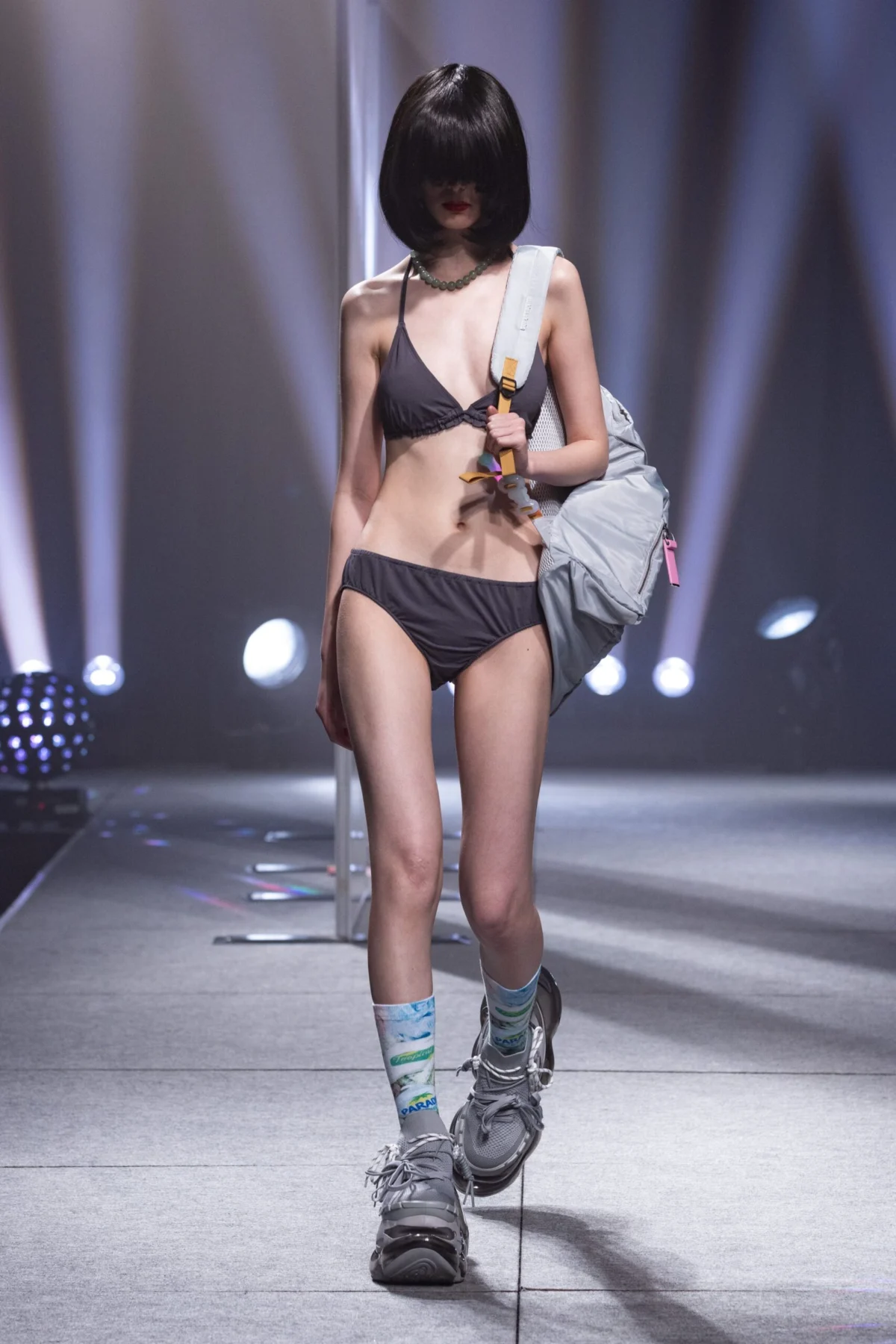
Tokyo, Japan – Mikio Sakabe, the acclaimed designer known for his intellectual yet playful deconstruction of fashion tropes, presented his Spring/Summer 2027 collection in the iconic La Foret mall in Harajuku, delivering a show that was both a vibrant spectacle and a subtle commentary on contemporary culture. The choice of venue, a legendary hub for youth fashion and subcultures since its establishment in 1978, provided an acutely fitting backdrop for a collection deeply rooted in the pursuit and fleeting nature of fantasy. Sakabe’s latest offering, staged amidst the bustling retail environment, drew inspiration from Japan’s distinct gravure magazine culture, transforming the everyday commercial space into a stage for a "swimsuit show held in a shopping mall" that resonated with both brightness and an underlying melancholy.
The Context: La Foret Harajuku and Tokyo Fashion Week
La Foret Harajuku stands as a cultural touchstone in Tokyo’s dynamic Harajuku district, a microcosm of Japan’s ever-evolving youth fashion scene. Since its opening, it has consistently served as a launchpad for emerging trends, a haven for niche subcultures, and a bustling nexus for fashion enthusiasts. Its multi-story retail labyrinth, housing an eclectic mix of independent boutiques, avant-garde designers, and mainstream brands, embodies the very essence of Japanese street style and consumerism. Hosting a fashion show within its active premises, rather than a conventional runway space, immediately set a tone of immersion and challenged the traditional boundaries between high fashion and everyday life.
This presentation was a highlight of Rakuten Fashion Week Tokyo, the nation’s premier fashion event, which typically showcases Spring/Summer collections in October of the preceding year. Tokyo Fashion Week has carved out a unique identity on the global calendar, often celebrated for its innovative spirit, embrace of technology, and its distinct reflection of Japanese aesthetics, ranging from minimalist elegance to exuberant street styles. Sakabe’s show, with its conceptual depth and location-specific staging, perfectly encapsulated the adventurous spirit that defines Tokyo’s contribution to the international fashion dialogue.
Mikio Sakabe’s Vision: Gravure Culture and the Quest for Fantasy
At the core of Sakabe’s Spring/Summer 2027 collection was a fascinating and somewhat unconventional starting point: Japan’s gravure magazines. These publications, a distinct phenomenon within Japanese popular culture, are vaguely erotic, male-marketed periodicals that feature "bambi-eyed" models posing in various states of dress, from lingerie and swimwear to elaborate cosplay. They represent a manufactured, hyperreal fantasy, often characterized by an idealized, almost innocent sensuality. Sakabe’s genius lay in extracting this specific cultural artifact and recontextualizing it within the high-fashion sphere, using it as a lens to explore universal themes of desire, escapism, and the search for an alternate reality.
"There’s something interesting about the concept of a fashion show in a Japanese fashion mall. It feels bright and showy but it’s also a little sad," Sakabe remarked, articulating the paradoxical emotional landscape of his collection. This sentiment was meticulously woven into the fabric of the show’s presentation. The runway, rather than being pristine, was intentionally littered with discarded coffee cups and drink cans, the detritus of everyday consumerism. This deliberate scattering served as a potent visual metaphor, juxtaposing the glossy, aspirational fantasy presented by the models and garments with the banal, disposable reality of a shopping mall. It underscored the ephemeral nature of manufactured dreams and the underlying melancholy of their pursuit within a consumerist landscape.
A Designer’s Journey: From Antwerp to Asian Influence
Mikio Sakabe’s journey in fashion is marked by intellectual rigor and a distinct artistic sensibility. An alumnus of the prestigious Royal Academy of Fine Arts in Antwerp, he shared a formative educational experience with figures who would go on to redefine global fashion, including Demna Gvasalia, the creative director of Balenciaga. This shared background in the rigorous, concept-driven environment of Antwerp undoubtedly shaped Sakabe’s approach, imbuing his work with a critical perspective and a penchant for deconstruction.
Upon establishing his eponymous label, Sakabe quickly gained recognition for his ability to mine the depths of underground culture, transforming its raw energy into fashion that, while often ironic and challenging, remained undeniably desirable. His aesthetic typically fuses elements of traditional Japanese subcultures with avant-garde Western influences, creating a unique hybrid language. This distinctive style has garnered him a substantial following, particularly across Asia, where his work resonates with a generation that navigates complex cultural identities and digital realities. His influence extends beyond the runway, with his designs frequently seen in prominent fashion editorials and adopted by tastemakers throughout the region.
The Collection: Deconstruction, Playfulness, and Iconic Accessories
The Spring/Summer 2027 collection itself was a masterclass in Sakabe’s signature aesthetic, blending the overtly commercial appeal of swimwear with his characteristic deconstructed tailoring. Models alternated between straight-up bikinis, stark in their simplicity, and more complex ensembles. These included Sakabe’s trademark oversized tailoring and shirting, which were presented in chaotic, artfully deconstructed forms. Fabrics were slashed and layered, creating dynamic, asymmetrical silhouettes that challenged conventional garment construction. Some pieces were festooned with delicate frills, adding a touch of playful femininity, while others featured floppy appendages that playfully evoked animal ears, particularly bunny ears, injecting a dose of innocent surrealism and perhaps a nod to cosplay culture, a common element in gravure imagery.
A unifying element across all looks was the presence of Sakabe’s now-signature eye-obscuring, helmet-like wigs. These striking accessories, which the designer confessed, "somehow I really like them," have become synonymous with his recent collections. They serve multiple functions: obscuring the models’ individual identities, creating a sense of anonymity or a uniform, and lending an almost doll-like or futuristic quality to the presentation. By minimizing individual facial expressions, the wigs shifted the focus entirely to the garments and the overarching conceptual narrative.
Equally prominent were the distinctive bubble-soled sneakers from Sakabe’s highly successful footwear project, Grounds. Founded in 2019, Grounds has rapidly grown into a global enterprise, now employing approximately 100 people worldwide. The inclusion of these immediately recognizable, commercially successful sneakers underscored Sakabe’s unique ability to bridge the gap between avant-garde design and mass appeal. The futuristic, almost sculptural quality of the Grounds sneakers perfectly complemented the collection’s themes of fantasy, escapism, and the blurring lines between digital and physical realities. Their significant commercial success also provides tangible data points for the designer’s impact beyond the runway, demonstrating a savvy understanding of market demands and consumer desires for innovative, comfortable, and aesthetically distinctive footwear.
Broader Implications: Escapism, Hyperreality, and Consumerism
Like much of Sakabe’s oeuvre, this collection was a profound exploration of the human desire to escape from reality and, crucially, the inherent futility of such attempts. The hyperreal superficiality of gravure culture, with its meticulously crafted illusions of fantasy, was deliberately contrasted with the starkly banal and transient context of a shopping mall. This juxtaposition highlighted the often-melancholy experience of seeking manufactured joy and belonging within commercial spaces. The discarded coffee cups and drink cans on the runway were not mere set dressing; they were poignant symbols of the ephemeral nature of consumer satisfaction and the constant cycle of desire and disposal.
The collection culminated in a powerful final look: a half-worn shirtdress adorned with slits of silver material. These metallic accents were not just decorative; they appeared as literal "portals to another universe," offering a glimmer of hope for genuine transcendence, even as the overall narrative suggested the difficulty of achieving true escape. This concluding statement encapsulates Sakabe’s nuanced perspective: while the pursuit of fantasy in commercial realms might lead to a sense of "sadness," the human spirit continues to yearn for profound connection and alternative realities.
Mikio Sakabe’s Spring/Summer 2027 collection is more than just a presentation of clothes; it is a meticulously crafted cultural commentary. It challenges viewers to consider the sources of their fantasies, the environments in which these fantasies are consumed, and the often-complex emotional landscape that lies beneath the glossy surface of contemporary life. By blending his intellectual design approach with accessible cultural references and commercially successful accessories, Sakabe reaffirms his position as one of Japan’s most thought-provoking and influential designers, whose work consistently resonates with a global audience grappling with the blurred lines between reality and aspiration. His ability to evoke both brightness and sadness, often simultaneously, makes his work a compelling reflection of our times.
