
 By admin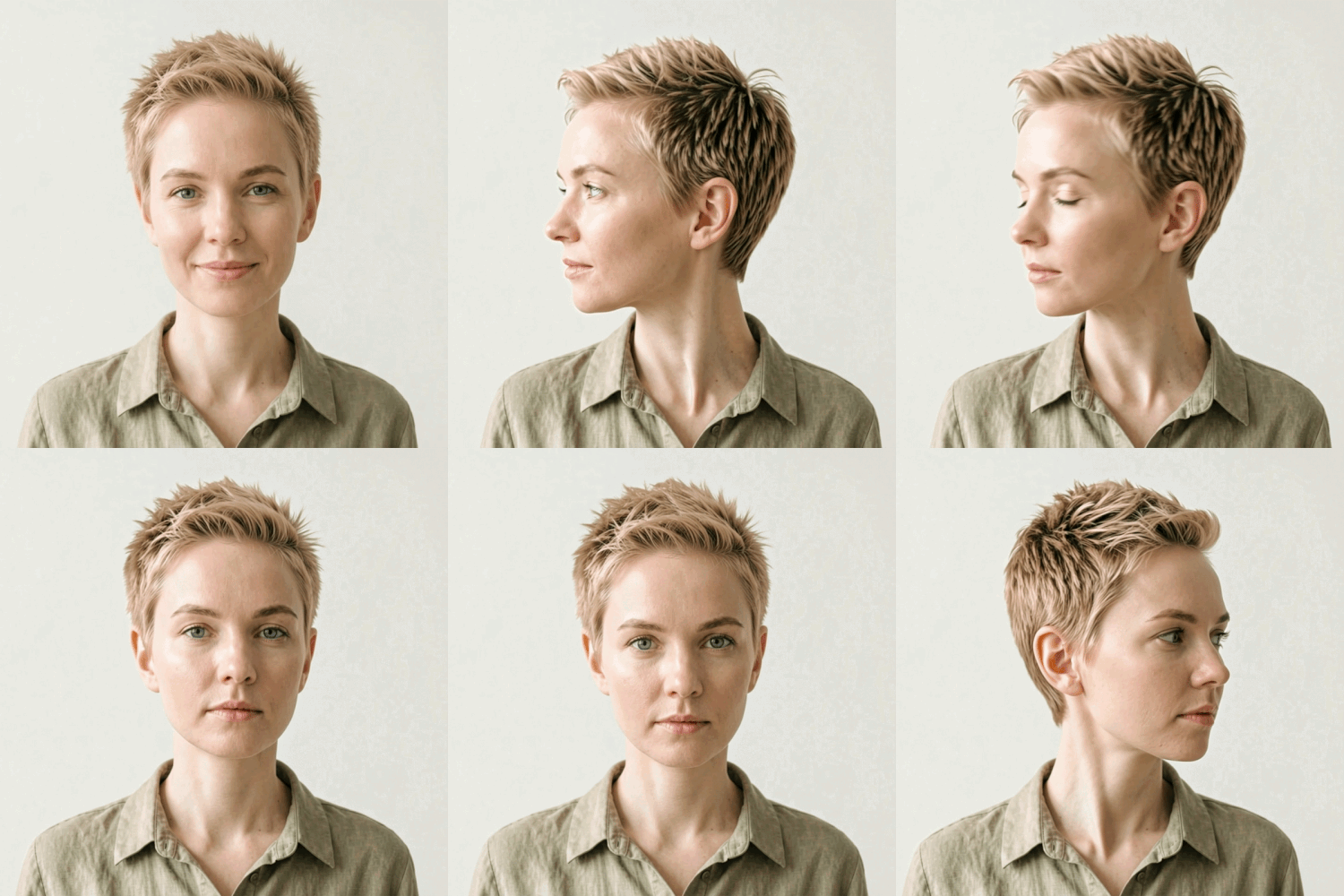
The rapid advancement of artificial intelligence has ushered in a new era of creative and analytical tools, with large language models like ChatGPT and image generation platforms such as DALL-E and Google’s Nano Banana capturing public imagination. While these technologies excel at tasks ranging from composing résumés and planning vacations to debugging code, their efficacy in highly specialized and nuanced applications, such as virtual hairstyle try-ons, is now under scrutiny. A recent comparison between general-purpose AI image generators and dedicated beauty technology platforms highlights a significant divergence in performance and utility when it comes to making concrete aesthetic decisions, particularly concerning hairstyles.
The allure of AI’s boundless capabilities, often summarized by the phrase "AI can do anything," has led to its application in diverse fields, including the beauty industry. Platforms leveraging AI image generation can, in theory, allow users to visualize themselves with different haircuts. However, the practical outcomes often reveal limitations, especially when precision and personal likeness are paramount. This disparity is starkly illustrated when comparing the extensive effort required to achieve even a semblance of a desired hairstyle using a general AI tool versus the near-instantaneous results provided by specialized virtual hairstyle applications.
The genesis of this exploration lies in the increasing integration of AI into consumer-facing applications. The past few years have witnessed an explosion in AI-driven image creation tools. DALL-E, for instance, utilizes diffusion models to transform textual descriptions into highly realistic visuals. Similarly, Nano Banana, powered by Google’s Gemini, allows users to edit photos based on written prompts, while ChatGPT itself has incorporated functionalities to modify user-uploaded selfies. These advancements, while technologically impressive and continually improving, present a specific challenge when applied to the delicate art of hairstyle visualization.

The "AI Can Do Anything" Paradox: Where General AI Meets Specialized Needs
The core issue arises from the fundamental design principles of general AI image generators versus those of dedicated beauty applications. General AI tools, such as DALL-E and Nano Banana, are primarily engineered for creative output and the generation of novel imagery based on textual prompts. When these tools are employed to modify a user’s photograph for a hairstyle preview, they are, in essence, generating an entirely new image with a synthesized hairstyle, rather than accurately overlaying a hairstyle onto the user’s existing features. This distinction is critical, as it leads to creative interpretations that may not reflect the user’s true appearance with the chosen style.
In contrast, specialized virtual hairstyle applications are built with a singular purpose: to provide accurate, personalized previews of how specific hairstyles would look on an individual. These platforms employ distinct technical methodologies to achieve this, focusing on overlaying virtual hairstyles onto a user’s actual photograph while preserving their facial features, skin tone, and natural lighting. This difference in approach is why a dedicated app can deliver a reliable preview in seconds, whereas a general AI tool might require hours of meticulous prompt engineering and still yield unsatisfactory results.
The Prompt Engineering Gauntlet: A Time-Consuming Endeavor

One of the most significant hurdles in using general AI for hairstyle try-ons is the reliance on intricate "prompt engineering." To achieve a somewhat realistic outcome with a tool like ChatGPT, users must meticulously describe every detail of the desired hairstyle, including lighting, camera angle, hair texture, preservation of skin tone, realistic shadow placement, and precise ear lines. The expectation is that the AI will then generate an image that not only incorporates the hairstyle but also accurately represents the user’s likeness.
For instance, a user might attempt a prompt like: "Generate a realistic photograph of myself with a layered bob haircut, maintaining the current lighting conditions, ensuring clean edges around my ears, preserving my original face proportions, applying no filter effects, and matching the hair color to my existing shade." This seemingly straightforward request can still fall short. The inherent complexity of accurately translating such detailed instructions into a visually faithful representation means that users often find themselves refining prompts iteratively.
In a comparative test, the article’s authors reportedly spent two hours crafting prompts for ChatGPT to achieve a specific hairstyle. The resulting images, while potentially visually interesting, often failed to accurately depict the user’s face or the intended hairstyle with precision. This contrasts sharply with the experience of using a dedicated app like HairHunt. Within approximately 10 seconds, users can select a hairstyle and instantly see it applied to their photograph, demonstrating the profound efficiency difference. This stark contrast underscores the reality that while AI can perform a multitude of tasks, its effectiveness is highly dependent on its specific design and purpose.
Consistency: The Achilles’ Heel of General AI for Beauty Applications

A critical factor for any virtual try-on tool is consistency. Users need to be able to rely on the generated previews to accurately reflect a hairstyle across multiple attempts. General AI image generators, by their nature, are designed to produce novel content, and consistency in replicating specific features or maintaining a user’s exact likeness is not a primary objective.
When using platforms like Nano Banana or ChatGPT for hairstyle simulations, users often encounter variations in their facial features, proportions, or even the overall appearance of their face from one generation to the next. This inconsistency is a direct consequence of the AI’s generative process, which creates new images rather than modifying existing ones directly. The result is a series of distinct visual interpretations, making it challenging to compare styles accurately or to trust the preview as a faithful representation.
Dedicated hairstyle apps, conversely, are engineered to prioritize consistency. Tools like HairHunt achieve this by employing a different technical approach. They essentially overlay virtual hairstyles onto a user’s actual, unaltered photograph. This method ensures that the user’s face remains the constant element, allowing for direct comparison of different hairstyles without the distraction of fluctuating facial characteristics. In repeated tests, HairHunt consistently presented the same facial features, providing a stable baseline for evaluating hairstyle options. This technical distinction is paramount for any application aiming to aid in decision-making rather than purely creative exploration.
Beyond the Prompt: The Limitations of General AI Image Generators

The limitations of general AI tools extend beyond prompt engineering and consistency. Their inherent design as creative engines means they often lack the curated selection and structured guidance that users seeking aesthetic changes require.
1. Lack of Curated Selection: While general AI can theoretically generate "any hairstyle" imaginable, this vast, uncurated output can be overwhelming and unhelpful. There are no built-in categories for face shapes, trending styles, or recommendations based on real-world hair considerations. This is akin to asking a general contractor to also serve as an interior designer; they possess broad skills but lack the specialized expertise and curated vision necessary for a specific design task. Dedicated hair apps, on the other hand, typically offer a library of hundreds of meticulously selected hairstyles, chosen for their realism, achievability, and relevance to current trends and salon practices.
2. 2D vs. 360-Degree Previews: A significant differentiator is the ability to view a hairstyle from multiple angles. General AI image generators often produce a single, static 2D image. This offers a limited perspective, failing to capture how layers fall, how light interacts with the hair, or how the cut frames the face from the sides or back. Specialized platforms, however, often incorporate 360-degree preview capabilities. This allows users to rotate the virtual hairstyle around their head, providing a comprehensive view that mimics the experience of seeing a haircut in a mirror from all directions, a crucial element for making an informed decision.
3. Entertainment vs. Decision Support: Ultimately, general AI image generators are built for entertainment and creative exploration. Their outputs can be stunning and imaginative, but they do not inherently address the core question a user faces when considering a new haircut: "Will this look good and work in real life?" Dedicated virtual hair try-on applications, conversely, are designed as decision-support tools. They prioritize realistic previews, consistent results, and shareable images that can be effectively used in discussions with a professional stylist.

The Emergence of Specialized Beauty Technology
The development of platforms like TheRightHairstyles and its accompanying app, HairHunt, predates the widespread integration of AI into the beauty conversation. Launched in 2013, TheRightHairstyles has a long-standing history of helping individuals visualize hairstyles, evolving its technology to incorporate AI capabilities specifically tailored for hair-related decisions. This foundational understanding of the user’s journey—from browsing styles to consulting with a stylist—informs the design of its tools.
These hair-specific platforms aim to solve the problems encountered with general AI by focusing on accuracy, realism, and ease of use. The HairHunt app, for example, emphasizes a streamlined process: users upload a photo, select a hairstyle and color from a curated library, and receive a preview within approximately 10 seconds. This rapid turnaround, coupled with the 360-degree preview feature, positions it as a practical tool for real-world decision-making.
Comparative Analysis: General AI vs. Dedicated Hair Platforms

To provide a clearer picture, a comparative breakdown of the strengths and weaknesses of each category of tool is essential:
-
ChatGPT with DALL-E:
- Strengths: Powerful creative capabilities, ability to generate visually striking and imaginative images, versatile for broad artistic applications.
- Weaknesses: Requires extensive prompt engineering for even moderate results, inconsistent facial representation, each generation produces a new image, best suited for inspiration and fantasy edits rather than precise previews.
- Data Point: Reports suggest that achieving a satisfactory hairstyle image from ChatGPT can involve multiple hours of prompt refinement, a significant time investment compared to specialized apps.
-
Nano Banana (Google/Gemini):
- Strengths: Impressive image editing capabilities responding to natural language, visually striking outputs.
- Weaknesses: Lacks curated hairstyle options, consistency issues in AI image generation, requires detailed textual descriptions, primarily serves as an entertainment tool.
- Analysis: While innovative in its natural language processing for image editing, Nano Banana, like other general AI tools, doesn’t fundamentally solve the problem of accurate hairstyle representation on a specific individual.
-
HairHunt by TheRightHairstyles:

- Strengths: Rapid results (approx. 10 seconds), instant previews with hairstyle and color selection, 360-degree hair preview, high user trust (over 980,000 users, 300,000+ virtual try-ons completed), shareable screenshots suitable for stylist consultations.
- Weaknesses: Limited to styles and colors available within the app’s curated library (though this is a feature designed for practicality).
- Data Point: The platform’s extensive user base and high number of completed try-ons suggest a strong market demand for accurate and efficient hairstyle visualization tools.
When to Deploy Which AI Tool
It is important to recognize that both general AI and specialized AI tools have their place. The choice depends entirely on the user’s objective.
-
General AI (e.g., ChatGPT, DALL-E, Nano Banana): These tools are ideal for generating fantasy images, engaging in creative projects, or for amusement, such as visualizing oneself as a cartoon character. Their strength lies in producing novel and often aesthetically pleasing images when the goal is entertainment or artistic exploration, rather than a practical preview.
-
Dedicated AI Hairstyle Apps (e.g., HairHunt): These platforms are indispensable for making concrete haircut decisions, preparing for salon consultations, comparing realistic hairstyle options side-by-side, and alleviating the anxiety associated with significant aesthetic changes. Their design prioritizes accuracy, consistency, and decision support.

The 10-Second Transformation: How Hair-Specific Platforms Excel
The operational simplicity and speed of hair-specific platforms are a testament to their focused design. The process typically involves a few straightforward steps:
- Access: Visit TheRightHairstyles.com or download the HairHunt app (available on iOS and Android).
- Selection: Browse a library of over 100 curated hairstyles. Many platforms offer guided quizzes to help users identify styles suited to their face shape.
- Upload & Process: Upload a clear, front-facing photograph with good natural lighting. The system processes the image, delivering a virtual hairstyle preview in approximately 10 seconds.
- 360-Degree View: Utilize the 360-hair preview to examine the hairstyle from all angles, observing how layers fall and how the length frames the face.
- Save & Consult: Save the preferred preview and use it as a visual aid when discussing haircut options with a professional stylist.
This streamlined process stands in stark contrast to the time-consuming prompt engineering often required by general AI tools. While a user might be struggling with their third ChatGPT prompt, someone using a dedicated app could have already tried twenty different styles and narrowed down their choices.
Frequently Asked Questions: Clarifying the AI Landscape for Hair Decisions

The rapid evolution of AI has naturally led to numerous questions regarding its application in personal grooming. Here are answers to common queries:
-
Can ChatGPT show me with a specific hairstyle? ChatGPT can generate images, but the results are highly variable and demand extensive prompt engineering. Outputs often appear overly polished or filtered, prioritizing aesthetic appeal over personal accuracy.
-
Is Nano Banana good for trying hairstyles? Nano Banana is a powerful creative tool for general image editing. However, it lacks curated hairstyle options and struggles with precise placement of highlights or specific bang styles.
-
Why do I need a dedicated hair app? Dedicated hair apps empower users to make informed decisions. Instead of relying on descriptive prompts and hoping for consistent results, users can instantly see their face with specific styles applied.

-
Which is more accurate, ChatGPT or HairHunt? For realistic hair previews on one’s actual face, dedicated tools like HairHunt are significantly more accurate than general AI. Accuracy in AI hairstyle applications hinges on face preservation, style consistency, and comparative viewing capabilities.
-
Does HairHunt take 30 minutes? No, recent assessments indicate that HairHunt provides results in approximately 10 seconds. Older claims of longer processing times may stem from the extended periods users spend refining prompts in general AI tools.
-
Can I use ChatGPT for a salon consultation? It is not recommended. The need to constantly tweak prompts, manage inconsistent facial rendering, and hope for a usable output makes it impractical for a professional consultation.
-
Are AI hair apps better than inspiration photos? They serve complementary purposes. AI hair apps offer personalized previews on one’s own face for decision-making, while inspiration photos are valuable for broad style exploration and idea gathering.

-
Is my photo stored? Reputable hair apps like HairHunt process images securely, typically deleting them after processing or storing them temporarily in accordance with their privacy policies.
-
What’s the difference between AI hair filters and AI hair try-on? AI filters apply visual effects over existing images. Filter-free hair apps, conversely, simulate structured hairstyles placed realistically onto a user’s preserved facial features.
-
Can AI show how a haircut looks from the side or back? Most general AI tools generate a single 2D angle. Dedicated platforms with 360-degree previews, like TheRightHairstyles, offer multi-angle views, crucial for a comprehensive understanding of the hairstyle.
-
Why do general AI haircuts look fake or "too perfect"? General AI prioritizes aesthetic output, often smoothing skin, adjusting proportions, or enhancing lighting. This is beneficial for creative imagery but not ideal for realistic hairstyle previews.

-
Can I try different hair colors at the same time as the cut? Many dedicated apps, including HairHunt, allow users to select both hairstyle and hair color simultaneously for an instant, comprehensive preview.
-
I want a big change, but I’m not sure where to start. Can AI help? Absolutely. A dedicated AI hairstyle app is an excellent starting point for considering major changes. Users can upload their photo, explore the style library, and identify looks that resonate before committing to significant alterations.
In conclusion, while the general capabilities of AI are undeniably impressive, their application in specialized fields requires careful consideration of their design and intended purpose. For decisions as personal and impactful as a hairstyle change, the precision, consistency, and user-centric design of dedicated virtual hairstyle platforms offer a far more reliable and efficient solution than the creative, but often imprecise, outputs of general AI image generators. The future of beauty tech lies in tools that augment personal decision-making, not just in generating aesthetically pleasing, albeit artificial, imagery.