
 By Nila Kartika Wati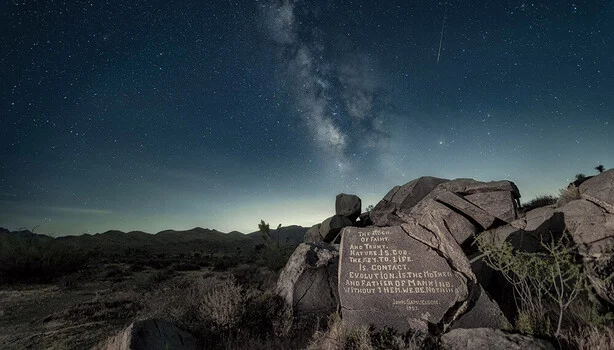
A rare astronomical alignment, featuring a Perseid meteor streaking across the Milky Way, has been successfully documented above the historically significant Samuelson’s Rocks within Joshua Tree National Park. The challenging expedition, undertaken by a seasoned photographer during extreme summer temperatures in early August, resulted in a compelling image that combines natural celestial phenomena with a unique piece of Mojave Desert history. This accomplishment highlights the rigorous preparation required for remote wilderness photography and the enduring appeal of the desert’s hidden gems.
The Enigmatic Legacy of Samuelson’s Rocks
Samuelson’s Rocks are not listed on official park maps, nor are they accessible via marked trails, adding to their mystique as a clandestine landmark. These seven massive boulders, bearing eight philosophical and political inscriptions carved by Swedish immigrant and prospector John Samuelson in the 1920s, represent a tangible link to the rugged individuals who shaped the early history of the Mojave Desert. Samuelson, an eccentric figure, arrived in the region around 1926, seeking work from pioneer Bill Keys. He was employed at Keys’ ranch and nearby mines, during which time he etched his profound musings into the durable granite.
The inscriptions offer a glimpse into Samuelson’s worldview, often reflecting anti-war sentiments, critiques of societal norms, and a deep connection to the desert environment. Phrases such as "A man’s best friend is his country, but a man’s worst enemy is his government" and "When the world is at peace, the world is at rest" resonate with a timeless quality, inviting contemplation from those few who manage to find them. Their remote location, deep within the park’s expansive wilderness, has preserved them from extensive vandalism, maintaining their integrity as a unique historical artifact. For photographers and historians alike, Samuelson’s Rocks represent not just a physical location, but a symbol of the untamed spirit of the American Southwest.
The Celestial Spectacle: Understanding the Perseid Meteor Shower
The Perseid meteor shower is one of the most anticipated annual astronomical events, renowned for its bright and numerous meteors. Originating from debris left by Comet 109P/Swift-Tuttle, the shower typically peaks in mid-August, when Earth passes through the densest part of the comet’s dust trail. During its peak, observers under dark skies can witness dozens, sometimes over a hundred, meteors per hour. These "shooting stars" are caused by tiny particles of cosmic dust entering Earth’s atmosphere at high speeds, burning up and creating luminous streaks of light.
Capturing a Perseid meteor on camera, especially a week before its peak, presents significant challenges. While the shower is active for several weeks, the frequency of visible meteors increases dramatically closer to the peak. Photographers often employ continuous long-exposure photography over extended periods, relying on chance and persistence to capture a meteor within the camera’s frame. The successful inclusion of a Perseid meteor in the image from Samuelson’s Rocks, angling precisely towards one of the carved boulders, underscores a remarkable convergence of meticulous planning, technical execution, and fortuitous timing. This achievement not only captures a fleeting celestial event but also frames it against a backdrop of enduring human inscription, creating a dialogue between the cosmic and the historical.
Navigating the Mojave’s Summer Extremes: Safety Protocols and Wilderness Challenges
The expedition to Samuelson’s Rocks was undertaken on August 5, 2026, a period notorious for extreme heat in the Mojave Desert. Daytime temperatures in Joshua Tree National Park during this week consistently exceeded 100°F (38°C), with the specific day of the hike reaching approximately 104°F. Such conditions pose significant risks to hikers, including dehydration, heat exhaustion, and heatstroke, which can be fatal.
National Park Service (NPS) guidelines strongly advise against extended hikes in Joshua Tree during the summer months, particularly those exceeding two miles. The park’s rugged terrain, characterized by spiky plants, cacti, and numerous washes, further exacerbates these dangers, demanding careful foot placement and appropriate attire. To mitigate these risks, the photographer meticulously planned the journey, opting to hike exclusively after sunset when ambient temperatures naturally begin to cool, benefiting from Joshua Tree’s higher elevation.
Critical safety measures included carrying a substantial water supply—1.5 gallons for the three-mile round trip, with additional reserves in the vehicle—and equipping a well-stocked emergency kit. Appropriate clothing was also essential: lightweight, moisture-wicking fabric for the upper body, paired with thick pants and sturdy boots to protect against the pervasive desert flora. This preparation aligns with NPS recommendations for responsible wilderness travel, emphasizing self-sufficiency and an acute awareness of environmental hazards. Park officials frequently remind visitors that the desert, while beautiful, is an unforgiving environment that demands respect and thorough planning, especially during extreme weather conditions.
Precision Navigation in Remote Wilderness: Leveraging Modern Technology
One of the primary challenges of reaching Samuelson’s Rocks is the complete absence of marked trails or signage. In an area notoriously devoid of cellular signal, traditional navigation methods often prove insufficient. The photographer utilized the Garmin Explore application on a smartphone, a tool lauded for its offline mapping capabilities and robust GPS functionality, even without pairing to a dedicated Garmin device. This technology allowed for precise waypoint tracking and route guidance through the open desert.
The navigation strategy involved pre-loading the destination coordinates and continuously monitoring progress. A crucial technique employed was aligning the intended direction of travel with distinct geological features in the distance, such as mountain peaks. This visual triangulation, combined with periodic checks of the GPS app, ensured a consistent bearing. Walking in the dark necessitated constant vigilance, with the flashlight primarily directed at the ground to identify and avoid hazardous desert plants like cholla cacti, known for their painful, easily detachable spines. This careful approach not only safeguarded the hiker but also minimized disturbance to nocturnal wildlife. The 1.5-mile trek to the rocks was completed in approximately 42 minutes, including hydration stops, demonstrating efficient navigation despite the challenging conditions and darkness.
The Expedition Unfolds: A Detailed Timeline
- August 5, 2026, Evening: The photographer arrived at the designated parking spot in Joshua Tree National Park shortly after sunset. The day’s peak temperature had been 104°F, underscoring the necessity of a nocturnal excursion.
- Post-Sunset Hydration and Preparation: Before commencing the hike, a significant amount of water was consumed, and the REI Lookout 40 backpack, containing camera gear, 1.5 gallons of water, flashlights, and emergency supplies, was secured. The choice of backpack highlighted a balance between carrying essential equipment and maintaining comfort for a three-mile off-trail trek.
- Initial Ascent and Navigation: The hike began in rapidly fading twilight. The Garmin Explore app provided initial directional guidance, which was supplemented by visual alignment with distant mountain outlines. The path involved careful maneuvering around dense patches of spiky desert vegetation and crossing several dry washes, common topographical features in the Mojave.
- Arrival at Samuelson’s Rocks: Approximately 42 minutes into the hike, after covering 1.5 miles, the photographer arrived at Samuelson’s Rocks. The relief of reaching the destination was tempered by the heat and exertion, despite the cooler night air. The immediate task was to establish the photography setup.
- Astrophotography Setup: A robust tripod was firmly embedded into the sandy ground to ensure stability against potential wind gusts, crucial for long-exposure photography. An intervalometer was set to continuously trigger the camera, a standard technique for increasing the probability of capturing transient events like meteors during a time-lapse sequence.
- The Waiting Period: The photographer spent a considerable duration sitting in the desert, observing the night sky, and allowing the camera to operate automatically. This period was marked by occasional strong wind gusts, which required manual stabilization of the tripod to prevent any shift in composition. Several meteors were observed visually, though their photographic capture remained uncertain.
- Moonrise and Departure: As the half-moon began to ascend above the horizon, its increasing luminosity started to wash out the faint light of the Milky Way, signaling the end of the prime astrophotography window. The equipment was packed, and the return journey commenced, with continued vigilance against desert hazards, particularly the sharp spines of cholla cacti.
- August 6, 2026, Post-Processing and Discovery: The following day, during the review of the captured images in Lightroom Classic, a single photograph stood out. It depicted Samuelson’s Rocks illuminated by the core of the Milky Way, with a distinct Perseid meteor streaking across the sky, perfectly angled towards one of the historic carved boulders. This discovery confirmed the success of the challenging expedition.
Implications and Broader Impact
The successful capture of a Perseid meteor above Samuelson’s Rocks holds multiple layers of significance. For the field of astrophotography, it represents a testament to dedication and technical prowess in challenging environmental conditions. Astrophotography experts frequently comment on the inherent difficulties of capturing meteors, which are unpredictable and require extended periods of continuous shooting. The resulting image serves as a powerful visual narrative, bridging the ephemeral beauty of a celestial event with the enduring human legacy etched into the desert landscape.
From a conservation perspective, such images raise awareness about the pristine dark skies over places like Joshua Tree National Park, highlighting their value as natural resources susceptible to light pollution. The park’s designation as an International Dark Sky Park underscores its commitment to preserving these conditions for both scientific research and public enjoyment. The photograph subtly advocates for responsible tourism and wilderness ethics, demonstrating that unique experiences can be achieved through meticulous planning and respect for natural and historical sites, rather than through reliance on developed infrastructure.
Furthermore, the assignment from Yucca Brevifolia Magazine to document celestial phenomena emphasizes the growing public and editorial interest in scientific and natural history content, particularly when presented through compelling visual storytelling. The image not only fulfills the magazine’s editorial objective but also provides valuable documentation of both astronomical occurrences and a lesser-known historical landmark. It underscores the role of photography in educating and inspiring audiences about the wonders of our universe and the rich heritage embedded within our national parks. This achievement is a compelling reminder of the extraordinary encounters possible for those willing to venture responsibly into the wild, embracing both the challenges and the profound rewards of discovery.
