
 By Nila Kartika Wati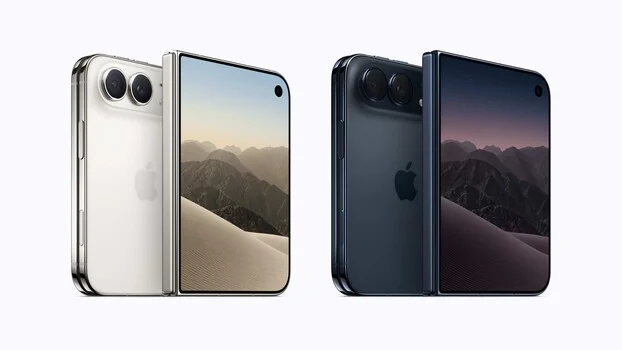
Apple has officially introduced the iPhone Duo, marking its highly anticipated entry into the foldable smartphone market. This groundbreaking device pairs a compact 5.4-inch Super Retina XDR outer display with a sprawling 7.6-inch Super Retina XDR folding inner display, presenting users with unprecedented versatility in a mobile form factor. Beyond its revolutionary design, the iPhone Duo integrates a sophisticated dual 48 MP rear camera system capable of 4K video recording at an impressive 120 frames per second, powered by the new A20 Pro processor. New photography features uniquely leverage the dual-screen setup, while an updated version of iOS, specifically designed for multitasking, promises to redefine mobile productivity.
The iPhone Duo will debut with a starting price of $1,999 for the 256 GB storage variant, positioning it firmly in the premium segment of the smartphone market. Preorders are slated to commence on October 16, 2026, with general availability following swiftly on October 23, 2026, across key global markets. This launch not only signifies a substantial shift in Apple’s hardware strategy but also signals a mature evolution of foldable technology, potentially catalyzing broader adoption of the form factor.
Apple’s Long Road to the Foldable Frontier
The introduction of the iPhone Duo represents the culmination of years of speculation, patent filings, and intensive research and development within Apple. For nearly a decade, the tech giant has been a prominent, albeit silent, observer in the burgeoning foldable phone space. Competitors like Samsung, Huawei, and Motorola have pioneered the category since 2019, navigating initial challenges related to display durability, hinge mechanisms, and software optimization. Early foldable devices often faced scrutiny over screen creases, fragility, and prohibitive costs, leading to a cautious, iterative development cycle across the industry.
Apple’s characteristic approach has been to enter established markets not as a first-mover, but as a refiner, aiming to deliver a polished, user-centric experience once the technology has matured sufficiently. Numerous patents detailing various folding mechanisms, display technologies, and hinge designs have surfaced over the years, providing glimpses into Apple’s internal efforts. The decision to launch the iPhone Duo in late 2026 suggests Apple believes the underlying display and hinge technologies have reached a level of reliability and user experience consistent with its brand standards. This strategic timing allows Apple to learn from the successes and failures of its predecessors, addressing common pain points before making its grand entry. Industry analysts project that the foldable smartphone market, while still a niche, is on a significant growth trajectory, with forecasts predicting tens of millions of units shipped annually by the late 2020s. Apple’s entry is expected to inject considerable momentum into this segment, potentially accelerating mainstream consumer acceptance and driving further innovation.
Revolutionary Design and Display Technology
The iPhone Duo’s design is centered around its dual-display configuration and robust folding mechanism. When closed, the device features a 5.4-inch Super Retina XDR outer display. This screen size is comparable to the compact iPhone mini models, providing a fully functional and pocketable smartphone experience for quick interactions, notifications, and basic tasks. Opening the phone dramatically reveals a expansive 7.6-inch Super Retina XDR inner display, which Apple proudly touts as its largest display ever on an iPhone. This transformation from a compact device to a tablet-like canvas is central to the Duo’s appeal.
Both the outer and inner displays are engineered with identical aspect ratios, a crucial detail that ensures content maintains consistent proportions and visual integrity as users transition between screens. This eliminates the jarring reframing issues sometimes seen on other foldable devices, enhancing the seamless user experience. Furthermore, both panels incorporate ProMotion technology, offering adaptive refresh rates up to 120Hz for fluid scrolling and responsiveness, alongside Always-On functionality for at-a-glance information. A remarkable 3,000 nits of peak outdoor brightness ensures exceptional visibility even under direct sunlight, a critical advantage for photographers and videographers working outdoors.
The inner folding display boasts a nano-texture finish, a subtle yet significant innovation designed to reduce glare and reflections, thereby making the crease less noticeable during use. This attention to detail underscores Apple’s commitment to delivering a premium visual experience. A discreet FaceTime camera is cleverly positioned beneath the inner display, remaining entirely hidden until activated, preserving the expansive screen real estate. Expanding its utility, Apple Pencil support is planned for a software update later in 2026, enabling precise note-taking, intricate drawing, and efficient document markup directly on either screen, blurring the lines between iPhone and iPad capabilities for creative professionals.
For biometric authentication, Apple has opted for Touch ID, seamlessly integrated into the side button, a departure from the Face ID system prevalent in its flagship non-foldable iPhones. This choice likely addresses the engineering complexities of integrating Face ID into a folding display while maintaining a sleek bezel, and offers users a familiar, reliable authentication method. The device can also be conveniently unlocked via a compatible Apple Watch, enhancing ecosystem integration.
The physical enclosure of the iPhone Duo is crafted from aerospace-grade 5 titanium, renowned for its exceptional strength-to-weight ratio and corrosion resistance. The intricate folding mechanism is protected by a 3D-printed titanium hinge cover, showcasing advanced manufacturing techniques. Internally, the hinge system comprises over 100 meticulously engineered components, supported by internal support ribs and ceramic fiber inserts to reinforce the structure against the stresses of repeated folding. For external protection, the back of the device is safeguarded by Ceramic Shield, while the front (when closed) features the even more advanced Ceramic Shield 2. The entire device is rated IP68 for splash, water, and dust resistance, providing peace of mind against environmental hazards. The folding display itself is a marvel of material science, incorporating a scratch-resistant coating, a high-strength polymer cover layer, multiple layers of robust glass, and an underlying titanium plate. Apple specifically highlights the polymer layer’s up to 40% greater stiffness compared to materials commonly used in similar applications, indicating a significant stride in foldable screen durability.
Dual 48 MP Cameras: A New Vision for Mobile Photography
At the heart of the iPhone Duo’s imaging capabilities lies a sophisticated dual-camera system, a significant upgrade for mobile photographers and videographers. It features a 48 MP Fusion Main camera and a 48 MP Fusion Ultra Wide camera. The Main camera, leveraging Apple’s computational photography, can capture full 48 MP images for maximum detail, while its default mode intelligently produces 24 MP files, balancing detail with manageable file sizes. This camera also offers an optical-quality 2x zoom option for tighter framing without digital degradation.
Technical enhancements to the Main camera include sensor-shift optical image stabilization (OIS) for superior low-light performance and sharper images, along with an updated computational imaging pipeline that processes vast amounts of data for optimal results. While specific sensor dimensions and aperture values were not detailed in the initial press release, Apple emphasizes a "large sensor" and "fast aperture," suggesting strong performance in challenging lighting conditions. The 48 MP Fusion Ultra Wide camera, according to Apple, is the same high-performance unit found in the iPhone 18 Pro line, known for its expansive field of view and capable macro photography features, allowing users to capture intricate details from close distances.
Beyond the rear cameras, the iPhone Duo integrates a Center Stage front camera, designed to keep subjects automatically centered during video calls and recordings, regardless of the device’s orientation. This intelligent feature adapts to multiple participants, making group video calls more engaging. A separate FaceTime camera is discreetly positioned beneath the folding inner display, further enhancing the device’s video conferencing capabilities. Apple has also refined its Photographic Styles, now offering granular controls over texture and grain, empowering users with more creative freedom to customize the aesthetic of their images directly on the device.
Leveraging the Foldable Design for Unprecedented Camera Features
The dual-display architecture of the iPhone Duo unlocks a suite of innovative camera features that transform the way users interact with their device for photography and videography. These features move beyond mere novelty, offering practical solutions for creators.
- Duo Preview: This groundbreaking feature sends a live camera preview to the outer display while a subject is being photographed or filmed. This allows the subject to see the framing and adjust their pose or position in real-time, directly engaging them in the creative process. This is particularly useful for portraits, interviews, and demonstrations, eliminating the need for an external monitor and fostering better collaboration between photographer and subject.
- Rear Camera Selfies: Users can now utilize the superior 48 MP rear camera system for selfies and self-recorded content, using the outer display for composition. This addresses a long-standing compromise in smartphone photography, where creators often had to choose between the higher quality of rear cameras and the convenience of monitoring with a front-facing camera. The Duo eliminates this dilemma, providing professional-grade self-portraits and vlogs.
- Smart Take: Harnessing on-device AI processing, Smart Take analyzes a scene and intelligently captures photographs when subjects appear to be posing naturally. This feature is primarily designed for group photographs, ensuring that the person operating the camera is not left out or forced to rely on timers, capturing more spontaneous and inclusive moments.
- Kid Cue: A playful yet practical feature, Kid Cue displays engaging Peanuts animations on the outer screen, designed to capture and direct a child’s attention towards the camera. This can be invaluable for parents and photographers attempting to get children to look at the lens, simplifying the often-challenging task of photographing young subjects.
- Duo FaceTime: This feature extends the utility of the dual displays to video calls, allowing people standing alongside the user to see and participate in a video call via the outside screen. This fosters a more inclusive and collaborative video conferencing experience, especially in group settings.
These applications of the dual display are relatively straightforward but profoundly practical, offering tangible benefits in scenarios such as portraits, interviews, self-recording, and small-scale productions where external monitoring solutions would otherwise be cumbersome or cost-prohibitive. They represent a significant advancement in mobile imaging interaction, redefining the boundaries of what a smartphone camera can achieve.
Expanded Video Capabilities and Creative Control
The iPhone Duo is not just a photographic powerhouse; it also sets a new benchmark for mobile video creation. The 48 MP Fusion Main camera supports 4K video recording at an impressive 120 frames per second in Dolby Vision HDR. This high frame rate provides immense flexibility for creators, allowing footage to be slowed down significantly for smooth, cinematic slow-motion playback without compromising resolution or quality.
Apple is further expanding its suite of Cinematic tools, providing creators with greater post-capture flexibility. Cinematic effects, which enable sophisticated depth-of-field and focus transitions, can now be applied or adjusted after capture at up to 60 frames per second. This shifts creative decisions from the often-pressured capture phase to the more controlled post-production environment, empowering filmmakers with greater artistic control. The Audio Mix feature receives updated processing, specifically intended to improve voice reproduction clarity, alongside the new ability to isolate music tracks, offering enhanced control over the soundscape of videos. Time-lapse recording also benefits from the advanced imaging pipeline, now capable of capturing stunning 4K footage in Dolby Vision HDR.
A significant practical advantage of the iPhone Duo’s folding design is its ability to function as its own support system. When partially folded, the device can be placed on a flat surface, creating a stable platform for shooting longer videos, time-lapses, group photographs, or self-recorded content without the need for a separate tripod or stand. This inherent stability and versatility make the Duo an invaluable tool for on-the-go content creation.
iOS 27: Redefining Multitasking on a Foldable Canvas
The iPhone Duo ships with iOS 27.1, a version of Apple’s operating system meticulously adapted and optimized for its unique folding hardware. This tailored software experience is critical to unlocking the full potential of the dual-screen design. Interface elements, including Lock Screen controls, the Home Screen Dock, app navigation, and other system controls, intelligently move towards the sides of the inner display when unfolded. This strategic placement preserves more vertical screen space, enhancing content visibility and immersive viewing.
When fully unfolded, the iPhone Duo’s expansive inner display can simultaneously showcase two distinct Home Screen pages alongside the Today View, providing a rich, information-dense dashboard. The Dynamic Island, Apple’s innovative notification and activity hub, has been redesigned for a vertical orientation on both the inner and outer screens, ensuring a consistent and optimized user interface regardless of the display in use.
Crucially for productivity, iOS 27 introduces Split View to the iPhone, a feature previously exclusive to iPad. This empowers users to run two applications simultaneously side-by-side, open two windows from the same application, quickly exchange one app for another, and even save commonly used app pairs for instant recall. For a photographer, this could mean keeping reference material (e.g., a mood board or shot list) open alongside a photo editing application, or managing client communications while reviewing content without constant full-screen switching. This level of multitasking significantly elevates the iPhone Duo’s utility as a mobile workstation.
Furthermore, apps on the iPhone Duo are designed to respond dynamically to the physical position of the phone. They can seamlessly change orientation, adapt their layout, or even move to the appropriate display as the device is folded, rotated, or flipped. This contextual responsiveness ensures a fluid and intuitive user experience, making the transition between different modes of use feel natural and effortless.
A20 Pro and Vapor Chamber Cooling: Unmatched Performance
Powering the iPhone Duo is Apple’s A20 Pro processor, the same cutting-edge chip found in the iPhone 18 Pro models, ensuring flagship-level performance across all tasks. To sustain this high performance, especially during demanding workloads like 4K video editing, complex gaming, or intensive AI processing, Apple has integrated a custom vapor chamber thermal management system. This advanced cooling solution is designed to dissipate heat more efficiently, with Apple claiming up to 35% better sustained performance compared to the iPhone 17 Pro.
The A20 Pro chip itself is a marvel of silicon engineering, manufactured using an advanced 2 nm process. It features a 6-core CPU, which Apple rates as up to 20% faster than the previous A19 Pro. The 7-core GPU delivers even more substantial gains, boasting up to 40% faster performance while also being more efficient. AI processing, a cornerstone of modern smartphone capabilities, is handled by a Dual 16-core Neural Engine, offering twice the compute performance of its predecessor. Furthermore, unified memory bandwidth has been increased by 50%, facilitating faster data access for the CPU, GPU, and Neural Engine, contributing to overall system responsiveness. A separate, dedicated display engine is incorporated to simultaneously manage the complex demands of both the inner and outer displays, ensuring smooth and lag-free visuals across the unique form factor.
Apple Intelligence and Siri AI: Smart Tools for Creators
The iPhone Duo serves as a premier platform for Apple’s expanded Apple Intelligence features and the enhanced Siri AI, integrating advanced machine learning directly into the user experience. Siri AI now leverages information from supported messages, emails, photographs, and other personal context, providing more personalized and proactive assistance. Its "onscreen awareness" allows it to respond intelligently to information currently being displayed, offering contextually relevant suggestions and actions.
For photographers and videographers, several new AI tools within the Photos workflow are particularly impactful:
- Spatial Reframing: This feature allows users to alter an image’s composition after capture, intelligently adjusting framing and perspective to achieve a desired aesthetic without re-shooting.
- Extend: Leveraging generative AI, Extend can create and add content beyond the original boundaries of an image, expanding the frame and offering new compositional possibilities.
- Clean Up: The enhanced Clean Up tool provides more sophisticated capabilities for removing unwanted elements from photographs, allowing for pristine, distraction-free images.
- Image Playground: This feature adds support for photorealistic imagery, empowering users to generate highly realistic visuals directly on their device, opening new avenues for creative expression.
In a move towards transparency and ethical AI, support for SynthID is planned through a software update later in 2026. Apple states that this will enable users to identify many images that have been generated or significantly edited using AI, depending on the extent and nature of the edits involved. This feature underscores Apple’s commitment to responsible AI deployment and content authenticity.
Power, Connectivity, and Ecosystem Integration
To power its dual displays and high-performance components, the iPhone Duo employs a dual-battery design, with one battery strategically placed on each side of the folding chassis. Software intelligently manages these two batteries as a single, cohesive power system. Apple provides impressive battery life estimates: up to 31 hours of video playback when primarily using the inner display, and an extended 44 hours when relying on the more power-efficient outer display. For typical mixed usage, where both displays are utilized roughly equally, Apple claims up to 24 hours of use per charge, a commendable figure for a device with such advanced capabilities.
For charging, the iPhone Duo supports wired fast charging, capable of reaching approximately 50% battery capacity in around 20 minutes with appropriate hardware. Wireless charging is also robust, supporting both MagSafe and Qi2 standards, achieving approximately 50% charge in about 30 minutes under Apple’s test conditions, offering convenient and flexible power solutions.
In terms of connectivity, the iPhone Duo embraces an eSIM-only approach worldwide, entirely eliminating the physical SIM tray. This move simplifies device design, enhances water resistance, and streamlines the activation process for users. Apple’s N1 wireless networking chip provides support for the latest standards, including Wi-Fi 7 for blazing-fast internet speeds, Bluetooth 6 for efficient accessory connections, and Thread connectivity for smart home integration. Cellular connectivity is managed by the advanced C2 modem system, which notably adds support for mmWave in the United States, promising superior speeds and lower latency in supported areas. iOS 27 also introduces "iPhone Handoff," a novel feature allowing users on supported carriers to seamlessly switch between two iPhones sharing the same phone number. Initially, this feature will be available with T-Mobile in the United States and Telekom Germany in Germany, enhancing the multi-device experience within the Apple ecosystem.
Market Positioning, Pricing, and Availability
The iPhone Duo will be available in two sophisticated color options: Star White and Night Sky. It offers a range of storage capacities to cater to diverse user needs, starting with 256 GB, and extending to 512 GB, 1 TB, and a capacious 2 TB. The starting price of $1,999 for the 256 GB model firmly places the iPhone Duo in the ultra-premium segment of the smartphone market, consistent with other high-end foldable devices. This pricing strategy reflects the advanced engineering, innovative display technology, and robust material science invested in the device.
Preorders for the iPhone Duo will commence at 5 a.m. PT on October 16, 2026, across more than 70 countries and regions globally. General availability is scheduled for October 23, 2026. Following this initial rollout, Apple plans to introduce the phone to another 28 countries and regions starting October 30, 2026, ensuring a broad international launch. The device will ship pre-installed with iOS 27.1, ensuring users benefit from the optimized software experience from day one.
Broader Impact and Future Outlook
The iPhone Duo represents a pivotal moment for Apple, signifying its most substantial hardware evolution in the smartphone category in years. Its relevance to photographers and video creators extends far beyond the novelty of a folding display. The innovative dual-screen camera modes, such as Duo Preview and rear-camera selfies, directly address long-standing challenges in mobile content creation, offering practical solutions for subject interaction and self-monitoring. The ability to use the partially folded phone as its own stable support is a game-changer for time-lapses, group shots, and static video, eliminating the need for additional accessories. The 4K at 120 fps Dolby Vision recording capability and the newfound flexibility of applying Cinematic effects post-capture further solidify its appeal as a professional-grade video tool.
The expansive 7.6-inch inner display fundamentally alters the post-capture workflow. This larger canvas provides significantly more room for detailed image review, precise editing, efficient file management, and seamless client communication. The introduction of Split View for side-by-side app usage on an iPhone offers a level of multitasking previously confined to tablets, blurring the lines between mobile and desktop productivity. While it may not entirely replace a dedicated tablet or laptop for all professional workflows, the iPhone Duo presents a compelling proposition for creators seeking a singular device that transitions effortlessly from a powerful capture tool to a robust editing and management workstation.
The $1,999 starting price, while premium, positions the iPhone Duo as a significant investment, particularly when considering higher storage capacities. However, for creators who already integrate an iPhone deeply into their professional shooting and editing workflows, the combination of a larger workspace, innovative camera configurations, and advanced performance makes the iPhone Duo one of Apple’s most consequential contributions to mobile imaging in recent memory. Its launch is poised to not only redefine expectations for what a smartphone can be but also to accelerate the broader adoption and innovation within the rapidly evolving foldable device market.
Despite the comprehensive announcement, certain technical specifications crucial for a complete professional evaluation remain undisclosed. These include precise physical sensor sizes, exact lens aperture values, video bitrates, specific recording codecs beyond Dolby Vision modes, and the extent of granular manual video controls. These details will be vital for photographers and filmmakers to fully assess the iPhone Duo’s capabilities as a primary imaging tool in demanding professional environments. Nevertheless, the iPhone Duo stands as a testament to Apple’s engineering prowess and a bold new direction for the future of mobile technology.
