
 By Nana Wu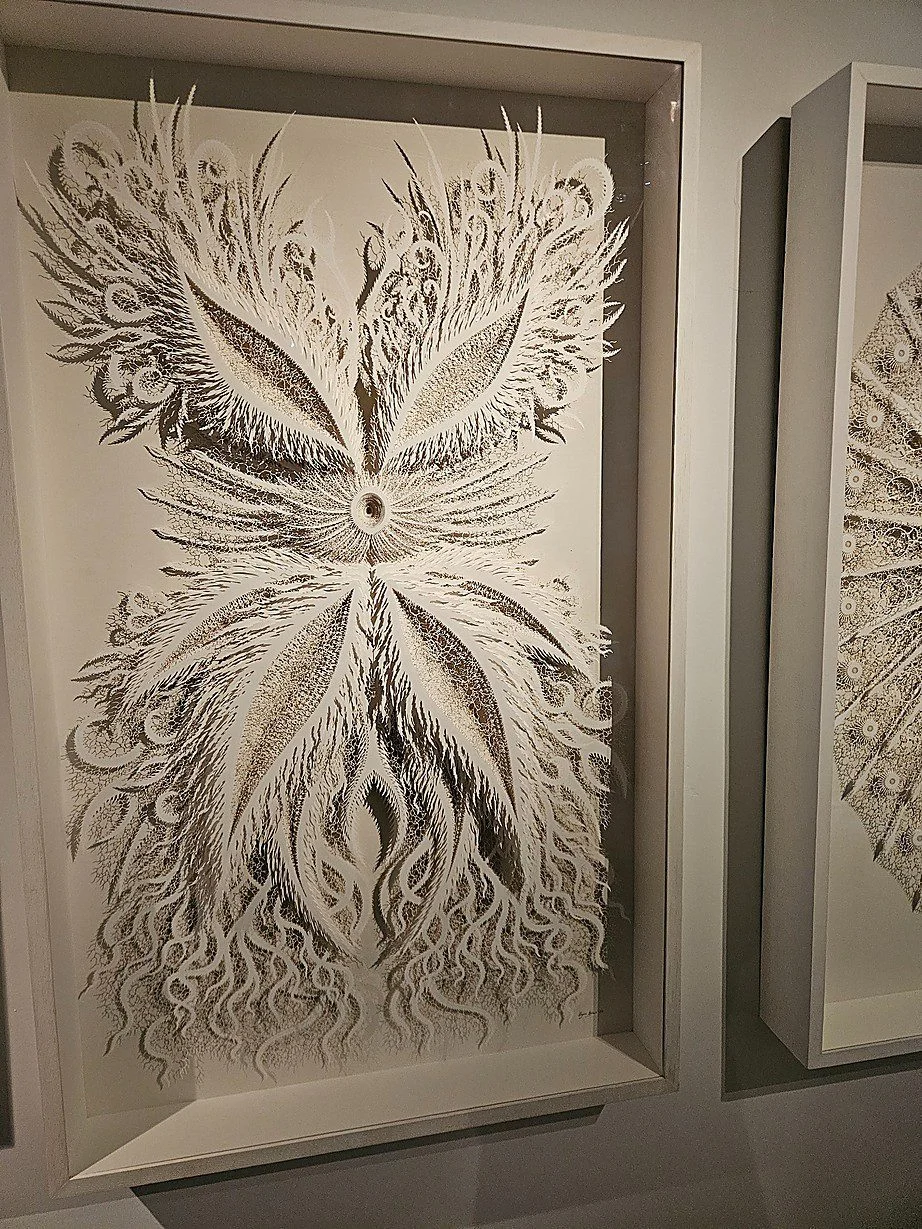
The Brooklyn Museum has inaugurated a major retrospective dedicated to the visionary work of Dutch fashion designer Iris van Herpen, titled Sculpting the Senses, which remains on public display through December 6, 2026. This extensive exhibition marks a departure from traditional fashion retrospectives by presenting more than 140 haute couture garments not as mere clothing, but as focal points in a multidisciplinary dialogue involving contemporary art, marine biology, skeletal anatomy, and architecture. By integrating these garments with scientific specimens and design objects, the museum offers a comprehensive look at how van Herpen has redefined the boundaries of the fashion industry over the past two decades.
The exhibition occupies a significant portion of the museum’s gallery space, organized into thematic sections that mirror the designer’s fascination with the unseen forces of the natural world. Visitors encounter a non-linear narrative where 3D-printed dresses, laser-cut finery, and hand-stitched silicone garments are paired with works by artists such as Philip Beesley, Casey Curran, and Rogan Brown. This curated environment emphasizes van Herpen’s role as a "polymath of couture," a designer whose process is as much rooted in the laboratory as it is in the atelier.
The Evolution of a Visionary: Background and Chronology
Iris van Herpen, born in 1984 in Wamel, the Netherlands, emerged on the international fashion scene after studying at the ArtEZ Institute of the Arts and interning under the late Alexander McQueen in London. Since launching her eponymous label in 2007, she has become a pioneer in the application of technology to high fashion. In 2011, she was invited to become a guest member of the prestigious Chambre Syndicale de la Haute Couture in Paris, a milestone that solidified her status within the upper echelons of the industry.
The "Sculpting the Senses" exhibition originally debuted at the Musée des Arts Décoratifs in Paris before traveling to New York. Its arrival at the Brooklyn Museum is significant, as the institution has a long-standing history of hosting boundary-pushing fashion exhibitions, including major retrospectives for Christian Dior, Jean Paul Gaultier, and Virgil Abloh. The chronology of the exhibit traces van Herpen’s career from her early experiments with umbrella ribs and industrial materials to her most recent collections, which utilize recycled marine plastic and complex digital modeling.
A pivotal moment in van Herpen’s career—and a central theme of the exhibition—was her 2010 introduction of the first 3D-printed garment to appear on a fashion runway. This "Crystallization" dress, inspired by the phase transition of water into ice, signaled a shift in how designers could conceptualize form. Since then, van Herpen has consistently utilized additive manufacturing to create structures that would be impossible to achieve through traditional weaving or sewing alone.
Technological Innovation and Material Science
One of the most compelling aspects of the Brooklyn Museum’s presentation is the detailed look at the supporting data and technical processes behind the garments. Van Herpen’s work is frequently cited as a prime example of the Fourth Industrial Revolution’s impact on the arts. The exhibition highlights her use of:
- Selective Laser Sintering (SLS): A 3D-printing technique that uses a laser to fuse powdered material into a solid structure. This allows for the creation of intricate, lace-like skeletal forms that possess both rigidity and flexibility.
- Injection Molding and Silicone Casting: Many of the garments that appear to "float" or "ripple" like water are constructed from hand-cast silicone, often embedded with metal filings or silk.
- Parametric Design: Collaborations with architects and computational designers allow van Herpen to translate biological growth patterns—such as the way coral reefs expand or how neurons fire—into wearable geometry.
The data presented alongside the garments reveals the labor-intensive nature of this "high-tech" couture. While a 3D printer may produce the base structure, hundreds of hours of manual finishing are required to assemble and refine each piece. This hybrid approach challenges the common misconception that technology replaces craftsmanship; instead, van Herpen uses technology to extend the limits of what the human hand can accomplish.
Thematic Architecture: From the Ocean to the Cosmos
The exhibition is structured around nine thematic "chapters" that guide the visitor through van Herpen’s conceptual universe. The first of these focuses on water, an element that has influenced the designer since her childhood in the river-rich landscape of the Netherlands. The garments in this section mimic the transparency and unpredictability of fluid motion, utilizing heat-bonded pleats and transparent polymers to capture the essence of a splash or a wave.
Transitioning from the aquatic to the biological, the "Skeletal" and "Sensory" sections explore the internal structures of the human body. Here, the museum displays van Herpen’s garments alongside anatomical models and 19th-century scientific drawings. The "Skeleton Dress" from her 2011 Capuchin collection serves as a highlight, illustrating how the designer uses the human frame as a scaffold for architectural expansion.
The latter half of the exhibition delves into the extraterrestrial and the macroscopic. Garments inspired by the Hubble Space Telescope’s imagery and the concept of "synesthesia" are displayed in darkened galleries, where lighting and soundscapes enhance the sense of immersion. By placing a dress inspired by galactic nebulae next to an actual meteorite or a celestial map, the curators underscore van Herpen’s intent to clothe the body in the "fabric of the universe."
Institutional Perspective and Curatorial Strategy
The decision to host "Sculpting the Senses" through late 2026 reflects the Brooklyn Museum’s commitment to fashion as a vital pillar of contemporary art. Curators at the museum have noted that van Herpen’s work serves as a bridge between disparate departments, appealing to audiences interested in technology, environmental science, and classical art history.
While the museum has not released formal visitor attendance projections, previous fashion retrospectives at the site have drawn hundreds of thousands of international visitors. Industry analysts suggest that van Herpen’s appeal lies in her ability to transcend the "trends" of the fashion world. Unlike ready-to-wear designers, van Herpen’s work does not age in a traditional sense; her pieces from 2008 appear as futuristic today as her 2024 collections. This timelessness is a key factor in the exhibition’s extended two-year run.
Responses from the fashion and design community have been overwhelmingly positive, with many praising the exhibition for its "de-siloing" of information. By including the physical inspirations—such as a dried jellyfish or a Gothic cathedral spire—the exhibit demystifies the creative process while maintaining the awe-inspiring nature of the final product.
Broader Impact and Future Implications
The "Sculpting the Senses" exhibition arrives at a time when the fashion industry is facing intense scrutiny regarding sustainability and its environmental footprint. Van Herpen’s work offers a potential, albeit specialized, path forward. By focusing on "slow fashion" and the creation of singular, durable works of art, she stands in opposition to the wastefulness of the fast-fashion cycle.
Furthermore, her use of recycled materials, such as the "Parley for the Oceans" fabrics made from upcycled marine plastic, highlights how haute couture can serve as a testing ground for sustainable innovation. The data gathered from these high-concept experiments often trickles down into more accessible industries, influencing everything from athletic footwear to medical prosthetics.
The broader implication of this retrospective is the elevation of fashion to a status of "total art." In the context of the Brooklyn Museum, van Herpen’s garments are treated with the same reverence as the Egyptian antiquities or European paintings housed in neighboring wings. This shift in perception suggests that the future of fashion exhibitions lies in their ability to engage with the "senses" in a holistic way, moving beyond the visual to include the intellectual and the visceral.
As the exhibition continues its residency in New York, it is expected to serve as a cornerstone for educational programming, with the museum planning a series of symposia on the intersection of AI, 3D printing, and creative labor. Iris van Herpen: Sculpting the Senses is more than a display of beautiful objects; it is a rigorous investigation into what it means to be human in an increasingly digital and synthetic world.
The exhibition remains open to the public daily, with special guided tours focusing on the technological aspects of the collection. For those unable to visit in person, the museum has launched a digital companion experience, ensuring that van Herpen’s "sculpted senses" reach a global audience long before the physical exhibit concludes in December 2026.
