
 By Nana Wu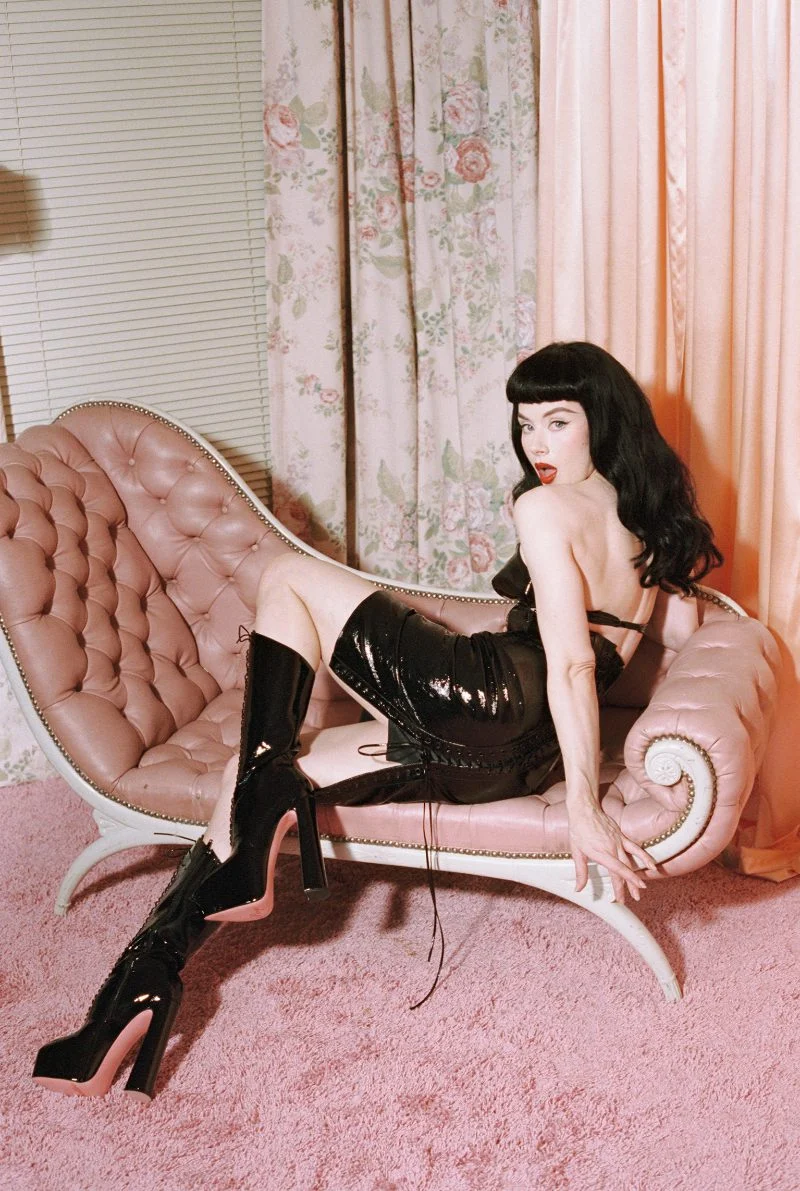
A Legacy of Self-Styled Empowerment
The collection is rooted in a deep historical appreciation for Bettie Page’s personal agency during the 1950s. While history often remembers her as a passive subject of the camera, the Jeffrey Campbell archive research highlights her active role in the construction of her visual identity. Page was known for styling her own shoots, designing her own lingerie and swimsuits, and commissioning custom footwear that would eventually define the pin-up silhouette. Most notably, she was a pioneer of the black leather fetish heel, a style she specifically requested and helped refine to suit her photographic needs.
Mark Roesler, Page’s longtime agent and the representative of her estate, was the primary catalyst for the collaboration. According to Roesler, the decision to approach Jeffrey Campbell was based on the brand’s history of unconventional design and its alignment with Page’s spirit of independence. Roesler noted that Page took immense pride in the technical aspects of her wardrobe, viewing the design of her garments as an integral part of her modeling career. The estate’s goal was to find a partner capable of translating those vintage technical specifications into a modern context without losing the "mythic" quality of the original pieces.
Technical Precision and Archival Integration
The design process for the capsule collection was led by Jeffrey Campbell’s creative director, Brigitte Campbell. Unlike many celebrity-inspired collections that rely on surface-level aesthetic cues, this collaboration utilized Page’s actual physical measurements and preserved footwear from her private collection. Brigitte Campbell described the experience of handling Page’s original "fetish heels" as a surreal moment that humanized the icon. The archive revealed nuanced details—specific curvatures of the heel, the weight of the platforms, and the tension of the leather—that were previously indistinguishable in 20th-century photography.
The resulting footwear line includes pumps, platforms, and "sky-high" heels that mirror the dramatic proportions Page favored. A distinctive feature of the collection is the inclusion of pink soles, a design choice intended to represent what the brand calls "soft feminine power." This serves as a visual contrast to the often-aggressive height and sharp silhouettes of the shoes. Every pair in the collection is hand-numbered, emphasizing the artisanal nature of the production. Production runs are strictly limited, with only 30 to 60 pieces manufactured per style, ensuring a high level of exclusivity for collectors and fashion enthusiasts.
Expansion into Apparel: The Spirit of the 1950s Silhouette
While Jeffrey Campbell is primarily recognized as a footwear brand, this collaboration expands into a curated selection of handmade apparel. The clothing line draws direct inspiration from Page’s "fetish wear" shoots, which were revolutionary and controversial in their time. Key pieces include a lace-up leather dress that utilizes structural techniques found in vintage corsetry, as well as the iconic "bullet bra" silhouette.
The bullet bra remains one of the most recognizable elements of the 1950s fashion era, characterized by its conical shape and reinforced stitching. In the Jeffrey Campbell iteration, the garment is updated with modern materials while maintaining the specific geometry that defined the "Page look." By including these pieces, the collection offers a holistic representation of the pin-up aesthetic, moving beyond footwear to address the entire visual language that Page helped create.
Brand Philosophy and the "Loved by Few" Ethos
Jeffrey Campbell has long maintained a niche position within the global footwear market. Despite the massive success of styles like the "Lita" boot in the early 2010s, the company remains a predominantly women-led operation with a staff of fewer than 20 people. This small-scale structure allows for a level of creative freedom that larger corporate entities often struggle to maintain.
Brigitte Campbell emphasized that the brand’s philosophy mirrors Bettie Page’s own approach to her career: a preference for being "loved by few than liked by many." This dedication to a specific, often polarizing aesthetic is what has allowed the brand to survive and thrive in an industry dominated by fast-fashion trends. The company views Page as a foundational figure for modern women-led businesses, citing her bravery in the face of 1950s social conventions as a precursor to the liberties and professional freedoms enjoyed by female designers today.
Chronology of the Collaboration and Launch
The timeline for the Jeffrey Campbell x Bettie Page collaboration reflects a multi-year effort to synchronize the brand’s production capabilities with the estate’s requirements for historical accuracy.
- Initial Outreach: Mark Roesler of the Bettie Page estate approached Jeffrey Campbell, citing the brand’s unique design DNA as a fit for Page’s legacy.
- Archive Research: Creative Director Brigitte Campbell spent months studying vintage books, photographs, and physical artifacts from the estate’s archives in Los Angeles and beyond.
- Design and Prototyping: The team focused on recreating the specific "pitch" of Page’s heels, ensuring that the dramatic heights remained wearable by modern standards while staying true to the 1950s silhouette.
- Production: Hand-numbering and limited-run manufacturing took place to maintain the "boutique" feel of the collection.
- Official Launch: The collection is set to debut on March 12, exclusively through the Jeffrey Campbell official website.
Market Analysis: The Resurgence of Pin-Up and Fetishcore
The release of this collection coincides with a broader trend in the fashion industry often referred to as "fetishcore." High-fashion houses have recently revisited the structural elements of mid-century lingerie and pin-up attire, integrating corsetry, latex, and exaggerated heels into mainstream luxury collections. However, the Jeffrey Campbell x Bettie Page collaboration is unique in its direct lineage to the source of these trends.
Market data suggests a growing appetite for "scarcity marketing" in the footwear sector. By limiting production to fewer than 60 pieces per style, Jeffrey Campbell is positioning this collection as a series of wearable artifacts rather than mass-market consumer goods. This strategy appeals to both the vintage-collecting community and the "hype" culture that drives modern footwear sales. Furthermore, the use of Page’s personal signature as the collection’s logo adds a layer of authenticity that typically commands higher resale value and long-term brand loyalty.
Broader Implications for the Fashion Industry
This collaboration highlights a shifting perspective on how heritage estates manage the legacies of 20th-century icons. Rather than licensing Page’s image for generic merchandise, the estate has opted for a creative partnership that emphasizes her technical contributions to fashion. This sets a precedent for other estates to move toward "creative-first" collaborations that prioritize the icon’s actual work and skills over mere likeness.
For Jeffrey Campbell, the collaboration reinforces its status as a brand that operates outside the traditional fashion calendar. By focusing on a "personal" project that aligns with the creative director’s long-standing admiration for Page, the brand signals to its audience that it values narrative and history over high-volume sales. As the collection prepares for its March 12 launch, it stands as a testament to the enduring influence of Bettie Page—a woman who, 70 years ago, understood that fashion was not just about clothes, but about the meticulous construction of an unforgettable identity.
