
 By admin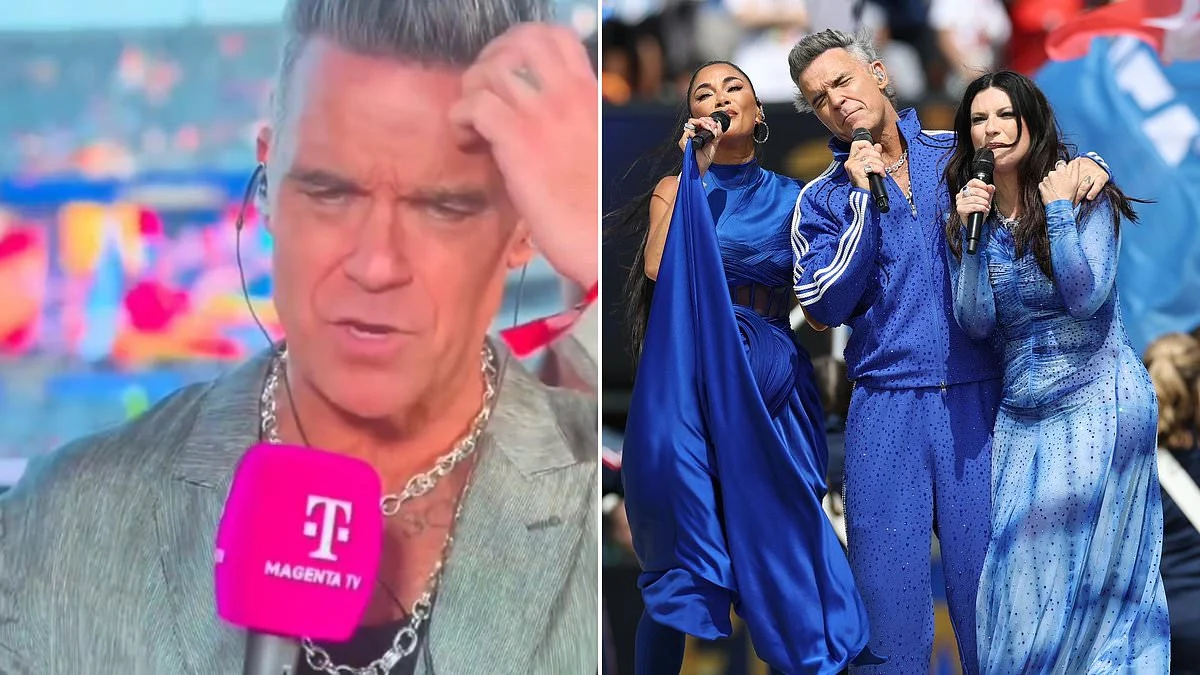
The 2026 FIFA World Cup, hosted across North America, reached its climactic stages this week, but much of the global conversation has shifted from the pitch to the media center following a controversial incident involving British pop veteran Robbie Williams. Williams, who performed the official tournament anthem "Desire" alongside international stars Laura Pausini and Nicole Scherzinger, found himself at the center of a social media firestorm after a live interview clip appeared to show a small, white granular object falling from his person. The moment, which has since been viewed tens of millions of times across various digital platforms, sparked immediate speculation regarding the singer’s health and long-standing sobriety.
The incident occurred during a post-performance press junket where Williams, 52, was discussing the significance of being the sole British musical representative at the final stages of the tournament, following the England national team’s quarter-final exit to Argentina. During the broadcast, a white "speck" was observed falling toward the microphone. Williams was seen swiftly retrieving the object with his fingers and subsequently rubbing his face, which resulted in the substance appearing on his forehead. Given Williams’ well-documented history of substance abuse and his high-profile journey through recovery, the footage prompted a polarized reaction from the public, ranging from deep concern to cynical skepticism.
Chronology of the Event and Immediate Aftermath
The timeline of the controversy began on the evening of July 22, 2026, during the official FIFA closing festivities. Williams, Pausini, and Scherzinger delivered a high-energy performance of "Desire," a track commissioned to serve as the sonic backdrop for the tournament’s final matches. While the song itself received mixed reviews from critics—some noting the audience’s unfamiliarity with the lyrics—the performance was considered a technical success.
However, the narrative shifted less than an hour later during the live interview segment. By 19:00 EDT, clips of the "microphone incident" began circulating on X (formerly Twitter) and TikTok. By midnight, "Robbie Williams" was a top trending topic globally. Early the following morning, on July 23, Williams took to his official Instagram account to address the rumors directly. In a short video, the singer appeared in a reflective mood, acknowledging the unprofessional nature of the footage while attempting to clarify the situation with his signature humor.
In the video, Williams stated, "I’d just like to apologize for the object that fell onto the microphone yesterday. It was deeply unprofessional and people worried about me. But it is OK because I had several more." He then revealed two white mints on his tongue, suggesting that the "granular object" was simply a breath mint that had escaped his mouth during the interview. While the explanation satisfied his core fanbase, it did little to quell the debate among digital forensic enthusiasts who continued to analyze the 4K footage for inconsistencies.
Historical Context: A Journey of Recovery and Relapse Risks
To understand the intensity of the public reaction, one must look at Williams’ turbulent history with addiction. The singer, who rose to fame as the "bad boy" of the 1990s boy band Take That, has been candid about his struggles with heroin, cocaine, and alcohol. His path to sobriety began over 25 years ago, catalyzed by a famous intervention staged by Sir Elton John. Williams has frequently described his mid-twenties as a period of "rampant addiction" characterized by near-fatal overdoses and severe mental health crises.
In a 2025 interview reflecting on his career, Williams admitted to ingesting "everything he could get his hands on" during the height of his fame, including a bottle of vodka every night before rehearsals. His recovery has been a cornerstone of his public identity for two decades, a theme heavily explored in his 2023 Netflix documentary series. This "hagiography," as some critics termed it, helped revitalize his image in the United States—a market he has historically found difficult to conquer compared to his monumental success in Europe and Latin America.
The stakes for Williams in 2026 are particularly high. As a father of four and husband to American actress Ayda Field, his domestic stability has been a recurring theme in his recent work. Field has spoken openly in the past about the emotional toll his previous addictions took on their family life. A relapse at this stage in his career, especially on a stage as visible as the FIFA World Cup, would represent not only a personal tragedy but a potential end to his commercial viability in the North American market.
Supporting Data and Global Reach
The 2026 World Cup is projected to be the most-watched sporting event in history, with FIFA estimating a cumulative global audience of over 5 billion people. The inclusion of Robbie Williams in the musical lineup was a strategic move to appeal to the European and Commonwealth demographics, while Nicole Scherzinger and Laura Pausini provided appeal to the US and Latin American markets, respectively.
The "Desire" anthem, despite the criticism mentioned by observers regarding its lyrical complexity, reached the top 10 on streaming charts in 42 countries within 48 hours of the performance. However, social media analytics provided by Brandwatch indicate that during the 24 hours following the final, "Robbie Williams + Health/Mints" generated 300% more engagement than "Robbie Williams + Desire." This data highlights the modern challenge for performers: on-stage technical proficiency is often overshadowed by off-stage viral moments captured by high-definition cameras.
Industry Reactions and PR Strategy Analysis
Public relations experts have analyzed Williams’ response as a textbook example of "deflection through self-deprecation." By using the "TicTactical" approach—showing the mints on his tongue—Williams attempted to shift the narrative from a potential health crisis to a minor lapse in manners.
"The best way to disarm a brewing scandal is to be self-deprecating," noted one London-based crisis management consultant. "Humor is the most effective weapon to take the wind out of social media squalls. By framing the incident as an embarrassing ‘mint’ mishap rather than a drug-related event, he reclaimed the narrative before it could solidify into a career-damaging rumor."
However, not all observers were convinced. Online forums remained divided, with some users creating memes comparing the singer to a "polar bear in snow," while others defended him, citing the physical toll of a high-pressure performance in the summer heat. The absence of an official statement from FIFA or his record label suggests that his personal social media response was deemed sufficient to contain the immediate fallout.
Broader Implications for Celebrity Scrutiny
The Robbie Williams incident underscores the intense level of scrutiny faced by public figures in the era of ultra-high-definition broadcasting. In previous decades, a small object falling during an interview would likely have gone unnoticed. In 2026, every frame of a live broadcast is subject to instant replay, slow-motion analysis, and global distribution.
Furthermore, the incident raises questions about the "forgiveness culture" surrounding celebrity addiction. While Williams received a groundswell of support from fans who prayed he had not relapsed, the swiftness with which "outrage" and "condemnation" began to form indicates a low societal tolerance for perceived lapses in professional conduct.
As Williams moves forward from the 2026 World Cup, the long-term impact of this "minty-fresh" controversy remains to be seen. While his immediate career seems intact, the event serves as a stark reminder of the fragile nature of a "reformed" public image. For a 52-year-old veteran of the industry, the requirement for circumspection is higher than ever. Whether the object was a mint or something more concerning, the global reaction has demonstrated that for Robbie Williams, the "world stage" is a place where there is nowhere to hide.
Conclusion
The 2026 World Cup will be remembered for its athletic feats, but for the music industry, it serves as a case study in celebrity crisis management. Robbie Williams has successfully navigated the immediate aftermath of a viral faux pas, yet the incident highlights the persistent shadow cast by his past. As he continues his efforts to maintain a foothold in the American entertainment landscape, the balance between his "cheeky-chappy" persona and the requirements of professional decorum will remain a focal point for critics and fans alike. For now, Williams remains the "last Englishman standing" on the global stage, though he does so under a more powerful microscope than ever before.
